Gaza’s environmental apocalypse: ‘What we have left is not soil, it’s contaminated waste’
December 26, 2025
The destruction in Gaza is visible from a distance: vast expanses of scorched earth have replaced the agricultural land, transforming it into a lunar landscape of deep craters and debris. But the real catastrophe is invisible, caused by what is seeping into the ground, polluting the water table and poisoning the air. Gaza’s environmental systems have degraded to such a level that the government and scientific experts now talk about it in terms of ecocide.
“What has happened in Gaza is an environmental genocide,” says Professor Abdel Fattah Abd Rabou, an environmental scientist at the Islamic University of Gaza. He speaks with the authority of someone who has spent decades studying the ecosystems that have now been destroyed. Abd Rabou has also buried five of his children, killed in Israeli air strikes in 2024. He himself has been displaced from the north to Deir al Balah, in the center of the Strip.
The green of Gaza’s landscape has been replaced by debris and dust. The water is poisoned. The air is polluted. The soil is toxic. The biodiversity that supported human life has been virtually wiped out.
Israel’s brutal response to the October 7, 2023 massacre of 1,200 of its citizens by Hamas who also took 251 Israelis hostage, has left more than 70,000 Palestinians dead and around 170,000 injured. In October, a ceasefire was declared but it has not led to major changes for the population. The United Nations has flagged up the fact that since the ceasefire, 379 people have died and not all the necessary humanitarian aid has been able to enter the Strip.
“For two years and three months, an integrated agricultural and environmental war has been waged, which has systematically attacked each and every element of the environment,” says Abd Rabou who insists that the destruction of ecosystems is not simply “collateral damage.”
More than 61 million tons of rubble make up the new Gaza landscape, the equivalent of 15 of Egypt’s pyramids of Giza, according to data from the report The Environmental Impact of the Conflict in the Gaza Strip, published in September by the United Nations Environment Programme (UNEP). According to the Palestinian Authority, there are also 100,000 tons of explosives lurking in the debris. This, it adds in a statement published on November 6, the Day Against the Use of the Environment in War, constitutes “a genocide of all environmental components and systems, the effects of which are expected to last for decades.”
Unrecognizably contaminated soil
The environmental catastrophe is under foot. The Strip’s soil, which constitutes the basis of all agriculture and life, has been destroyed, chemically and physically. “The fertile top layer, the layer that supports life, has been completely torn away. What we have left is not land. It is contaminated waste,” Abd Rabou explains.
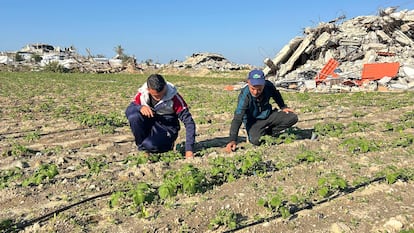
An astounding 98.5% of agricultural land is damaged or inaccessible, the Food and Agriculture Organization of the United Nations (FAO) and the United Nations Satellite Centre (UNOSAT) reported in August. In other words, only 1.5% of Gaza’s agricultural land, some 232 hectares, is still available to grow food in a territory populated by more than two million people.
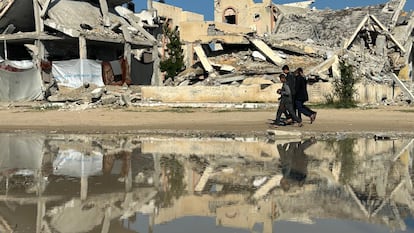
Huge bulldozers have scraped away the fertile topsoil, the productive layer that took generations to develop. What remains has been mixed into a toxic mishmash of debris from demolished buildings, fragments of unexploded ordnance, explosive dust, rocket residue and artillery shells. In its September report, UNEP, said that 15% of the debris could “present a relatively high risk of contamination by asbestos, industrial waste or heavy metals.”
Medical waste, which must be managed through specialized disposal protocols, is now mixed in with normal trash and debris. This poses a direct threat to public health and pollutes the environment in general. Dioxins and other persistent organic pollutants accumulate in the soil and in the bodies of living organisms, creating long-term health risks.
Debris is, in itself, a source of continuous pollution. As its breaks down, it releases pollutants into the soil and groundwater. This creates a physical barrier that prevents the rehabilitation of the underlying land, resulting in an environmental debt that will require active management for decades.
As the clean-up work begins, the soil in some areas is being found to have been disturbed to such a depth that farmers cannot locate the boundaries of their own land. Talal Milad, a farmer from Gaza City who has managed to partially clear four of his fifteen dunams (the equivalent of 1.5 hectares) in Khan Younis, describes the experience as working in alien terrain. “The agricultural land is completely mixed with rubble, dust, rocket debris and shelling debris. We don’t know what the consequences will be,” he told EL PAÍS.
Water crisis
The water crisis in Gaza predates the war. The territory has long suffered from aquifer depletion, saltwater intrusion from the Mediterranean, and pollution. But the past two years have transformed a chronic crisis into an acute catastrophe, experts say.
The Israeli army has systematically destroyed the infrastructure that made water accessible and drinkable: thousands of wells have been demolished, water treatment plants have been destroyed, and distribution networks have been dismantled. A study by the Arava Institute for Environmental Studies on the ecological impact of the conflict estimated that the efficiency of the water system had plummeted from 60% to 25%. The water that reaches the population requires in-depth scientific study since, according to Abd Rabou, most of what is available is seriously contaminated and poses a direct risk to the health of those who consume it. “Before the war, Gaza was already facing depletion of aquifers. The situation is now catastrophic,” he says.
The Arava Institute adds that the water sources that Gaza shares with Egypt and Israel are at risk. The destruction of wastewater treatment facilities has created a secondary pollution pathway: sewage now flows untreated into the Mediterranean, poisoning the marine environment and creating health risks for anyone who enters the water. It is not possible, however, to gauge the degree of damage because the Strip cannot be accessed to take samples. “We are facing a water crisis that will persist for years,” says Abd Rabou. “This affects everything. Agriculture cannot survive without clean water, but, more importantly, human survival itself depends on access to clean water.”
Air impregnated with unknown compounds
The air has become a vector of pollution. The destruction of residential buildings has released toxic gases and vapors into the atmosphere. Fires and explosions also produce pollutants that are harmful to health. And hundreds of unmanned landfills, created during the conflict, emit dangerous compounds: dioxins, carbon monoxide, nitrogen oxides. These are not traces of pollutants, but the main atmospheric composition in the affected areas.

But the most damaging air pollution comes from ammunition waste. Unexploded ordnance, bomb and rocket remnants are scattered throughout Gaza, releasing compounds whose nature and impact on health remain largely unknown. “There is radiological and chemical contamination due to the enormous number of explosives, bombs and ammunition,” explains Abd Rabou. “No one knows the full extent of what was used or what the health consequences will be.”
Meanwhile, asthma rates are rising, along with chronic bronchitis and other lung diseases, due to the burning of plastics or wood for cooking or to withstand the cold.
Biodiversity: the disappearance of life
The visible green that once characterized some parts of Gaza is gone. Since 2023, Gaza has lost 97% of its tree-based crops and 95% of its shrubland, according to the UNEP report. The orchards and groves that took decades to establish and which provided food security and environmental stability, have been cut down or decimated by the bombings. Date palms, citrus and olive trees have been eliminated. “We are seeing desertification spreading, especially in eastern Gaza, where the vegetation has been almost completely removed,” says Abd Rabou. The consequences ripple throughout the ecosystem. The Arava Institute argues that Gaza’s animal diversity “is under enormous pressure due to the degradation of its habitat, conservation sites and zoos.”
The livestock sector has also been affected: cattle, sheep and poultry raised in homes and small farms have been all but wiped out. Without vegetation, there is no fodder and domestic animals cannot survive. Wildlife has largely disappeared: birds, mammals, reptiles and amphibians that were native to Gaza or passing through have gone. The fishing sector has been decimated. More than 1,900 of Gaza’s approximately 2,000 fishing boats, including the largest vessels, which allowed access to deeper waters and diverse fish stocks, have been destroyed.
Cascading collapse
Each of these environmental crises create a chain of failures in interconnected systems. “There is no agriculture in Gaza now,” says Nahidh al-Astal, director of the Khan Younis Agricultural Society. “The land has been destroyed, the water is polluted, the livestock have disappeared. Less than 5% of the agricultural sector is still operational. And this was a deliberate goal, because agriculture is critical for food security and provides livelihoods for a large part of the population.”
When asked about the recovery periods, Abd Rabou is direct: “We are talking about years, many years, of partial and gradual recovery. And that’s assuming massive international support and scientific intervention,” he says.
Sign up for our weekly newsletter to get more English-language news coverage from EL PAÍS USA Edition
Search
RECENT PRESS RELEASES
Related Post