GM invests $830m in US propulsion plants as EV demand wavers
April 30, 2026
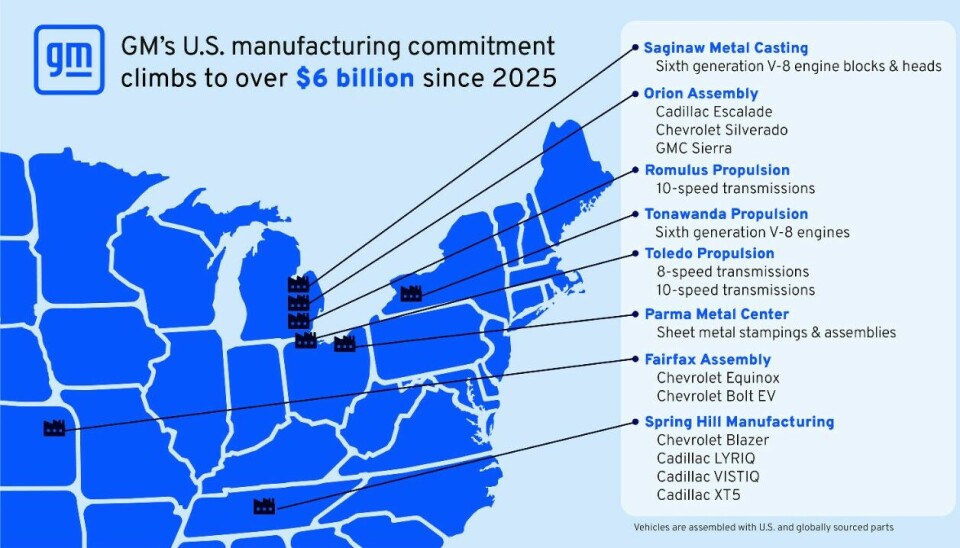
General Motors is making a statement. As electric vehicle (EV) growth continues to vacillate, forcing carmakers into an uncomfortable balancing act between EVs and internal combustion engines (ICE), $830 million has now been directed at three propulsion plants in Michigan and Ohio. This investment represents only a portion of the more than $6 billion the automaker has committed to overall domestic manufacturing over the past twelve months, yet its significance exceeds the sum of its parts.
This is an OEM placing a deliberate wager on the enduring commercial strength of full-size trucks and SUVs, as opposed to going all-in on EVs.
The latest tranche of investment spans three facilities, each playing a distinct role in GM’s propulsion supply chain. Romulus Propulsion Systems in Michigan receives $300 million to expand its capacity for 10-speed transmissions – a further injection that follows an identical $300 million announced late last year. Then Toledo Propulsion Systems in Ohio receives $40 million on top of a separate $40 million disclosed to employees in March, reinforcing its manufacturing flexibility as a critical support plant for some of GM’s highest-demand light-duty truck lines.
Alongside; Saginaw Metal Casting Operations, also in Michigan, secures $150 million to increase head casting volume for the company’s sixth-generation engines, which will power not only next-generation full-size pickup trucks but also the Corvette.
Advertisement
Transmission capacity at the heart of the strategy
The concentration of investment in 10-speed transmission capacity is not incidental. Full-size trucks and SUVs remain the most lucrative segment in the American car market, and the 10-speed automatic has become the preferred gearbox for vehicles in that class. By expanding output at both Romulus and Toledo simultaneously, GM is ensuring that its supply chain does not become the bottleneck on a product launch that will define its near-term commercial performance.
Romulus, which employs around 1,000 people, has now accumulated a cumulative $600 million in transmission-related investment over the span of twelve months. Toledo Propulsion, which employs approximately 1,650, has similarly absorbed $80 million in new capital since March alone. These are not marginal upgrades. They reflect a systematic effort to scale capacity ahead of demand, rather than scrambling to catch up with it. That distinction matters in an industry where production constraints on a newly launched vehicle can translate rapidly into lost revenue and ceded ground to competitors.
Saginaw and the casting renaissance
Less visible than transmission work, but no less consequential, Saginaw Metal Casting Operations occupies a specialist position in GM’s manufacturing ecosystem. Its approximately 350 employees produce the cast metal components that form the structural core of internal combustion engines, and the $150 million now flowing to the facility will specifically increase the volume of head castings for the sixth-generation engine family.
That the Corvette features among the beneficiaries is worth noting. It signals that GM’s investment logic extends beyond mass-market utility and into the higher-margin performance segment, a reminder that the company’s full-size truck strategy and its performance brand ambitions are not competing priorities. Taken together, the three plants employ roughly 3,000 workers across two states. The cumulative effect of these investments is to make each facility a more integral, and more resilient, node within a manufacturing network that GM plainly intends to strengthen rather than wind down.
The $6 billion signal
Context matters here. When an automaker deploys more than $6 billion into domestic manufacturing in a single year, the message to suppliers, legislators, and competitors is unmistakable. GM is not hedging its position in American manufacturing; it is reinforcing it.
Advertisement
The $830 million now announced is not a pivot but a continuation, and the speed with which these investments are being implemented suggests a leadership team acutely aware of the competitive and political environment it is navigating.
These investments mean greater job security for our members and stability for these facilities, which could not be more important to us. The future of US manufacturing is in our hands, and together we will shape it, define it and set up future generations of auto workers on the foundation of our success. In many ways, today is just the beginning
Mike Trevorrow, GM’s senior vice president of Global Manufacturing, framed the decision in terms of people as much as product. “By investing in these plants, we’re investing in our people and the communities they call home,” he said. “The work our teams do in Romulus, Toledo and Saginaw Metal supports families, strengthens local businesses and fuels economic growth across the country. This $830 million investment is another clear signal of our commitment to these facilities, the exceptional people who work here and the customers who depend on the products we build every day.”

Labour’s stake in the outcome
The United Auto Workers has been watching GM’s investment trajectory closely, and its response to the latest announcement was pointed. Mike Booth, the UAW-GM vice president, tied the investment directly to the wellbeing of union members. “On behalf of the International UAW, I want to congratulate our teams in Romulus, Toledo and Saginaw on this announcement,” he said.
“These investments mean greater job security for our members and stability for these facilities, which could not be more important to us. The future of US manufacturing is in our hands, and together we will shape it, define it and set up future generations of auto workers on the foundation of our success. In many ways, today is just the beginning.”
That final phrase carries weight. For a union that has spent years negotiating against the spectre of offshoring and automation, a commitment of this scale from a major domestic automaker represents something more than a capital expenditure announcement. It is a reaffirmation of the industrial compact between management and labour that underpins the entire Midwest manufacturing economy.
What comes next
Workers in Romulus, Toledo and Saginaw will see their facilities upgraded, their job security enhanced, and their role in GM’s forward production plans confirmed, says GM. The broader automotive supply chain across Michigan and Ohio will, it is said, feel the multiplier effects of sustained capital investment. And GM’s customers, who continue to purchase full-size trucks and SUVs in volumes that sustain the company’s profitability, will ultimately receive next-generation vehicles built on a production base that has been deliberately and substantially fortified.
Advertisement

But of course, whether the strategy proves ultimately prescient will depend on factors that no balance sheet can fully anticipate. Tariff environments, shifting consumer preferences and the pace of powertrain transition all introduce genuine uncertainty. But in the segments that matter most to its financial health, General Motors has made its position clear. It is investing in what it knows, and it is doing so at scale.
Search
RECENT PRESS RELEASES
Related Post