Governor McKee’s initiative to lower ratepayer energy costs seems more like political thea
February 9, 2026
But that doesn’t make the effort less contentious, as environmentalists and business executives stake out opposite sides of the issue…
Rhode Island Governor Daniel McKee signed an Executive Order at the Division of Public Utilities and Carriers (DPUC) on Monday, seeking to build “on his budget proposal for lowering energy costs by $1 billion over five years while creating an affordable path to the state’s climate goals.”
The event was attended by members of the business community seeking lower energy costs and by environmentalists who challenged the false narrative that renewable energy is responsible for rising energy costs.
Here’s the video:
“I’m signing an executive order to help make energy more affordable while keeping Rhode Island on a path toward clean energy,” said the governor. “This order directs the Office of Energy Resources (OER) and other partner agencies to conduct a review of the state’s net metering program and its renewable energy growth program. This review has one goal: to control costs for rate payers. The review process will be advised by the global energy policy expert, Dr. Noah Kaufman of Columbia University.
“This order also directs the DPUC to evaluate ratepayer impacts of all significant energy legislation and communicate those impacts to the public,” continued the governor. “In many cases, that will result in the DPUC preparing and sharing an official ratepayer impact note – no more silent costs. This executive order will take effect upon my signature.”
In some ways, Governor McKee’s executive order was a relief to environmentalists concerned about his stated intention to rollbackthe renewable energy standard, net metering, and energy efficiency. Ordering OER and DPUC to review the programs and provide suggestions is a months- or even years-long process. This gives climate activists time to make their case for these programs.
“I’m pleased that many business leaders are here today from the Rhode Island Manufacturers Association,” said Governor McKee. “We need to work every day to help Rhode Islanders struggling with rising energy costs.”
The Governor presented a video explaining how the electric bill works and how his office can effectuate savings with the narrow parameters of his job:
The video’s narrator:
“Let’s help you decipher your electric bill. The average residential electric bill has four kinds of charges, 35% for supply, the cost to generate the energy you are using; 16% for transmission costs across the region; 25% for distribution costs to Rhode Island homes and businesses; and, here in Rhode Island, 24% is for the cost of state programs and taxes.
“While we don’t have control over most of these costs, we do have full control over that 24%. That 24% is made up of programs that include the renewable energy standard, net metering, and energy efficiency.
“We use the renewable energy standard to buy clean energy certificates. Those costs are rising due to the Trump Administration’s policies, and this charge is set to triple over the next five years.
“Net metering is designed to incentivize solar projects, but the program is out of line with our neighbors, and the costs have grown 250% over the last five years.
“The Energy Efficiency Program, which handles weatherization, has become less cost-effective over the last 10 years.
“These are the three programs the governor’s team is reforming to bring Rhode Islanders up to $1 billion in energy savings over the next five years.“
“I’m out in the community a lot, and I hear people, and I know that one of the number one things I hear from constituents is the cost of our energy bills,” said Governor McKee. “There is no question about that. In Rhode Island, we have the fourth-highest electric residential rates in the country, and since President Trump came into office, he’s only made it more challenging. His erratic tariff policies and permitting actions drive up energy costs, and he has eliminated millions of dollars in funding for clean energy programs and repeatedly attacked offshore wind.”
Governor McKee continued:
“We’ve been to court twice now to fight the Trump Administration to make sure that the offshore wind project, Revolution Wind, stays in place and continues to put people to work. It will electrify 200,000 homes at a rate I believe is lower than our current winter rate.
“The supply of energy is shrinking, and the cost to buy that energy goes up. Meanwhile, tariffs are driving up costs and creating greater uncertainty across the market. We can’t ask Rhode Island’s rate payers to bear the brunt of Trump’s chaos in Washington. There’s a new landscape, and we all need to realize that. Other states are realizing it and doing exactly what we’re doing now: making adjustments. The landscape has changed, and that’s why I have a plan to make energy more affordable for Rhode Island homes and businesses.
“Under my Affordability-for-All Agenda Rhode Island will save $1 billion in energy costs over the next five years. Adjusting our renewable energy standard and leveraging other low-cost, low-carbon resources, such as nuclear energy and hydropower, would save nearly $600 million. Reforming net metering for large-scale solar projects would save $175 million. Capping the energy efficiency program at $75 million per year, putting us in line with Massachusetts and Connecticut, would save more than $100 million.
“The energy companies aren’t off the hook either. We are eliminating unnecessary performance bonuses for utility shareholders. The plan provides immediate relief to lower your bill while creating a more affordable path to reducing emissions.”
“Donna Rook is the Administrator for Family and Adult Services at the Rhode Island Department of Human Services and runs a program that helps low-income families stabilize their housing,” said Governor McKee. “Across the low- and moderate-income scale, we will continue to invest as needed to ensure housing and other immediate needs are met. But unless we start addressing this energy issue and improving affordability, a number of the things we have going in the right direction could turn against us. That’s why this is so important. Donna knows firsthand the financial burdens, especially with energy costs.”
“I oversee a housing stability pilot designed to prevent evictions for low-income families with children,” said Rook. “To date, we’ve assisted over 800 families, just under 3,000 individuals. After rent, the largest burden for the families we serve is utility costs. More than a quarter (26.4%) of the applications we receive include requests for utility assistance. The average request for utility assistance remains higher than the average request for housing assistance among families requesting utility assistance. According to United Way 211, requests for help with utilities during the cold months account for nearly 19% from 2024-2025, consistent with our data.”
Rook continued:
“And hot off the press. as we just heard this morning from United Way: as of January, comparing January 2025 to January 2026, the increase has been 49%.
“In the LIHEAP (Low Income Home Energy Assistance Program) cycle, we are not halfway through the heating season, but have assisted 20% more households than at this time last year. To put this into perspective, utility costs in these households are preventing the family from stabilizing and increasing the risk of losing their housing. For example, a family on disability or SSI, even with a rental subsidy, may not have their utilities included. Utility costs for them may exceed 30% of their income. Families are having to make a difficult decision between paying rent and paying their utility bills. Most will pay rent and then accumulate utility arrears. Of course, if the utilities are terminated and housing becomes unfit and unsafe for our children, in some rental arrangements, that means that they could also be evicted. To date, the highest utility arrears are just over $19,000, which was requested from us.
“On average, the request for assistance is $4,665 in arrears. Every dollar matters and makes the difference between a safe home for children and one that isn’t. With over $1 million in savings over five years, more families will be able to focus on working, attending school, pursuing additional training, and becoming more independent.”
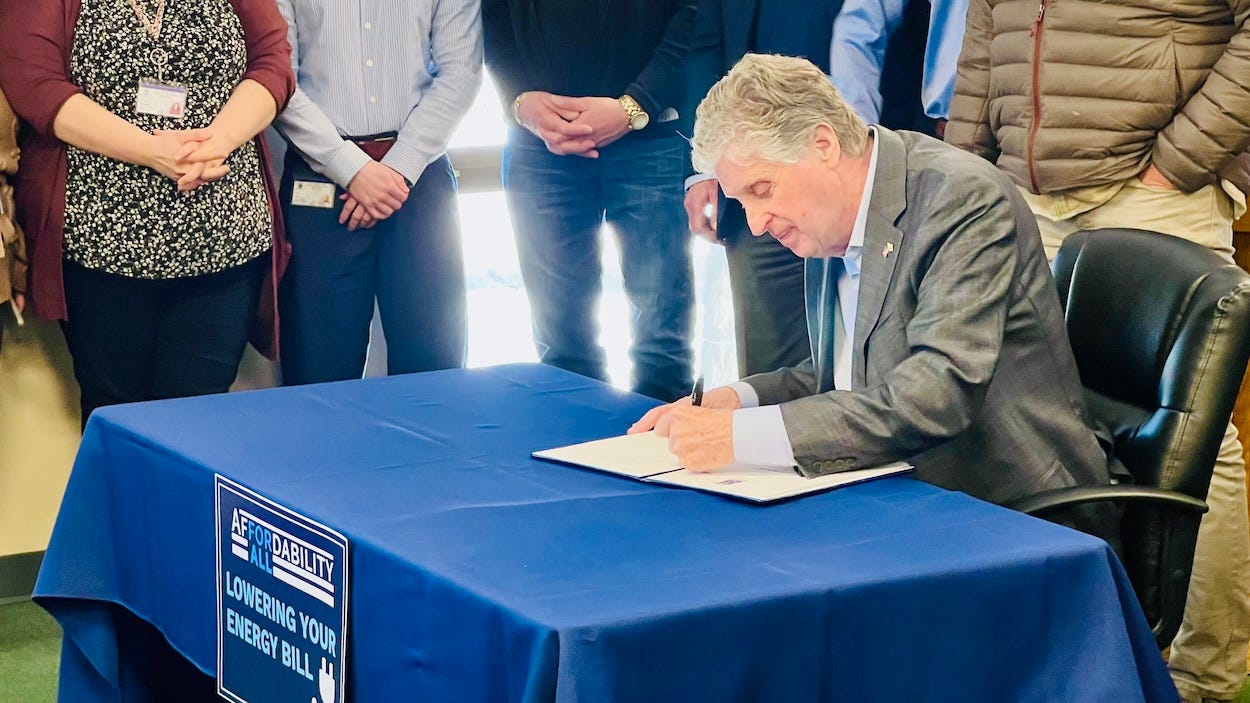
Business Executives who attended were in support of Governor McKee’s initiative:
-
“We’re a large manufacturer of plastic goods,” said Felix Brockmeyer, CEO of igus. “Our business is extremely energy-intensive. Over the last four or five years, we’ve very strongly expanded in Rhode Island. We’ve brought many jobs – 150 jobs roughly – to the state, and we love it here, but energy is the lifeblood of every company. It has to be available and affordable. Over the last four years, our energy costs have become a line item on our financial statement that I can no longer ignore. It used to be that energy was just there. Now you need to ensure it is reliable and cost-effective so you don’t have to relocate your business. Ultimately, having a reduction in energy costs will bring more jobs to Rhode Island, allow us to further expand in Rhode Island, and that’s ultimately what we want to do. So I appreciate the initiative.”
-
“I run a business in Lincoln, Rhode Island, Bullard Abrasives, as well as representing the Rhode Island Manufacturers Association,” said CEO Craig Pickell. “It’s not the businesses that are hurting from these high costs; it’s our people. 60,000 people rely on manufacturing jobs in the state, and we’re trying to help them by raising wages, but you can’t continue to do that while also paying another fee for energy usage. As you pointed out, when you look at the bill over the last four years, you see that the actual cost of the energy itself isn’t that great compared to all the ancillary charges that go into it. We’re very concerned that this trend is going to continue because we see inflation in all these other markets. It will only push energy costs higher. I applaud [the governor’s] efforts on this because we’re really hurting. Out of nowhere, [the governor] comes up and goes, ‘We have a workable solution.’ And for that, I pay [him] great respect. Thank you, Governor.”
-
“I have the pleasure to sit on the Commerce Board with the governor, who’s our chair,” said Karl Wadenstein, President of VIBCO. “There are many initiatives. You see the small things that he’s doing now, but these are big things because he’s doing them daily. He’s doing it every single time he comes to Commerce. One of the initiatives is solar power. We’ve seen a downturn in the grants we’ve been giving. As rate holders in the manufacturing community, we pay a share that supports these initiatives, but manufacturing competitiveness is getting razor-thin. We moved to Rhode Island from New Jersey in 1975, when Governor Garahy was in office. And when you looked at a budget, energy wasn’t even on that budget. We all assumed energy was so inexpensive that we didn’t need to consider it…
“You look at energy now, and a lot of the things that we have, transportation, energy, healthcare charges; it’s unbelievable the amount of money that we have to look at every day. If we could take all this snow that we just got and turn it into energy, we’d be energy-rich again. We’d be turning back the clock. I hope Rhode Islanders are smart – our governor’s smart – so we can put our heads together and figure out how to save energy. Your Grammy and your mom used to tell you, ‘Turn off the lights.’ These are small, common-sense things. We should figure out the new nuclear technologies, these mini-nuclear systems that are emerging. They’re putting nukes into the submarines here in Davisville and Quanset. Let’s harness that. Let’s harness the best and brightest. Stefan Pryor and the governor have been courting many of the smartest people in manufacturing who are looking at these issues.
Is it ironic that some of the companies represented above (and Toray Plastics, whose CEO, Christopher Roy, was unable to attend and was replaced at the last minute by Wadenstein) have benefited from renewable energy technology and programs?
-
Toray has leveraged solar and the REG program to lower its energy costs.
-
igus’ East Providence facility publicly discussed features such as a solar array and carbon neutrality, and it appears to be part of the solar power industry supply chain.
-
Bullard Abrasives and Toray have been contractors or subcontractors performing work directly for Rhode Island’s energy efficiency programs.
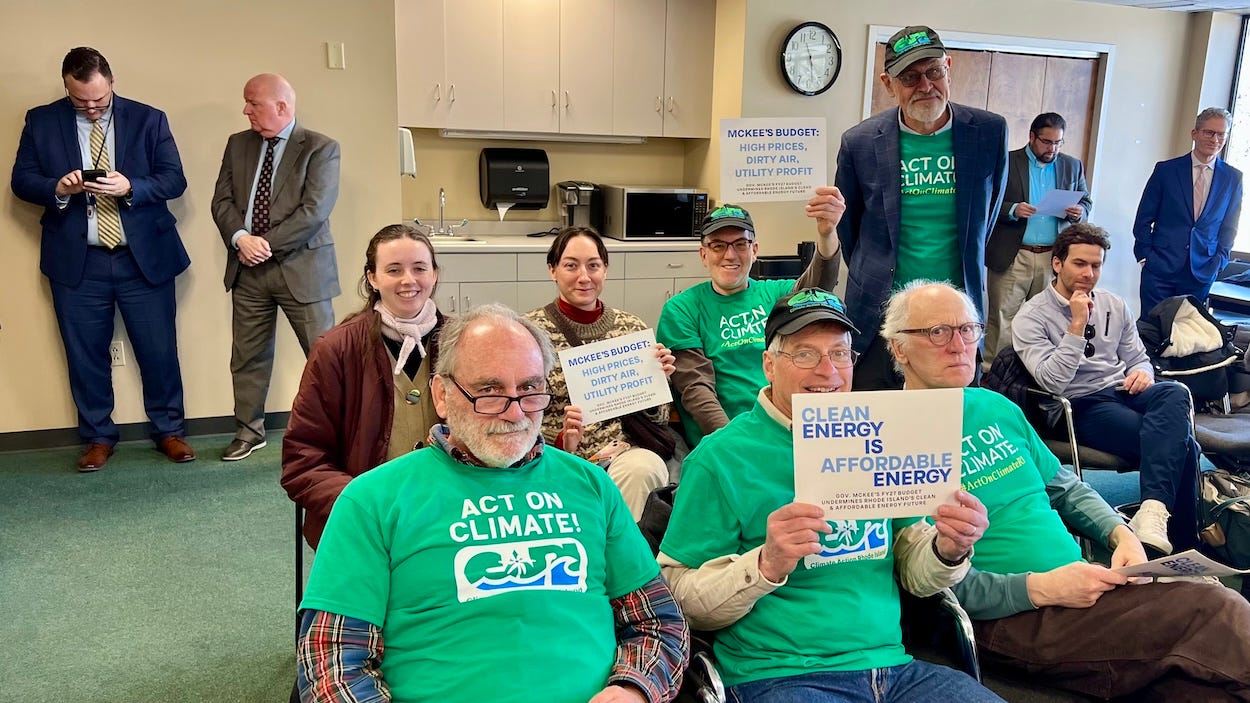
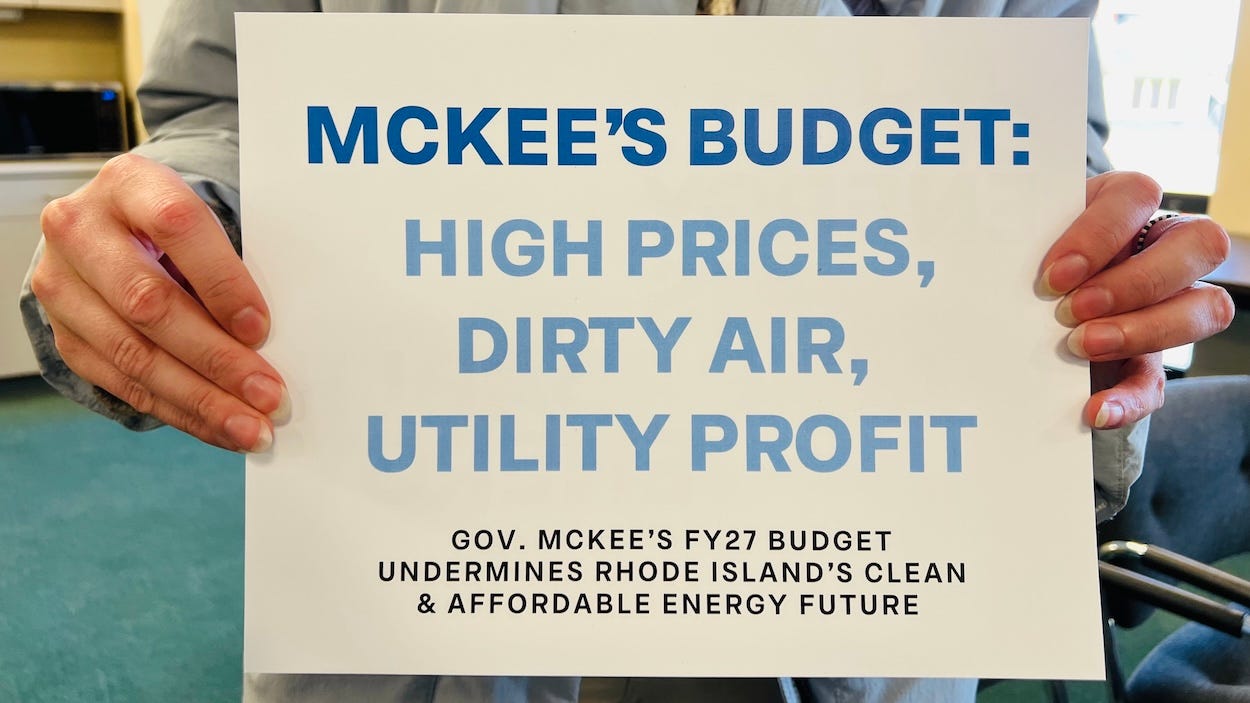
Members of Climate Action Rhode Island (CARI) and other environmental groups pushed back against Governor McKee’s plans:
-
Justin Boyan (CARI): We don’t believe that Governor McKee’s agenda will actually help with energy affordability. In fact, it goes in the opposite direction we need to be going. Reducing energy-efficiency programs will drive up electricity demand. More people will spend more, and they will use more energy. By reducing the net metering and renewable energy standard, the governor is preventing new energy supply from being built. This agenda will disincentivize new solar and wind projects. If this goes through, we’ll have less energy supply. We’ll have more energy demand. Prices are going to go up. We can cut the incentives and investments that make up a small part of our bill, but the result will be that the rest of our bill, the bigger part, goes up as demand goes up and supply goes down over time.
-
Bill Ibelle (CARI): The Governor presents a false narrative about cost because the governor blames high rates on clean energy – and that’s just not true. The states with the lowest electricity rates have a lot of clean energy and less gas. We’re too dependent on natural gas, and that’s the issue. The vast majority of the bill depends on natural gas costs.
He’s saying that these proposed cuts are going to save us money, and they are going to save us money – in a very short term. This is an election-year ploy to do something quick. It’s not thinking about the future. We’re hitching our wagon to fossil fuels, rather than hitching our wagon to clean energy, and worldwide, that’s where the world is going.
Why would we want to hitch our wagon a 20th century fuel rather than looking at 21st century technology? It’sshortsighted.
Trump makes it difficult, but the governor’s proposal is feeding right into the Trump administration. Trump is trying to crush clean energy. He wants to move towards coal and natural gas, and he wants clean energy to go away. He has financial reasons for doing that. The governor’s plan is basically saying that we’re going to cut all of our clean energy programs in response to Trump, and that’s exactly what he wants.
-
Jeff Migneault (CARI): It’s an election year floor. McKee can point to specific costs, but this analysis doesn’t account for all the savings those programs have already achieved through energy efficiency. We’d be using about 15% more energy now than if those programs weren’t in place. Less demand means lower overall costs. Those programs have already saved significant money. This will devastate the solar industry. That’s a lot of jobs. More solar energy means we’re sending less money out of the State to buy fossil fuels. Rhode Island doesn’t produce fossil fuels. We can produce solar energy that improves the whole economy. The very narrow focus on some line on your electric bill to tell the Rhode Island public that he’s going to make electricity more affordable, when in the long run, even the medium run, it’s going to make electricity supply costs much higher, and there’s analysis to prove that.
Solar, wind, and battery energy have plummeted in price and continue to go down. And it’s just going to get cheaper and cheaper. The price of natural gas is rising and is expected to continue rising because Trump is exporting so much of it to the rest of the world. The price of electricity is dependent on the price of natural gas because Trump is getting so much of the rest of the world interested in natural gas. As more of our supply comes from renewable energy, it decouples energy costs from natural gas. And that’s exactly what 100% renewable RES program does, and the governor pushing it out 17 years slows that process.
Search
RECENT PRESS RELEASES
Related Post





