GXO Isn’t Sweating Amazon. Here’s Why.
May 6, 2026
GXO is welcoming the competition from Amazon as the e-commerce giant directly takes on the logistics industry.
The contract logistics provider raised its full-year adjusted earnings guidance upon releasing its first quarter earnings report, which saw organic revenue growth increase 4.1 percent and overall revenue jump 10.8 percent to $3.3 billion.
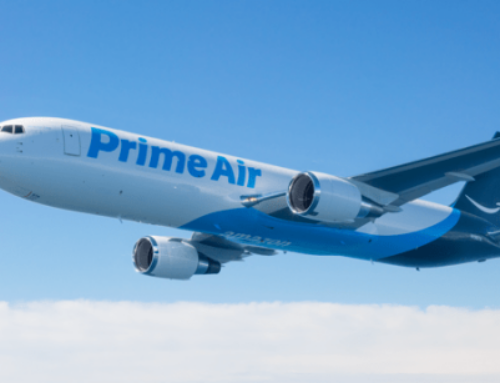
Amazon recently unveiled that it is opening its end-to-end supply chain services to all businesses rather than just its own third-party sellers. This includes its portfolio of fulfillment, parcel delivery, warehousing and cross-border logistics capabilities.
Monday’s announcement sent logistics stocks in a tailspin, with GXO shares plummeting more than 17 percent during the day.
But GXO CEO Patrick Kelleher considered Amazon’s move to be validation for the wider contract logistics industry, which he said is currently a $500 billion market. Roughly 70 percent of the market remains insourced, he said, delivering a major opportunity for contract logistics providers to capture share.
“Amazon is selling access to its supply chain, whereas GXO, we build custom solutions for our customers. That distinction means everything to our blue-chip customers,” Kelleher said during a Wednesday morning earnings call. “We’re not a one-size-fits-all provider. What we do is bespoke, operationally complex, and relationship-driven. The more complex the supply chain, the more bespoke really matters.”
Kelleher noted that enterprise customers often aren’t willing to share data, or provide deeper visibility into areas including inventory, demand patterns and sales channels. Unlike Amazon, GXO has extensive experience in sectors including aerospace, defense and industrial, which were defined as important growth verticals for the company.
“[Amazon] can differentiate between transactional supply chain activity like air freight and parcel in establishing short-term contracts for great rates and buying capacity,” Kelleher said, before countering that the outsourcing and contract logistics markets require more long-term relationships.
According to Kelleher, GXO’s average contract is five years.
“The business is very different. The engagement with the customer is very different,” said Kelleher. “The competitive dynamics there are very different from the competitive dynamics in contract logistics.”
In particular, Kelleher was confident the GXO Direct shared fulfillment and multi-tenant warehousing offering is positioned well to compete against the tech titan’s Fulfillment by Amazon (FBA) service.
GXO Direct is designed to help companies only use the warehouse space they need, when they need it to flexibly adapt to market conditions. The solution offers “pay-as-you-grow” pricing models and shared access to technology and services like returns and workforce management.
Sales from GXO Direct grew 5 percent in the first quarter of 2025, representing just under 6 percent of the company’s overall business.
The CEO feels GXO’s differentiation comes from its partnerships with high-end brands that leverage services in packaging and other white-glove type services.
Kelleher also brushed aside concerns of an erosion of pricing in the contract logistics market based on Amazon’s service expansion, noting that GXO’s churn rate is less than 5 percent.
“When customers leave, it is typically because of a restructuring of their supply chain. It is closing one warehouse node in order to open up a new node somewhere else,” Kelleher said, noting that customer losses to competitors are “a very small part” of the churn.
For the full year, GXO now expects adjusted EBITDA of $935 million to $975 million, up from the initial range of $930 million to $970 million. Concurrently, adjusted diluted earnings per share are now projected to be between $2.90 to $3.20, up from the previously anticipated $2.85 to $3.15 range.
GXO is still forecasting organic revenue growth of 4 percent to 5 percent, and free cash flow conversion of 30 percent to 40 percent.
Net income at the Stamford, Conn.-based company was $5 million, compared with a net loss of $95 million in the first quarter of 2025. The company brought in diluted earnings of 3 cents per share, compared with a diluted loss per share of 81 cents for the year-ago period.
Volumes for the first quarter overall were relatively flat, as initially forecasted.
B2B volumes in the aerospace, defense, industrial technology and life sciences sectors were slightly up, while B2C volumes in retail and consumer packaged goods (CPG) slightly down.
The logistics provider is continuing to scale its AI warehouse operating system GXO IQ, moving it from a pilot to a global rollout. The technology is being deployed across North American and European warehouses, with U.K. sites set to follow later in the year. The company is targeting more than 50 sites by the end of 2026.
Kelleher said GXO is focused on leveraging AI to bolster productivity in two areas. One is customer warehouse and transport operations, where the firm is “already seeing benefits from the eight modules that we’ve rolled out there and more to come.”
The other is for overhead and functional efficiency, with the company leveraging the operating system in departments such as human resources, finance and IT.
Since GXO has virtually no direct exposure to the Middle East, the company is not seeing any material impact from the conflict.
GXO plans to schedule its investor day after third-quarter earnings date, which takes place in November.
The company will lay out a three-year strategy including expectations for organic growth, productivity improvements and investments.
Search
RECENT PRESS RELEASES
Related Post