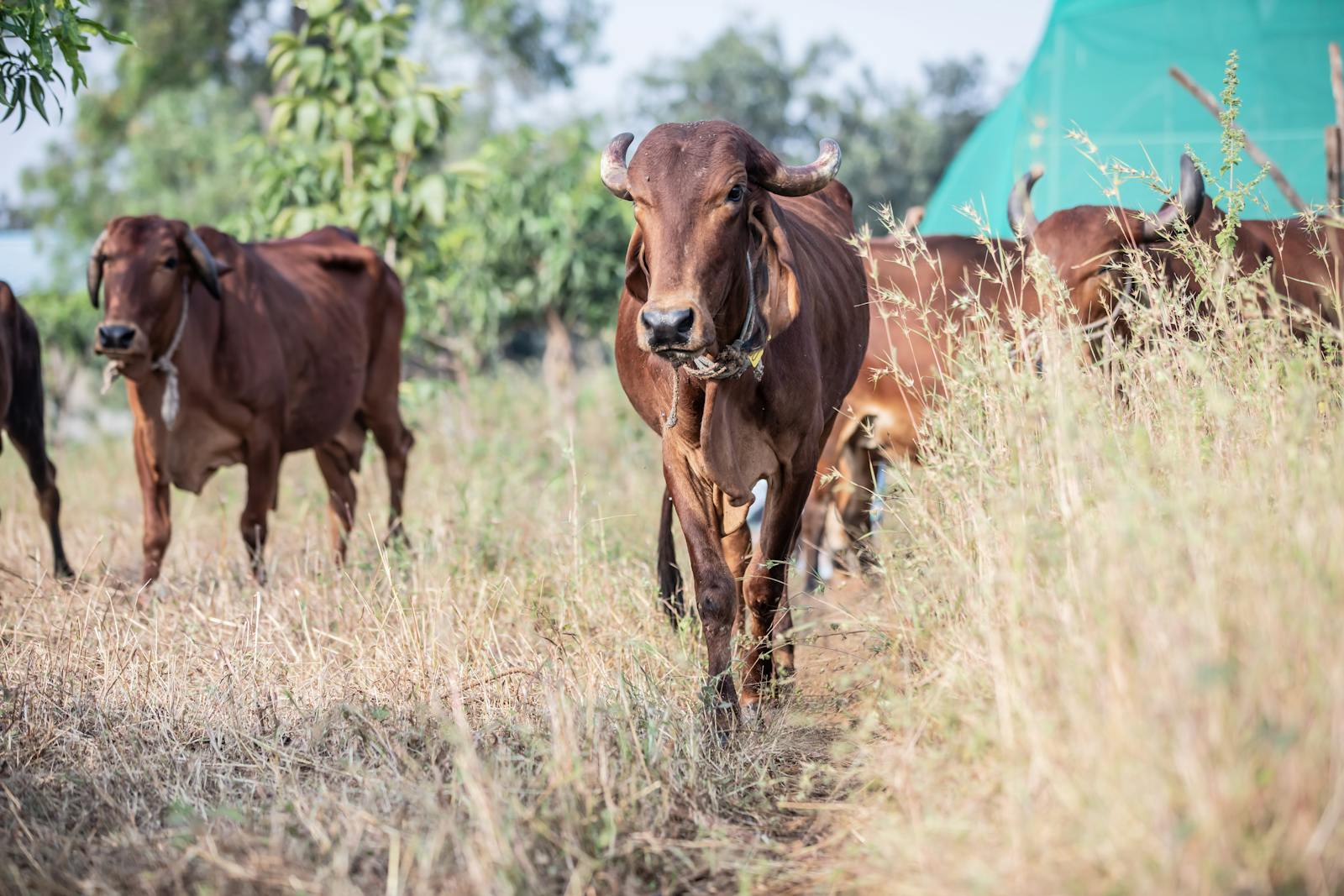
Halter’s solar-powered cattle collars are on one million animals — the real asset is the d
April 5, 2026
Founders Fund, the venture capital firm associated with Peter Thiel, has led a $220 million Series E round in Halter, a New Zealand agtech startup that makes solar-powered smart collars for cattle. The deal values the company at $2 billion and brings its total funding to approximately $400 million.
The investment stands out in a venture landscape dominated by AI and robotics. There are no large language models here. The core product is a collar, a network of low-frequency towers, and a smartphone app that together replace physical fences on pasture-based farms.
The economics of virtual fencing
Halter’s pitch to farmers is built around land productivity. On pasture-based operations — whether dairy or beef — the central economic lever is grazing control: where cattle eat, when land rests, and how quickly paddocks rotate. Virtual fences replace the rigid infrastructure of physical fencing with software-defined boundaries managed from a phone, enabling precision that was previously impossible without constant human presence on horseback or by helicopter. The result is productivity gains of up to 20%, with some customers reporting doubled output.
The collars also function as continuous health monitors, tracking fertility cycles and flagging illness — capabilities underpinned by a substantial dataset of cattle behaviour built over multiple years and hardware generations.
Scale and penetration
Halter’s collars are deployed on more than one million cattle across thousands of farms in New Zealand, Australia, and multiple U.S. states. That figure represents a small fraction of the global cattle population, with current penetration remaining below 0.1%.
The company is prioritising expansion into South America and Europe alongside deeper U.S. penetration. Unlike most tech companies, Halter doesn’t treat the American market as the centre of its universe — a strategic choice that reflects the geographic reality of global agriculture.
Why this deal matters beyond agtech
Halter’s raise arrives during a pronounced slump in agricultural technology funding. Many agtech startups have struggled to demonstrate clear ROI to farmers who are, understandably, conservative adopters of new systems. Halter’s founder, who started the company at a young age after working in the aerospace sector, has attributed the company’s traction to an obsessive focus on financial returns rather than technological novelty.
The competitive landscape includes virtual fencing products from established players and newer entrants proposing alternative approaches to cattle management. The biggest challenge remains farmer inertia rather than direct competition.
The structural play
For Founders Fund, the thesis is legible. A hardware-software system with minimal global penetration, a demonstrable productivity gain, and an enormous addressable market fits established venture frameworks. But the deeper play is data — and the scale is staggering. One million collared cattle, each generating continuous streams of location, movement, grazing behaviour, rumination patterns, and biometric signals, produce billions of data points per month. Over multiple hardware generations, Halter has assembled what is likely the largest proprietary dataset of individual cattle behaviour ever created.
That dataset is qualitatively different from existing agricultural data sources, which tend to be aggregated, seasonal, and self-reported — crop yield estimates, soil surveys, commodity price histories. Halter’s data is granular, real-time, and animal-level. It captures how individual cattle respond to weather shifts, pasture conditions, and herd dynamics on a continuous basis. That kind of longitudinal behavioural data has obvious applications in precision agriculture and breeding optimisation, but the higher-value plays may sit further downstream: parametric insurance models that price risk based on actual animal behaviour rather than regional averages, supply chain forecasting that predicts production months in advance, and carbon credit verification tied to measurable grazing patterns.
The pattern is familiar from other Founders Fund bets: infrastructure that generates proprietary data at scale, deployed in sectors where incumbents have underinvested in technology. The collar is the product. The dataset is the asset.
Feature image by Karol Czinege on Pexels
Search
RECENT PRESS RELEASES
Related Post