How Does Nature Contribute to the Economy? These Environmental Accountants Are Trying to F
January 13, 2026
In an era of rapid globalization, economic growth has come with trade-offs. To make room for urban development or fossil fuel extraction, countries often clear forests, pollute water and decimate wildlife populations.
However, while nations and businesses build lucrative markets around these activities, destroying nature often comes at a cost—literally. Natural resources underpin the global economy, from pollinators supporting agricultural supply chains to forests ensuring water quality and availability. One estimate suggests that more than half of the world’s gross domestic product is moderately or highly dependent on the environment.
Research shows the services that nature provides are diminishing as we degrade it. Now, a growing number of economists and ecologists around the world are helping decisionmakers understand the full extent of the contributions to local and national economies made by plants, animals or entire ecosystems—and what’s at risk financially if they are lost.
Nature’s Accountants: Since time immemorial, humans have relied on natural resources like clean water, forests and soil to prop up economies. As Stanford University ecologist Lisa Mandle put it to me bluntly, “if there were no nature, there would be no economy.”
But it wasn’t until fairly recently that experts formally started to catalogue the environment’s financial contributions to society through an approach dubbed “natural capital accounting.” In 2005, a report compiled by hundreds of scientists from around the world, which was called for by the United Nations, estimated that human activities had driven the decline of two-thirds of ecosystem services on Earth, including freshwater supply, climate-change mitigation and disease control.
Dubbed the “Millennium Ecosystem Assessment,” the report also revealed how much was not known about the environment’s financial contributions, finding that the costs of degrading nature were rarely tracked in local and national economic accounts. Since then, experts have scrambled to fill these gaps.
Mandle is the co-executive director of Natural Capital Alliance, a Stanford-based collaboration of research institutions and nonprofits such as The Nature Conservancy working to help countries better understand their natural resource availability and how to balance those benefits with development. For example, the group recently worked with the Colombian National Planning Department to calculate the economic value of the country’s Upper Sinú Basin. Using input from locals and complex financial models, they found that ecosystems in the region deliver around $100 million in benefits to hydropower production and the delivery of clean water to households and economic sectors—nearly 2 percent of the region’s GDP.
“In many decisions, nature has been treated as essentially worthless or of negligible value when compared to other kinds of human activities,” said Mandle. “Natural capital accounting is an effort to correct that and to shine a light on the many different ways that nature and biodiversity supports human well-being and the economy.”
It’s not just governments using this type of data; businesses around the world are increasingly required to disclose the biodiversity risks of their operations, the Financial Times reports. At the same time, investors have shown more interest in companies that can show they are environmentally friendly, Viorel Popescu, an ecologist at Columbia University, told me.
Large corporations are major contributors to biodiversity loss, but Popescu said they are also at “the forefront of being able to do something about it,” and can often move at a faster pace than governments. With this in mind, Columbia University announced in September the creation of a master’s program focusing on biodiversity data analytics. The idea is to help businesspeople understand the implications of corporate operations on nature.
“We’ve been training ecologists to do ecology forever, and they don’t always get into places where they can actually make decisions, unfortunately,” said Popescu, who is the director of the program. He has been an ecologist for more than two decades and stressed that the new program is “trying to get people that don’t have necessarily an ecology or a conservation background … but are in the position of making a difference.”
The Cost of Degradation: Ecosystem accounting has revealed some staggering stats on nature’s financial contributions. Pollinators contribute $800 billion in gross economic value annually, including $34 billion in the United States. A recent federal report found that U.S. birders spent an estimated $107.6 billion related to their pursuits in 2022 alone, which is almost six times the total revenue generated by the National Football League that year. Mangrove forests prevent more than $65 billion in property damage around the world each year, according to a 2020 study.
Even a single species can bring in the big bucks: The National Oceanic and Atmospheric Administration estimates that the endangered North Atlantic right whale generated $2.3 billion in sales for the whale-watching industry and across the broader economy in 2008 alone. Conservation groups often use these analyses to make the case for protection of plants and wildlife.
Experts recognize that natural capital accounting has limitations, largely due to the diversity of ecosystems and what values different groups of people put on various services. Additionally, interactions across a single ecosystem can be incredibly complex, and “it can be hard to tease out what the value is of an individual component, because its value is not just [that component], but it’s how it interacts within this system to sustain life,” Mandle said. The UN has a framework to help countries track ecosystem services, though much of these processes are case by case.
In recent years, new markets have emerged to commodify nature-based solutions through the sale of carbon offsets or “biodiversity credits,” which represent a measured unit of biodiversity protection that companies can purchase to support conservation. However, critics say the “financialization of nature” fails to recognize its intrinsic value, and could actually work against its protection.
“Only humans would have the audacity to assign ‘financial value’, in their colonial thought process ways, to the Sources of Life and the living beings that are our relatives,” Casey Camp- Horinek, an elder of the Ponca Nation of Oklahoma and chairwoman of the Indigenous Council of the Global Alliance of the Rights of Nature, said in a statement on the group’s website. “We do not own anything that is called Nature, we are Nature, and to participate in the commodification and financialization of our Relatives is an affront to the Natural Laws and quite simply wrong.”
Popescu said he’s “conflicted” about assigning financial values to ecosystem services. “But at the same time, I’m well aware that if we don’t try to do that, you’re not going to advance the conversation,” he said.
Echoing this sentiment, Mandle said that while it’s crucial to also consider the intangible values of nature, “there are some decisions that get made, you know, comparing numbers, lines on a spreadsheet, or weighing costs and benefits.”
It’s a “head approach and a heart approach,” she said. “I think they work together.”
In any case, it’s clear that environmental degradation and climate change are already taking a heavy toll on the global economy, costing trillions of dollars annually, according to a UN report released in December.
“I think [natural capital accounting] has become especially relevant recently as the size of the human enterprise relative to Earth systems has grown,” Mandle said. “Many of these values have only been apparent once they’ve been lost.”
More Top Climate News
The U.S. Department of the Interior officially announced on Monday the launch of the new U.S. Wildland Fire Service, which will combine wildfire operations across the agency under a single entity. However, the newly passed appropriations bill package does not provide funding for this consolidation effort.
I recently dove deep into this initiative, which has been in the works for months and represents one of the most profound shifts in how the U.S. manages wildfire, if you’d like to read more.
The U.S. Environmental Protection Agency plans to stop determining the cost benefits of reducing air pollution for health, including avoided deaths, according to The New York Times, which reviewed internal agency emails and documents on the matter. The EPA has calculated these factors for decades and attributed many associated health gains to stricter clean-air rules. The emails reportedly said that silencing this metric could make it easier to repeal limits on air pollution associated with extractive activities and industrial facilities. Richard Revesz, the faculty director of the Institute for Policy Integrity at New York University School of Law, told The Times this move would be the “anathema to the very mission of E.P.A.”
A bit of good news for your Tuesday: 18 new North Atlantic right whale calves have been identified so far since November, already a jump from the 11 born last year during calving season, which extends through April, Kate Selig reports for The Boston Globe. Conservationists are heartened by this news, given that just around 380 of the endangered species remain, with many killed in recent years by vessel strikes and entanglements with fishing gear. Experts believe that protection efforts such as boat-speed restrictions and fishing closures are helping whales recover. But they estimate that around 50 calves or more will need to be born annually for the population to really start bouncing back.
Postcard from … Colorado
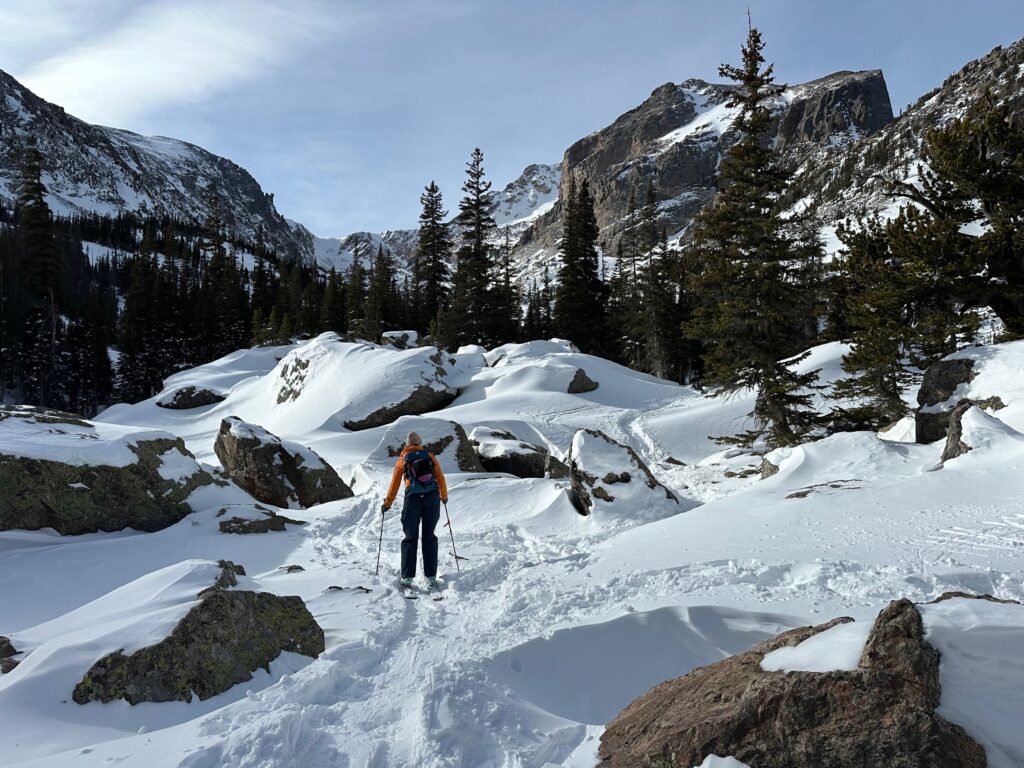
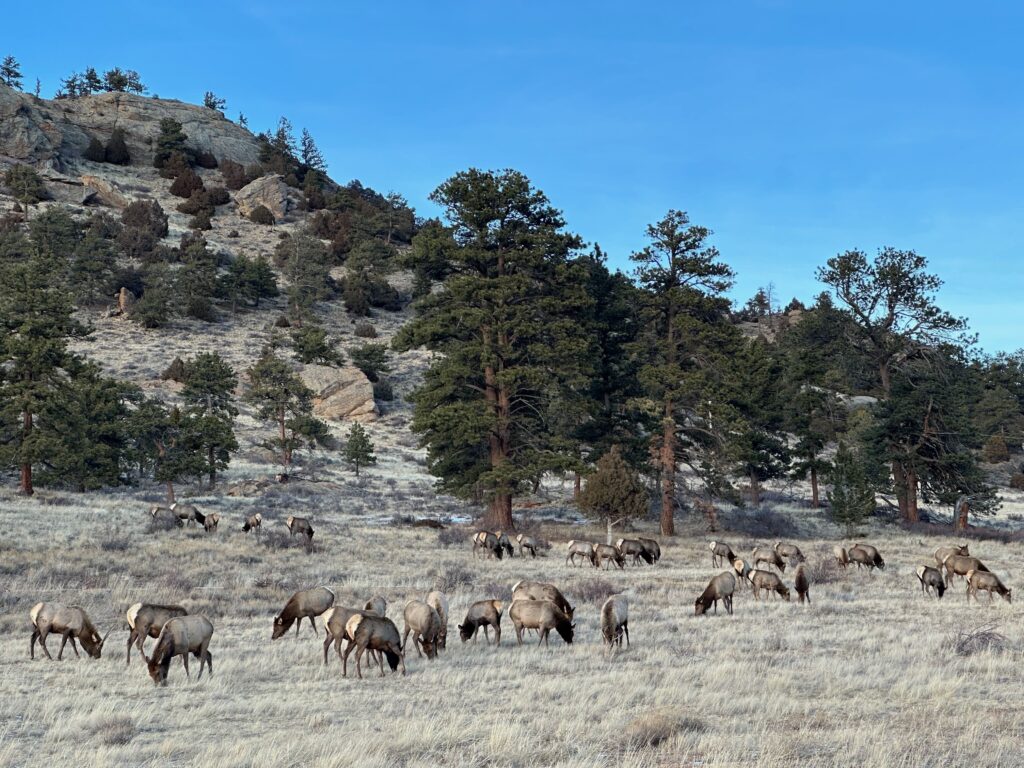
This week’s installment of “Postcards From” is courtesy of one of ICN’s editors, Michael Kodas. He is based in Colorado and spotted some critters on a recent adventure.
“We found full conditions in Rocky Mountain National Park last weekend, with snow, although far less than usual for this time of year, in Chaos Canyon around Lake Haiyaha, but nothing covering the grass elk grazed on just a few miles away,” Michael said. “Colorado’s current snowpack is near record lows, with the snow on the ground across much of the state equivalent to what would be found in early December in a year with average snowfall.”
About This Story
Perhaps you noticed: This story, like all the news we publish, is free to read. That’s because Inside Climate News is a 501c3 nonprofit organization. We do not charge a subscription fee, lock our news behind a paywall, or clutter our website with ads. We make our news on climate and the environment freely available to you and anyone who wants it.
That’s not all. We also share our news for free with scores of other media organizations around the country. Many of them can’t afford to do environmental journalism of their own. We’ve built bureaus from coast to coast to report local stories, collaborate with local newsrooms and co-publish articles so that this vital work is shared as widely as possible.
Two of us launched ICN in 2007. Six years later we earned a Pulitzer Prize for National Reporting, and now we run the oldest and largest dedicated climate newsroom in the nation. We tell the story in all its complexity. We hold polluters accountable. We expose environmental injustice. We debunk misinformation. We scrutinize solutions and inspire action.
Donations from readers like you fund every aspect of what we do. If you don’t already, will you support our ongoing work, our reporting on the biggest crisis facing our planet, and help us reach even more readers in more places?
Please take a moment to make a tax-deductible donation. Every one of them makes a difference.
Thank you,

Kiley Price
Reporter
Kiley Price is a reporter at Inside Climate News, with a particular interest in wildlife, ocean health, food systems and climate change. She writes ICN’s “Today’s Climate” newsletter, which covers the most pressing environmental news each week.
She earned her master’s degree in science journalism at New York University, and her bachelor’s degree in biology at Wake Forest University. Her work has appeared in National Geographic, Time, Scientific American and more. She is a former Pulitzer Reporting Fellow, during which she spent a month in Thailand covering the intersection between Buddhism and the country’s environmental movement.
Search
RECENT PRESS RELEASES
Related Post