Hyundai Ioniq gains on Tesla as oil prices drive EV demand
April 26, 2026
Hyundai chips away at Tesla’s lead in US with wider EV offering
Hyundai Motor’s electric vehicle sales in the US jumped in March as surging oil prices fueled demand, sharpening its challenge to Tesla’s dominance.
According to industry sources Monday, Hyundai’s EV sales in the US rose by approximately 40 percent in March from the previous month. The Ioniq 5 crossover SUV led the growth, with 4,425 units sold, up 37 percent from 3,234 in February. The Ioniq 9 SUV also gained momentum, jumping 79 percent to 905 units from 505 in the same period.
As a result, sales of the Ioniq 5 from January to March reached 9,765 units, up 13.4 percent from 8,610 units a year earlier. The Ioniq 9 recorded its highest monthly sales since September.
Market watchers say the surge in Hyundai’s battery-powered vehicle sales is largely attributed to higher oil prices, prompting consumers to switch from internal combustion engine vehicles despite the removal of up to $7,500 in federal EV subsidies in September.
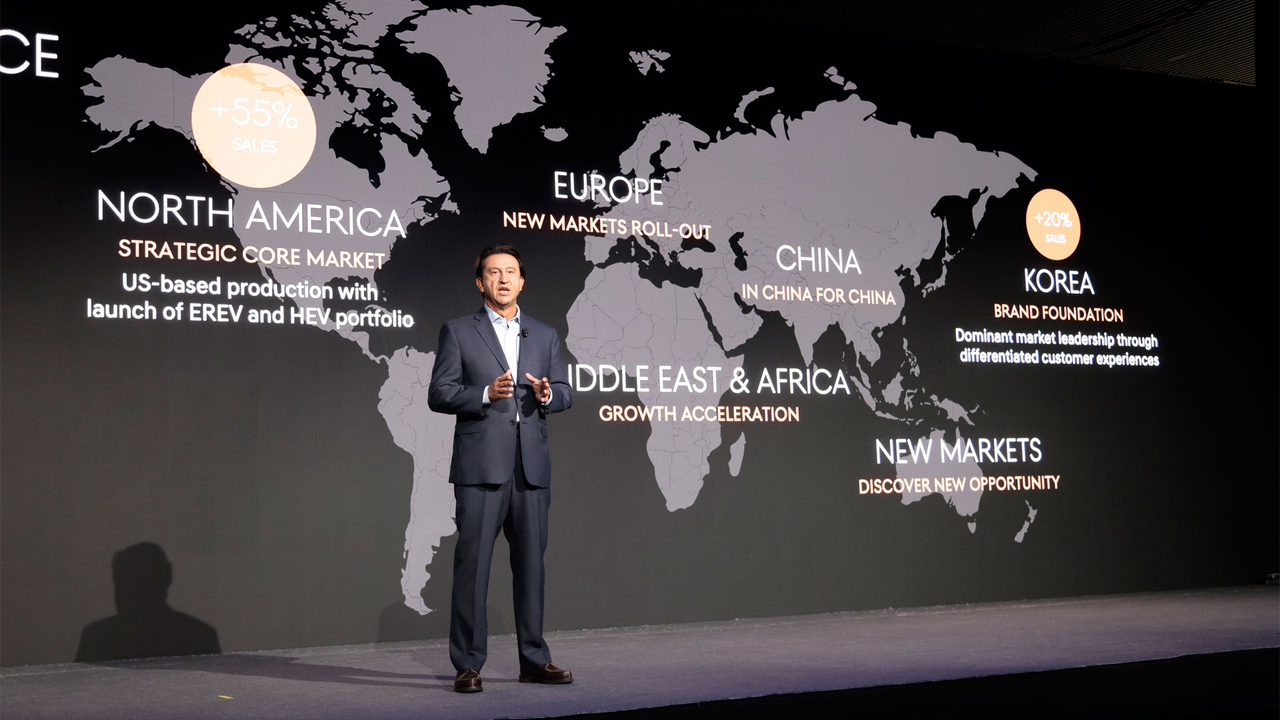
Acknowledging this shifting trend, Hyundai Motor Company CEO Jose Munoz said during the 2026 Milan Design Week on April 20, “As fuel costs rise, consumers tend to seek more economical alternatives.”
Notably, US gasoline prices have continued to climb sharply after surpassing the $4-per-gallon ($1.06 per liter) mark in March for the first time in over three years, as supply disruptions rising from the Middle East conflict drive prices higher. According to the American Automobile Association, the national average for regular gasoline increased 30 percent year-on-year to $4.099 per gallon ($1.08 per liter) as of Friday.
Experts indicate that even if the Iran conflict ends, the era of cheap oil is effectively over, with structurally higher prices likely to persist globally — particularly in the US — reinforcing Hyundai’s push to expand its EV lineup in the region.
Kim Pil-su, an automotive engineering professor at Daelim University, said, “In the US, the rapid rise in fuel costs will accelerate the shift toward hybrids and EVs. Despite EVs costing about 1.5 times more than internal combustion models, strong demand for Hyundai’s Ioniq lineup — even without subsidies — highlights a clear change in consumer behavior.”
Hyundai’s share of the US EV market inched up from 5.6 percent to 6 percent year-on-year in the first quarter, excluding Kia. While still well below Tesla’s 54.2 percent, Kim noted the Korean automaker is expanding its presence with a broader EV lineup, in contrast to Tesla’s reliance on a narrower range of models, such as the Model 3 sedan and Model Y SUV, and its longer product cycles.
According to Cox Automotive estimates, despite its market-share stronghold, Tesla’s US sales fell in the January-March period, marking a third consecutive year of first-quarter declines. The EV maker, which sells only battery-powered vehicles, sold 117,300 vehicles, its lowest quarterly total since late 2021 and an 8.4 percent drop from a year earlier.
By contrast, Hyundai Motor and Kia also saw US EV sales drop 21.6 percent to 18,086 units. Strong hybrid demand helped to offset the decline, with hybrid sales jumping 53.2 percent to 97,627 units and lifting total eco-friendly vehicle sales 33.3 percent to 115,713 units. Eco-friendly models accounted for 26.8 percent of their combined sales.
Meanwhile, Hyundai is ramping up local production to strengthen its position in the US eco-friendly vehicle market. The company aims to raise its US production share to over 80 percent by 2030, with its Georgia plant set to reach an annual capacity of 500,000 units by 2028 and assemble 10 models, including hybrids and EVs.
hyejin2@heraldcorp.com
Search
RECENT PRESS RELEASES
Related Post