IEA Global Electric Car Sales Topped 20 Million In 2025
May 26, 2026
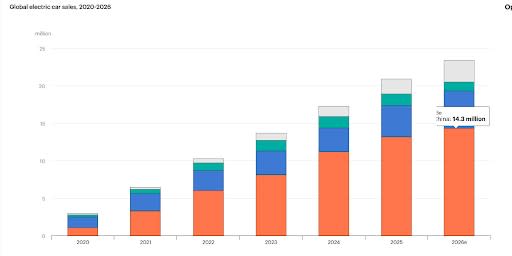
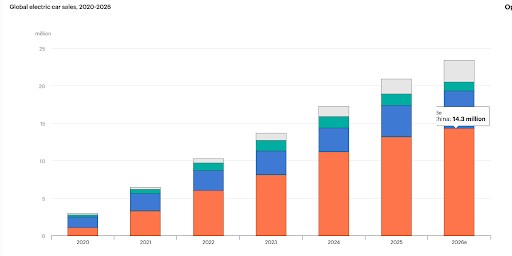
Over the past five or so years, the global electric vehicle (EV) market has been rapidly transforming from a niche segment into a mainstream industry thanks to plunging battery costs, aggressive emissions standards and an influx of affordable models from major manufacturing hubs, most notably, China. Back in 2022, the EV sector achieved an important milestone after global sales crossed 10 million for the first time ever. But now, the sector has crossed another milestone, with the International Energy Agency (IEA) reporting that 20.7 million EVs were sold worldwide in 2025, good for a healthy 20% Y/Y growth. EV sales accounted for a quarter of all automotive sales across the globe in 2025.
But China continues to dominate the EV market, accounting for roughly 60% of all EVs sold worldwide and 55% of total new car sales in the country in 2025.
China’s domestic new energy vehicle (NEV) sales, which encompass Battery Electric Vehicles (BEVs) and Plug-in Hybrids (PHEVs), reached 12.86 million passenger cars, good for 19% Y/Y increase. This marked the first time that new energy vehicles officially outsold traditional internal combustion engine cars. Chinese automakers sold 34.35 million vehicles worldwide, accounting for a record 35.6% of the entire global automotive market and leapfrogging Japan as the world’s leading automotive exporter. The global export surge was mainly driven by high demand in South America and Southeast Asia, where total auto exports jumped 21% to over 7 million units.
Related: Trump’s Iran Signals Send Oil Markets Into Chaos
Domestically, BYD Company (OTCPK:BYDDF) maintained its undisputed leadership by capturing 27% of the NEV market with 3.5 million registrations, while Geely Automotive (OTCPK:GELYF) nearly doubled its EV sales to secure a 12.4% market share.
Source: International Energy Agency
EV sales in the United States finally snapped a multi-year growth streak, with only 1.8 million units sold in 2025, good for a 4% Y/Y decline in part due to the removal of incentives by the Trump administration. During the Biden administration, new EV purchases were eligible for $7,500 in federal tax credits under the Inflation Reduction Act (IRA); however, the landscape shifted dramatically after Congress passed OBBBA in 2025, with the legislation terminating the primary federal Clean Vehicle purchase and used EV tax credits entirely for vehicles acquired after September 30, 2025. EV sales surged in double-digits in the months leading up to the subsidy deadline but fell sharply thereafter, demonstrating a clear pull-forward effect.
Tesla’s (NASDAQ:TSLA) EV sales in the U.S. contracted by roughly 7% year-over-year in 2025, with total estimated sales of 589,160 units compared to 634,000 in 2024. However, the company made sizable market share gains from around 43% at the start of the year to over 56% by the end of the year, thanks to its resilience following the expiration of federal tax credits. Several legacy automakers logged massive year-on-year leaps in EV deliveries during 2025, with General Motors (NYSE:GM) and Volkswagen (OTCPK:VWAGY) posting gains exceeding 100% in certain periods, while Hyundai saw a 45% increase.
Meanwhile, sales in Europe rebounded sharply in 2025, with Battery Electric Vehicles (BEVs) surging 29.7% year-on-year to reach 2.58 million units, primarily driven by strict EU fleet emissions mandates, a wave of affordable new EV models, and a massive spike in fuel prices.
The single largest regulatory driver was the EU’s car CO? regulation which forced automakers to lower their average fleet carbon dioxide emissions by 15% compared to 2021 levels. To avoid multi-billion euro fines, legacy carmakers aggressively pushed EV sales to close their compliance gaps. Europe’s automakers also introduced highly appealing leasing packages, triggering a massive wave of corporate and commercial fleet purchases. Equally important, a massive influx of competitive, lower-cost vehicles from Chinese manufacturers like BYD–which rapidly expanded its European market share–forced the entire industry to adjust pricing downward. In Germany, the continent’s largest auto market, the average BEV price dropped by roughly 6% due to the arrival of these cheaper models.
Finally, the IEA has reported that EV sales in emerging markets and developing economies jumped by ~80% in 2025 to reach nearly 1.2 million units, mainly driven by affordable models from Chinese OEMs, local policy incentives, and rising energy/fuel costs. Sales in Southeast Asia more than doubled, pushing the EV market share in the region to nearly 20% of all new light-duty vehicle sales, more than double the United States’ ~8% share, heavily driven by rapid adoption in Vietnam, Indonesia, and Thailand. Sales in Latin America grew by 75% Y/Y to surpass 350,000 cars, with Brazil and Mexico acting as the primary drivers of the growth.
EV sales in India across all categories crossed the 2.27 million mark in CY2025, a record high that represented about 8% penetration of total vehicle registrations. This growth was driven primarily by electric two-wheelers and three-wheelers, along with a surge in electric passenger car sales. Electric Passenger Vehicles achieved an all-time high of over 176,000 units, good for a robust 77% year-on-year increase driven by mass-market SUVs while electric two-wheelers and electric three-wheelers continue to dominate India’s EV sector, accounting for 57% and 35% of total EV sales, respectively.
By Alex Kimani for Oilprice.com
More Top Reads From Oilprice.com
- Oil Prices Plunge Below $100 on Iran Deal Optimism
- U.S.-Iran Deal Delayed as Trump Refuses to “Rush” Agreement
- TotalEnergies Eyes $100M+ Stake Sales in European Solar and Wind Portfolio
Search
RECENT PRESS RELEASES
Related Post