Illinois Is Going All In on Battery Storage. What Will That Mean?
December 23, 2025
Illinois is lagging on battery storage—projects that collect solar and wind energy to use when the sun isn’t shining and the wind isn’t blowing.
But major energy legislation that the state’s General Assembly passed in October, and which Gov. JB Pritzker has pledged to sign, could change that. It includes incentives to create much more storage.
Since 2021, states such as California and Texashave embraced grid-scale batteries as a tool to build a more reliable, clean energy grid. These batteries are now providing power to millions of homes during periods of high energy demand and helping prevent blackouts, and other problems.
The growing interest in battery storage comes at a high-stakes moment in the country, as tech companies spend billions of dollars building power-hungry data centers around the country, raising energy rates for ordinary customers. It also comes as the Trump administration rolls back tax credits and Biden-era support for renewable energy in favor of the fossil fuel industry, calling on Americans to “Drill, baby, drill.”
Get Inside Clean Energy
Today’s Climate
Tuesdays
A once-a-week digest of the most pressing climate-related news, written by Kiley Price and released every Tuesday.
Get Today’s Climate
Breaking News
Don’t miss a beat. Get a daily email of our original, groundbreaking stories written by our national network of award-winning reporters.
Get Breaking News
ICN Sunday Morning
Go behind the scenes with executive editor Vernon Loeb and ICN reporters as they discuss one of the week’s top stories.
Get ICN Sunday Morning
Justice & Health
A digest of stories on the inequalities that worsen the impacts of climate change on vulnerable communities.
Get Justice & Health
Set against this backdrop, Illinois’ sweeping new bill seems all the more significant.
As of October, according to federal data, the state had just over 80 megawatts of operating battery storage, ranking it 23rd in the nation despite being the sixth-most populous state.
Under the new Clean and Reliable Grid Affordability (CRGA) Act, the state aims to add 3 gigawatts of battery energy storage systems to the grid by 2030. That’s more than 37 times the current operating capacity, and only three states top that today: California, Texas and Arizona.
The legislation will also create a program called “Storage for All” that provides incentives to certain groups, including low-income households and nonprofits, to procure their own batteries.
The Illinois Power Agency, forecasting the impact on customers of the state’s two biggest utilities in the 2030s, said the act should help reduce what Illinois residents would otherwise pay every month. For Ameren customers, the savings could top $240 a year.
CRGA is not without its detractors. Manufacturers have argued that the measure could increase costs rather than control them. It sparked a fierce debate between Republicans and Democrats, and an earlier iteration of the bill failed to pass in May amid pushback from farmers, unions and groups representing the fossil fuel industry.
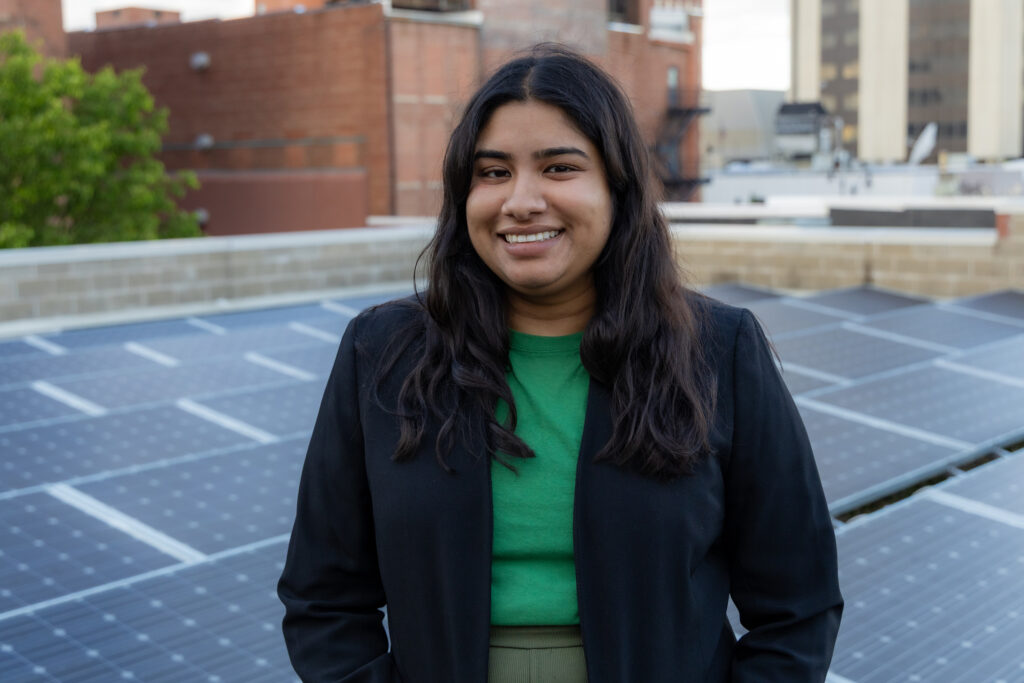
To learn more about why battery storage figures so prominently in the new bill, Inside Climate News spoke with Kavi Chintam, who works on Illinois clean-energy legislation for Vote Solar, a policy-focused nonprofit. Chintam is a former environmental-justice organizer who holds a doctorate in chemical engineering. This interview has been edited for length and clarity.
ALEXIA UNDERWOOD: First, can you explain what battery storage is for people who might not know?
KAVI CHINTAM: So, there are different types of battery storage, but ultimately battery storage is like the grid’s savings account. It can store excess power when it’s cheap or when you have too much wind or too much solar being produced than what is needed at any given time. Then it can release that energy at the exact moment that the grid is stressed.
It also really alleviates something that I’ve heard over the years, which is, “The wind isn’t always blowing and the sun isn’t always shining.” Well, that’s exactly where battery storage can fit into the equation because it can make renewables dependable across the clock and keep prices from spiking during extreme weather events or times of high demand and peak demand. So ultimately, battery storage is very important in our clean energy transition to fill some of the gaps.
“Battery storage is like the grid’s savings account.”
UNDERWOOD: Why did Illinois choose to make battery storage a big focus of its new energy bill?
CHINTAM: Over the past few years, battery storage has become much more economically feasible. We can talk about the national perspective in a second, but Illinois really wanted to get ahead of that trend.
Because CEJA [a climate-focused Illinois bill that passed in 2021] set goals for clean energy, it’s important to supplement those goals with even more clean technology, like battery storage. And the battery policies that are in the CRGA Act include 3 gigawatts of utility-scale battery storage that will help us with any intermittency from renewable energy, but also residential-scale storage that can be deployed through the virtual power plant program.
Additionally, the integrated resource planning process that is in the CRGA Act is important because it will make Illinois consider storage as part of that cost-effective resource mix investigation, and make sure storage is built not only where it delivers the most value, but also how much is required to deliver an adequate amount of value.
It basically allows for a really coordinated, forward-looking approach that positions Illinois as a leader in the Midwest, but also nationally, in grid reliability and clean energy. So, battery storage ultimately helps with reliability and affordability and helps us move toward clean energy overall.
UNDERWOOD: Tell me about what types of batteries we’re talking about here.
CHINTAM: Sure. This is coming from my background as a chemical engineer, because I worked on this a little bit in a past life. There are different types of battery technologies. There’s lithium-ion—that’s definitely the most popular—but there’s also zinc, there’s redox flow batteries, which are more complicated. There’s lead acid, and then there are also other types of energy storage. PSH is pumped storage hydropower.
So yeah, these are just different types of technologies that have been researched heavily by smart people [to create batteries that] store energy well. Lithium-ion batteries are definitely the most popular, but there are other types being researched as well, to figure out how we can minimize costs of the actual production process of batteries, and how we can make them even better at storing energy without being really big. It’s really balancing a lot of factors there.
UNDERWOOD: What exactly does that mean in terms of facts on the ground—are people going to be seeing just, well, more large batteries in their communities?
CHINTAM: Yeah. Utility-scale battery projects are what you just said, it’s big battery storage. The battery you put in your phone is storing energy. That’s why you charge it. The charging that’s happening [in this situation] is solar and wind power.
One reason that battery storage is so important in how it is deployed on a utility scale is that it can start replacing peaker plants, which are really expensive to maintain and really high polluting.
And yes, utility-scale batteries are huge batteries. But then also, like I mentioned, residential battery storage is also part of this equation. Those are just smaller battery systems that folks can keep in their garage, for example. So if they have solar power, it can store any excess solar energy that they’re not using during the day, put that into that battery and then deploy it either to their home or to the grid, if they’re enrolled in the virtual power plant program,and help shave peak demand.
[The new bill] sets procurement targets for the state to actually procure storage. I believe the first one is in 2027. And then, the big goal that I think has been touted a lot is the 3 gigawatts by 2030. The integrated resource planning [part of the bill] will help the state figure out exactly how much additional battery storage will be needed in future years to meet existing demand, and also meet demand that is being brought on by large loads like data centers.UNDERWOOD: Can you explain what a virtual power plant program is?
CHINTAM: Yes. When you imagine a traditional power plant, you probably imagine a single industrial unit that is making energy and is connected to transmission lines. A virtual power plant is also called a distributed power plant. So, it’s exactly that: It takes resources that people have in their homes and businesses—small battery storage that’s connected to solar, electric vehicle charging stations and smart thermostats—and allows them all to work in a centrally managed but geographically dispersed manner. It basically sends energy back to the grid at times of peak demand.
So it’s essentially like everyone’s little batteries are coming together and making one power plant, but it’s greener, it’s distributed, it doesn’t take up a bunch of space and it’s not polluting.
UNDERWOOD: Are other states also looking to battery storage as a renewable energy solution, like Illinois is?
CHINTAM: Nationally, I would say, in recent years, and maybe even the past year, we’re seeing battery storage move from being a niche technology to a core part of the U.S. energy system.
In 2024, the U.S. added record storage capacity, and there is still a federal incentive for standalone storage. It’s a tax credit, which really opened the floodgates for investment, but that will end later this year.
But even states without renewable mandates, like Texas, are building major storage projects simply because the economics are so strong. Even without the tax incentives, the costs of battery storage is reducing as the years go on and as research is being done to make them more efficient and make them cheaper to build, too.
I would say, especially for states that are dedicated to building more renewable and clean energy, if states wait too long, they’ll end up hitting a wall because you can’t scale renewable energy without storage being part of that equation. You simply need it because of the gaps that are admittedly there with wind and solar. Battery storage fills those gaps and really just completes that picture.
“We’re seeing battery storage move from being a niche technology to a core part of the U.S. energy system.”
UNDERWOOD: Are there any concerns or drawbacks that exist, and can you talk about the pushback? Some people raised objections to the bill over the costs it would incur.
CHINTAM: I would say that the most important thing there is that the 3 gigawatts of battery storage, they aren’t procured all at once, and ratepayers don’t pay for those immediately. As soon as the bill is passed, we’re not going to see a new line item that’s like, “You are paying for the 3 gigawatts that were in CRGA.”
Ratepayers won’t pay for those until they are online and running, which means that ratepayers will pay a lot less for that storage when energy and capacity prices are high, and they’re expected to be going forward.
Ultimately, at the end of the day, what matters is having a grid that is reliable and affordable and clean, and battery storage is a part of that. It’s important to have a grid that works in extreme weather, keeps costs stable and supports Illinois’ broader clean energy strategy, and storage helps us retire aging fossil fuel plants responsibly, integrate renewables and make room for other green solutions. So it’s really the backbone of a modern grid.
And like I said, we’re going to see that become even more popular across the country. So, it’s really important that Illinois acted during the veto session and made that part of our story now.
I think the main pushback, in Illinois or otherwise, is from opponents who want to push fossil-heavy generation mixes and have [energy]base load that is purely fossil heavy. Battery storage isn’t base load because it’s not generating electricity, but it does help with flexibility in terms of energy. So, in states that rely heavily on coal and gas, those power grids don’t necessarily have enough renewable energy to force a flexibility solution.
In Illinois, we have targets set by CEJA to close certain plants. I’m expecting the integrated resource planning process to point us towards more renewables because, as I said, it is more cost effective, especially as time goes on. So, storage will be, again, the commonsense solution here as we move even further away from fossil-heavy generation mixes.
This story is funded by readers like you.
Our nonprofit newsroom provides award-winning climate coverage free of charge and advertising. We rely on donations from readers like you to keep going. Please donate now to support our work.
UNDERWOOD: How do batteries figure into the data center boom in the state? Do people anticipate this will help the situation?
CHINTAM: Yeah, for sure. Data centers bring challenges on both the demand and supply side of the energy system in Illinois and elsewhere. So, on the demand side, they need a lot of energy. And on the supply side, there isn’t enough current supply in the state of Illinois or in our regional transmission organization to fulfill the expected data center boom that’s coming in the next few years.
So, what battery storage does from both the utility-scale level and residential smaller battery storage systems, they add capacity. So, it’s just simple supply and demand. When supply goes up, costs go down. So, as you get more battery storage, you can combat some of the increased and unprecedented demand, frankly, that data centers are bringing to the state.
UNDERWOOD: If you’re just a regular consumer, how would you see the benefits of battery storage play out in your everyday life? Fewer blackouts, for example? Can you break it down?
CHINTAM: There are really two ways that a regular person would see it. One, if you don’t have battery storage, you will see net reductions on your bill because of battery storage, because your supply charge could go down because there’s more capacity. So there’s just more to go around, which yes, could reduce the possibilities of blackouts because you’re shaving the peak [demand] because there’s more supply available.
Battery storage will also be apparent to people who have batteries because it can directly impact your own energy use and your own personal capacity, and then also what you can send back to the grid.
UNDERWOOD: Have the Trump administration’s policies had an impact on battery storage programs?
CHINTAM: I would say the main effect from the federal government in terms of battery storage is the standalone storage credit. That is a federal incentive that made it make [a lot of] economic sense for different states to adopt and for individuals to get standalone storage. That’s going away at the end of 2025.
So, that will be negative. I mean, particularly in states that don’t have strong state mandates like Illinois [does]. In Illinois, part of what is in the CRGA Act is the virtual power plant program. That is coupled with an updated storage rebate. So, if you buy a battery, then you get a rebate, and then when you participate in the virtual power plant program, you get compensated even more. And there’s also carve-outs—even higher rates of compensation for income-eligible folks as well.
In Illinois, I think we’re protected in a lot of ways, and CRGA has helped bolster our protections even more because we have our own in-house incentives for battery storage, but I don’t want to minimize the loss that the federal incentives going away is going to cause. We don’t have support on the federal level to make [the case for] batteries even stronger. And that is unfortunate, to say the least. But we are lucky to have legislation now that is combating that federal narrative for sure.
That’s the thing with state policy; it’s really great to get things passed, and I truly believe Illinois is a leader, but there’s so many other states and individuals that need these things as well. State governments—this is their time to step up.
About This Story
Perhaps you noticed: This story, like all the news we publish, is free to read. That’s because Inside Climate News is a 501c3 nonprofit organization. We do not charge a subscription fee, lock our news behind a paywall, or clutter our website with ads. We make our news on climate and the environment freely available to you and anyone who wants it.
That’s not all. We also share our news for free with scores of other media organizations around the country. Many of them can’t afford to do environmental journalism of their own. We’ve built bureaus from coast to coast to report local stories, collaborate with local newsrooms and co-publish articles so that this vital work is shared as widely as possible.
Two of us launched ICN in 2007. Six years later we earned a Pulitzer Prize for National Reporting, and now we run the oldest and largest dedicated climate newsroom in the nation. We tell the story in all its complexity. We hold polluters accountable. We expose environmental injustice. We debunk misinformation. We scrutinize solutions and inspire action.
Donations from readers like you fund every aspect of what we do. If you don’t already, will you support our ongoing work, our reporting on the biggest crisis facing our planet, and help us reach even more readers in more places?
Please take a moment to make a tax-deductible donation. Every one of them makes a difference.
Thank you,
Search
RECENT PRESS RELEASES
Related Post