Illinois Passed New Clean Energy Legislation—What to Look for in 2026
December 17, 2025
Illinois clean energy advocates are justifiably still giddy over the state legislature’s passage of the Clean and Reliable Grid Affordability Act (CRGA, or surge-ah as we call it). The wide-ranging legislation contains several energy policy updates to help Illinois achieve its clean electricity goals and meet the moment of rising electricity costs and federal policy attacks on clean energy.
Once signed into law by Governor Pritzker, CRGA will officially take effect June 1, 2026. But Illinois won’t wait until then to begin implementing various provisions of the bill; in this post, I’ll identify what to look for in early 2026 under the new legislation.
Before getting to that, let’s first recap how CRGA came together, what’s in the extensive policy package, and the role the Union of Concerned Scientists (UCS) played alongside all of our amazing partners in the Illinois Clean Jobs Coalition to secure passage of the bill.
The story of CRGA begins with an earlier law, the Climate and Equitable Jobs Act (CEJA). Passed in 2021, CEJA set foundational goals for the state, including phasing out fossil fuel plant emissions and expanding renewable generation, all through the lens of prioritizing equity from top to bottom.
But, as significant as CEJA was, it did not include substantial policies around energy storage, an essential piece of the clean energy transition. Proposals for storage programs began to emerge in 2023 and were discussed in various policymaking forums throughout 2024. UCS made a key contribution with our Storing the Future modeling analysis released in November 2024. The core recommendation from our work—that Illinois seek to install at least 3 gigawatts (GW) of 4-hour discharge duration batteries by 2030—was relied upon by the Illinois Commerce Commission in its storage policy report issued in May.
In addition to energy storage, several other important policies were identified along the way as CRGA continued to take shape—policies to bolster initiatives begun under CEJA, to create new clean energy programs, and to respond to emerging challenges of rising electricity demand and the Trump administration’s attacks on clean energy.
My colleagues at UCS and I joined other members of our coalition to craft policies, prepare legislative language, testify in numerous committee hearings in support of the bill, and mobilize supporters to contact their legislators and participate in lobby days. After extensive negotiations convened by legislative leaders, utilities and labor unions ultimately joined the clean energy industry and our advocacy coalition to support the package—leading to CRGA’s passage on the final day of Illinois’ fall veto session.
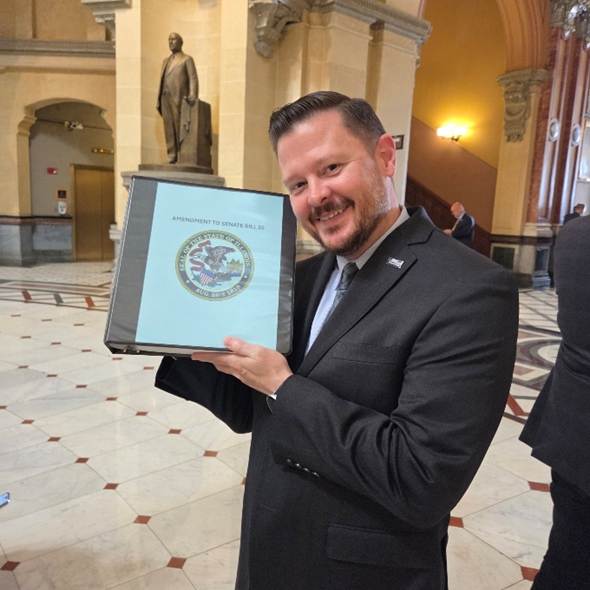
The author holding a copy of CRGA in the Illinois State Capitol building on October 30, 2025. Photo Credit: James Gignac.
Here’s a few of the big highlights and some of the primary policy areas we worked on at UCS:
- Drives energy storage deployment: CRGA adopted our recommendation that Illinois pursue at least 3 gigawatts of 4-hour discharge duration battery storage by 2030. It also added “Storage for All” provisions to ensure the benefits of residential batteries are equitably available to all households.
- Introduces integrated resource planning (IRP): Through the legislation, Illinois will now join numerous other states that conduct IRPs, a valuable and much-needed approach to comprehensive electricity system planning. CRGA created new mechanisms for Illinois agencies to conduct statewide resource planning and seek approval for adjustments to programs and targets from the Illinois Commerce Commission as needed.
- Boosts renewables and efficiency: CRGA bolstered these two pillars of the clean energy transition by increasing funding for wind and solar deployment and expanding energy efficiency goals for electric and gas utilities. CRGA also creates a virtual power plant program where utilities offer compensation for customer-owned resources such as rooftop solar and batteries to help the grid during periods of peak demand.
- Strengthens transmission planning: CRGA enhances the state’s existing Renewable Energy Access Plan process to encourage better consideration of grid-enhancing technologies (GETs) and other advanced transmission solutions to help unlock additional clean electricity and improve reliability.
An excellent round-up of the main policies contained in CRGA is available here, prepared by the Illinois Clean Jobs Coalition’s lead lobbyists at McFadden Strategies.
Here are some of the main CRGA-related activities we can expect early in 2026 in Illinois:
Resource adequacy and IRP: Under CRGA, Illinois state agencies are due to submit the state’s first IRP in November 2026. Earlier this week, those agencies published an initial Resource Adequacy Study resulting from a process specified under existing law. The study forecasts that increased electricity demand across the region, driven in large part by data centers, poses challenges to Illinois’ achievement of its power sector decarbonization goals. Fortunately, CRGA provides the state important new tools through the IRP process to identify—and act upon—the best, most cost-effective solutions to keep Illinois progressing toward a cleaner and more reliable electricity system.
Look for Illinois state agencies to schedule a stakeholder workshop in late January for further discussions on this week’s Resource Adequacy Study and how it will serve as a starting point for work on the IRP. Additional details on the timing for the IRP development process and opportunities for stakeholder involvement will also be forthcoming in early 2026.
Battery storage procurement: CRGA specifies that the Illinois Power Agency (IPA) will conduct an initial procurement by the end of August for new utility-scale battery storage projects. The agency will be seeking just over 1,000 megawatts of 4-hour duration batteries in that first procurement through an indexed storage credit mechanism developed via a workshop process earlier this year. Look for the IPA to begin preparing for this initial storage offering in the spring.
Virtual power plant (VPP) programs: Illinois utilities ComEd and Ameren will submit proposals by the end of 2027 to create multi-faceted VPP programs, but things will kick off much sooner for a “scheduled dispatch” offering focused on customer-owned batteries. Under CRGA, the utilities will propose details by June 1, 2026, for this initial program of rebates for battery equipment and compensation for customers providing electricity to the grid at scheduled times of expected peak demand.
Additional attention on data centers: One major category that was not addressed in CRGA is data centers and steps Illinois should take to protect its clean energy goals and other ratepayers as these large new electricity consumers seek to draw massive amounts of power for their facilities.
Look for policymakers and stakeholders to take up discussions around data centers and the power grid in early 2026, as well as an Illinois Commerce Commission ruling in January on ComEd’s proposed tariff changes to address large load customers (my UCS colleague Mike Jacobs submitted expert testimony in the case).
Finally, stay tuned for a new analysis that UCS will soon be releasing in the coming weeks examining data center impacts on Illinois’ power grid and policy recommendations to mitigate them.
Overall, 2026 will be a year of action to begin implementing CRGA’s many policies and continue Illinois’ progress toward its clean and equitable energy goals. The significance of Illinois’ action, its third major energy bill in the last decade, shows the state’s commitment to leading, innovating, and responding to a changing landscape.
We see Illinois as an inspiration for other states, taking action to address rising electricity costs and signaling that it will not allow the Trump administration to dictate a dirty energy future for its people. Illinois is moving forward, and UCS looks forward to continuing to lead and contribute to this important work in 2026.
Search
RECENT PRESS RELEASES
Related Post