In Batteries We Trust
April 3, 2026
A break for some good news
The war goes on, and so does the global energy crisis. In fact, I believe that prices of oil futures remain too low given how much spot prices will need to rise to resolve the shortages that will hit once oil supplies that were shipped before the Strait of Hormuz was closed are exhausted.
But a better future is coming, despite Donald Trump’s assault on renewable energy as he tries to drag us back into the fossil fuel past. Regardless of Trump’s chest-thumping, America is not the world. We account for only 15 percent of global energy consumption, compared with China’s 28 percent. And the rest of the world is moving rapidly to renewables, thanks to a technological revolution in solar power, wind power, and, less visibly, batteries.
So let me take an optimism break and talk about why batteries may save the world.
The decline in battery prices has been incredible. It’s like nothing anyone has ever seen before. Big, strong men with tears in their eyes come up to me and say, “Sir, have you seen the progress in batteries?”:
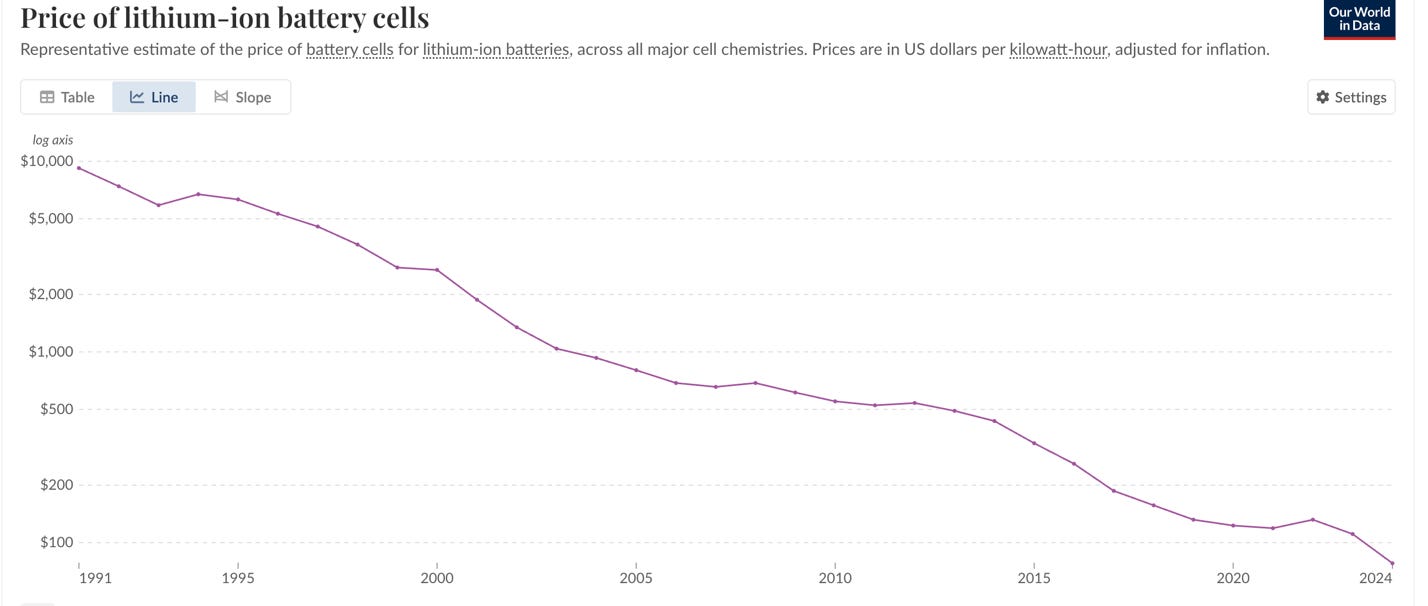
Why does this matter?
First, cheap battery storage of electricity greatly mitigates the problem of intermittency — the sun doesn’t always shine, the wind doesn’t always blow. This was a major concern early in the renewable revolution. Some energy economists scolded me for my naïve optimism when I first wrote about solar technology way back in 2011. But solar + batteries provides round-the-clock power.
Here’s a graph of California’s electricity supply generated by renewables and batteries over the course of 24 hours on April 1 that illustrates my point:
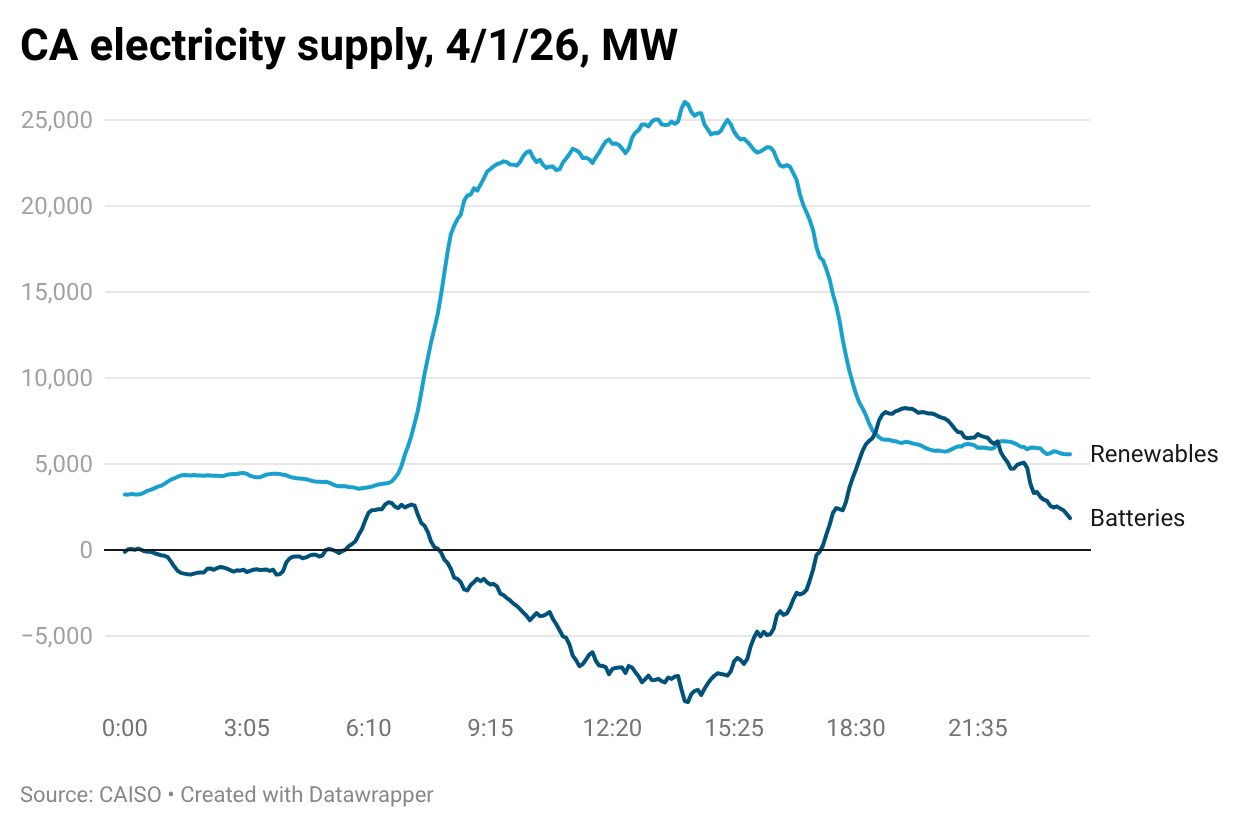
During the middle of the day, California generates lots of electricity from solar. Much of it is poured into batteries, which provide electricity when the sun sets. Californians don’t even notice the switch.
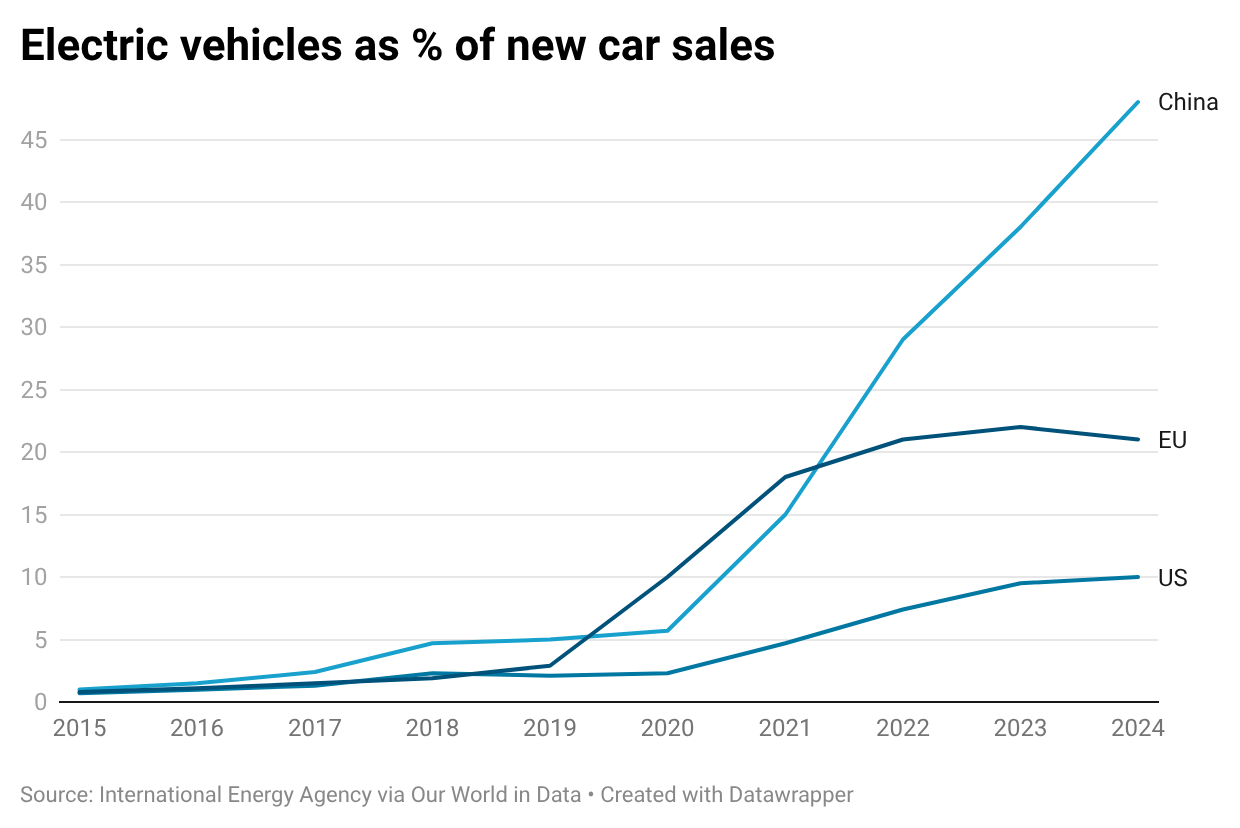
Second, battery performance has soared as prices have plunged. Crucially, there has been a huge increase in batteries’ volumetric energy density: the amount of electricity that can be stored in a given space. Until a few years ago the energy density of gasoline gave internal combustion a huge advantage over electric vehicles. But no longer. Outside the U.S. electrification, the transition away from petroleum and towards electricity — particularly green-sourced electricity — is well underway:
Third, we should expect continuing rapid improvement in renewable energy. That’s because the progress in batteries has come from cumulative learning rather than scientific breakthroughs. Lithium-ion batteries are, in fact, a decades-old technology. Yet costs have fallen drastically and energy density risen thanks to an ongoing process of learning, which shows no sign of coming to an end.
Furthermore, we’ve seen rapid progress in all components of the green energy transformation, even though their underlying technologies have little in common. Solar panels, wind turbines, and batteries are very different, yet all have seen revolutionary improvements. This strongly suggests that the whole renewable energy complex is experiencing a virtuous circle: ever-growing use leads to falling costs and falling costs lead to ever-growing use.
If we ask where this virtuous circle is taking place, the answer is, largely in China with an assist from Europe. And the corollary is “not in America.” The United States has allowed itself to be far surpassed by China and is now only a peripheral player in the renewable revolution. Fortunately for the rest of the world, this means that the Trump administration’s hostility to renewable energy, its attempts to sabotage progress, won’t stop that revolution or even noticeably slow its momentum. True, Trump’s anti-green, pro-pollution tilt will serve to leave America further behind, but progress in fighting climate change and reducing the risks of global dependence on oil will continue.
So although we are now in the midst of a severe energy crisis that could easily go on for many months, this too shall pass. A better, cheaper, cleaner energy future is on the way, and not even Trump can stop it.
MUSICAL CODA
Search
RECENT PRESS RELEASES
Related Post