In remote northern Philippines, a local solution to the global energy shock
May 11, 2026
In a mountain village in the northern Philippines, electricity does not arrive through transmission lines or come from burning imported fossil fuel. It flows from a local river.
Each night, as lights flicker on inside scattered homes, the power is generated by a small turbine turning steadily in the dark – built, maintained, and managed by the community itself.
“We don’t have to rely on outside power facilities. We decide when to switch it on and off,” says Rodolfo Sagban, chairman of the Lapat Micro Hydro Power Association in Nabuangan village, located in Apayao province. “Most importantly, everyone in the village can access it, regardless of economic status.”
The Iran war that began in late February has drawn attention to the Philippines’ fragile, import-dependent economy, as electricity costs, transport fares, and even food prices continue to climb. Roughly 3.6 million households across the Philippines live off the electrical grid – including about 1.2 million that rely on government-run, diesel-fueled power plants. These households have been hit especially hard by the global energy shock.
But in Nabuangan, these big-picture pressures barely register. Decentralized, renewable-based systems such as the one built here are shielding some communities from energy price spikes and grid instability – and they could offer a way to strengthen the country’s overall energy resilience.
“The real solutions are already here: community-led, small-scale energy systems that live in harmony with nature,” says Joan Carling, a co-founder of Indigenous Peoples Rights International.
Mark Saludes
Building power, one stream at a time
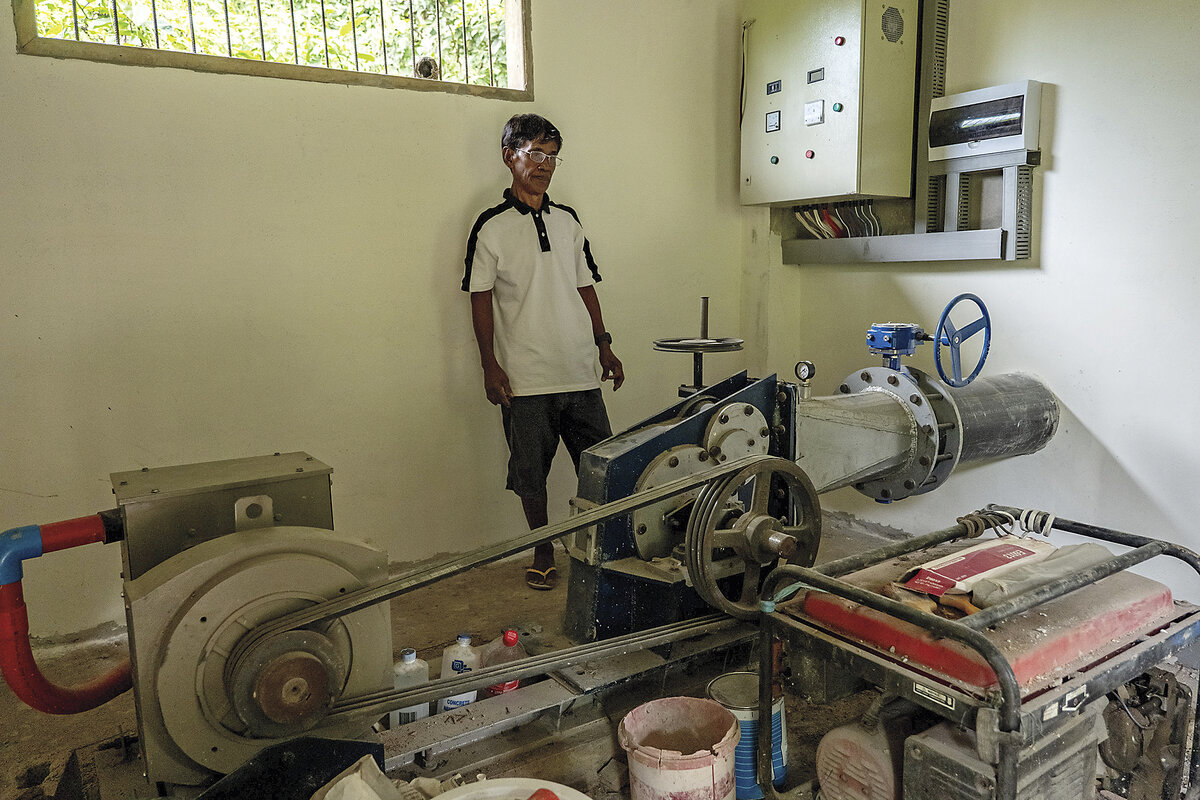
Nabuangan’s first micro-hydro system – a simple, streamside structure – began operating in 2002. Water is diverted into a narrow intake and collected in a small reservoir. From there, it flows quietly through a long pipe that slopes downhill. Gravity creates enough water pressure to spin a small turbine inside a concrete enclosure. Power lines carry the electricity to homes across the village.
Over time, the system has expanded to two other villages in the area, Bubog and Sitio Simud. A fourth facility is under construction to provide electricity to Sitio Lapat, and is expected to be operational within a few months.
Together, these water-powered energy stations form a small but stable network.
“If other villages want a micro-hydro, we will teach them,” says Mr. Sagban. “We will teach them how to manage it because management is what’s important.”
Community members contribute labor to build and maintain the local systems. Decisions are made collectively. The forest that feeds the river is protected, because it is essential to the system’s survival.
Mark Saludes
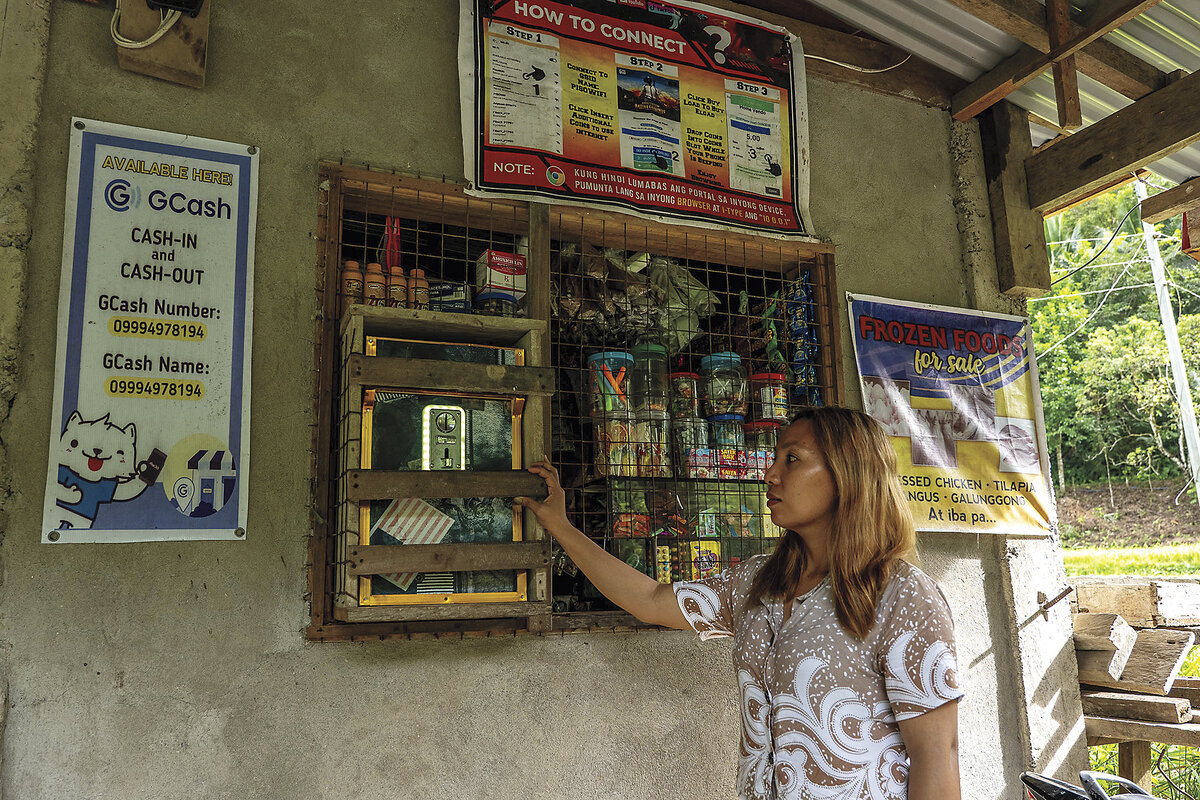
Faith Joy Bonifacio, a resident of Sitio Lapat who has worked overseas as a contractor, runs a small internet hub powered by the village’s micro-hydro system and solar panels. The setup allows locals to charge personal devices, access all kinds of information, and stay connected without leaving the village.
“We don’t have a mobile signal here,” she says. In the past, “we had to climb mountains just to send a message.”
Reliable electricity also extends working hours, supports small businesses, and improves access to education. The changes have been gradual and they make a real difference. But they would not have been possible without a commitment from the community.
“Unity among the people is very important,” Mr. Sagban says. “Without it, these projects would not have been possible.”
Rethinking energy from the ground up
The experience of Nabuangan is part of a broader shift in how energy is being reimagined in the Philippines.
“Given the Philippines’ heavy dependence on imported oil, the current Middle East crisis is a stark reminder of how exposed the country is to global price shocks,” says Gerry Arances, executive director of the Center for Energy, Ecology, and Development (CEED).
“Every disruption in supply quickly ripples through the economy,” he adds.
That exposure is intensified by geography. In the Philippines, an archipelago of more than 7,600 islands, extending centralized infrastructure remains costly and complex. And many communities are still underserved or dependent on expensive, fossil-fuel-based power generation.
Mr. Arances says decentralization is one part of a practical response to the current uncertainty in global energy markets.
“This does not mean dismantling the national grid, which remains essential for large industries and urban economies that require high-capacity power,” he says. “But for much of the country, especially remote and underserved communities, decentralized and community-managed systems can serve as a strong complement.”
By producing electricity closer to where it is consumed, distributed renewable systems can also reduce transmission costs. In 2024, CEED, together with Caritas Philippines, launched a project to install solar panels on 10 million rooftops, urging public and private institutions to expand distributed renewable energy systems. This sort of approach, Mr. Arances says, is worth investing in.
The system in Nabuangan is modest, but resilient. Unlike with larger national power grids, a failure in one turbine does not collapse the entire network. Local management means repairs can be made without waiting for outside assistance.
Local renewable energy systems are the “just transition that we want,” says Ms. Carling, the Indigenous rights activist, adding that they create “a power system that centers people, not profit.”
Search
RECENT PRESS RELEASES
Related Post