Industries To Get Integrated Environmental Consents As Centre Revamps Air And Water Approv
January 28, 2026
Business
Swarajya Staff
Jan 28, 2026 | Updated 04:06 PM GMT+5:30
The government today (28 January) announced that it has amended Uniform Consent Guidelines under the Air (Prevention and Control of Pollution) Act, 1981 and the Water (Prevention and Control of Pollution) Act, 1974 to streamline approvals for industries across states and union territories.
The amendments, building on guidelines issued last year, aim to reduce procedural delays while strengthening environmental governance through uniform national standards for Consent to Establish and Consent to Operate.
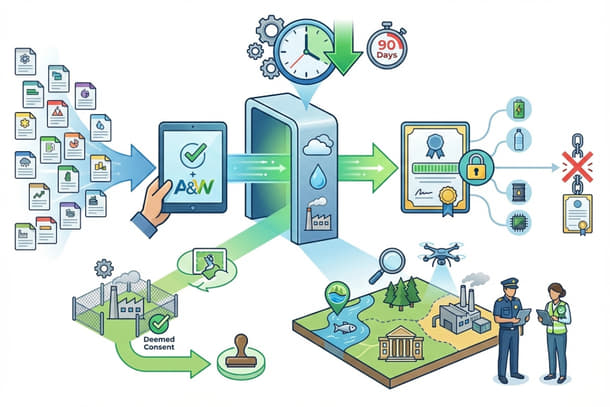
A major reform introduced consolidated consent and authorisation, enabling industries to apply through a single window for approvals under both Acts along with authorisations required under various Waste Management Rules.
State Pollution Control Boards can now process common applications and issue integrated permissions, reducing multiple applications and shortening timelines whilst retaining stringent monitoring provisions.
The amended framework specifies that Consent to Operate, once granted, will remain valid until cancelled rather than requiring periodic renewals.
Environmental compliance will be enforced through regular inspections, with consent subject to cancellation for violations.
Processing times for Red Category industries have been reduced from 120 days to 90 days, while Registered Environmental Auditors certified under the Environment Audit Rules, 2025 can now conduct site visits alongside SPCB officers.
Special provisions grant Micro and Small Enterprises located in notified industrial estates deemed Consent to Establish upon submission of self-certified applications, as environmental suitability of such land has been pre-assessed.
The amendments also replace rigid minimum-distance siting criteria with site-specific environmental assessments, allowing authorities to impose safeguards based on proximity to water bodies, settlements, monuments and ecologically sensitive areas.
States and union territories can prescribe one-time Consent to Operate fees for periods ranging from five to 25 years, reducing repetitive fee collection and administrative processing.
A uniform definition of capital investment has been introduced to remove ambiguity in fee calculations.
According to the Centre, the amendments retain safeguards for refusal or cancellation of consent in cases of non-compliance with standards, violations of consent conditions, environmental damage, or location in prohibited areas.

Get Swarajya in your inbox.
Magazine

Politics

The Adani-Ambani Debate Is Asking the Wrong Question
Maitreyaei Upadhyay and Krishna Kant Jain
4d
Rajasthan’s Disturbed Areas Bill Is Necessary, But Not Sufficient To Address Demographic Anxieties
Swarajya Staff
5d
Economy

27 FTAs In One: India-EU FTA
Chetan Aggarwal
8h
From SEZ To ODOP: Is India Following China’s Path To Development?
Rohit Shinde
8d
Defence

India’s Hypersonic Strike Capability Steps Out Of The Shadows
Swarajya Staff
4d
IAF Has Only Itself To Blame For Its 20-Year-Long Tanker Crisis
Swarajya Staff
3d
World
West’s Confession Of A ‘Lie’ And Trump’s Vandalism Open An Accidental Window For India
Anmol N Jain
1d
AT LEISURE | What Keeps India’s Former RAW Chief Awake At Night?
Anmol N Jain, Diksha Yadav, and Prakhar Gupta
1d
Culture

The Voice Of Saivite Temples: Othuvar Tiruttani Swaminathan’s Sacred Journey
K Balakumar
2d
Manikarnika’s Makeover: Does Our God Deserve To Exist In Dirt And Filth?
Diksha Yadav
4d
Search
RECENT PRESS RELEASES
Related Post