Inflation Just Soared at the Fastest Pace Since 2023, and It Could Spell Trouble for Stock
May 25, 2026
Last week, Kevin Warsh was sworn in as the new chairman of the U.S. Federal Reserve. He served on the Fed’s Board of Governors from 2006 to 2011, and he also spent several years on Wall Street. He will need every bit of that experience in his new role, because the U.S. economy might be facing another inflation crisis.
One of the Fed’s primary objectives is to keep the Consumer Price Index (CPI) measure of inflation increasing at a rate of around 2% per year. However, because of the recent surge in oil prices caused by the ongoing war in Iran, the CPI just increased at the fastest pace in three years.
As a result, Warsh might have to oversee at least one interest rate increase later this year, which could be bad news for the S&P 500 (^GSPC +0.37%) stock market index.

Image source: Getty Images.
The Fed might have to reverse some of its recent interest rate cuts
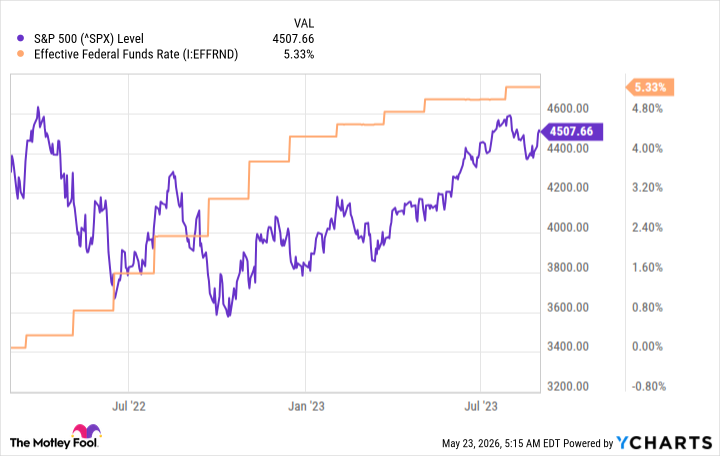
The CPI hit a 40-year high of 8% in 2022, which prompted the Fed to embark on one of the most aggressive campaigns in its history to raise the federal funds rate (the benchmark overnight interest rate). Over an 18-month period between March 2022 and August 2023, the central bank raised the effective rate from a historic low of 0.1% to 5.3%.
The policy seemed to work, because inflation settled at an annualized rate of around 2.9% in 2024, which allowed policymakers to start cutting rates in September of that year. There have been six cuts since then, but that progress is now at risk.
The ongoing war between the U.S. and Iran, which started in February this year, triggered a sharp spike in oil prices. A barrel of West Texas Intermediate crude currently trades for around $97, marking a 68% increase since the beginning of 2026. It’s driving up the price of every product that travels by boat, plane, or truck, so consumers aren’t just feeling the pinch at the gas pump, but also at the grocery store and at their favorite retailers.
The pain is starting to show up in the inflation data. The CPI rose at an annualized rate of 3.8% in April, which was the highest reading since May 2023 — but it could get even worse.
The Producer Price Index (PPI), which measures the year-over-year change in the price of input costs for businesses, rose at an annualized rate of 6% in April. The energy component of the index surged by 22.7%, which lays bare the impact of higher oil prices. Businesses often pass higher input costs on to consumers, so a rising PPI is an early warning sign of an inflation surge.
According to the CME Group‘s FedWatch tool, which tracks the probability of interest rate moves by analyzing the 30-Day Fed Funds futures market, Wall Street is now pricing in a 68% chance of an interest rate increase by the end of 2026.
Rising interest rates are bad news for the stock market
The S&P 500 produced practically no return during the Fed’s 18-month campaign to raise interest rates in 2022 and 2023. In fact, inside that window, the index fell by more than 20% which constituted a technical bear market.
Higher interest rates force consumers to allocate a bigger chunk of their budgets to debt repayments, leaving them with less money to spend on goods and services. Plus, higher rates increase the cost of credit for businesses, which eats into their profit margins. These are direct headwinds for corporate earnings, which typically determine stock prices.
Since interest rates were coming off a historic low when the Fed kicked off its last round of increases in 2022, the overall magnitude of the upcoming increases, if they do happen, will almost certainly be much smaller. Therefore, the impact on the stock market probably won’t be as severe, which is a silver lining for investors.
However, many oil producers in the Middle East have shut down production because Iran continues to disrupt commercial shipping lanes in the Strait of Hormuz, through which 25% of global seaborne oil supply transits each day. According to the International Energy Agency, it could take several months for all of that production to come back online, even if the U.S. and Iran were to reach a long-term peace deal today.
That means we probably haven’t seen the worst of the recent inflation spike, which will keep the pressure on Warsh and his colleagues to raise interest rates into the end of 2026.
Search
RECENT PRESS RELEASES
Related Post