Interstellar comet 3I/ATLAS born in a cold environment
April 26, 2026
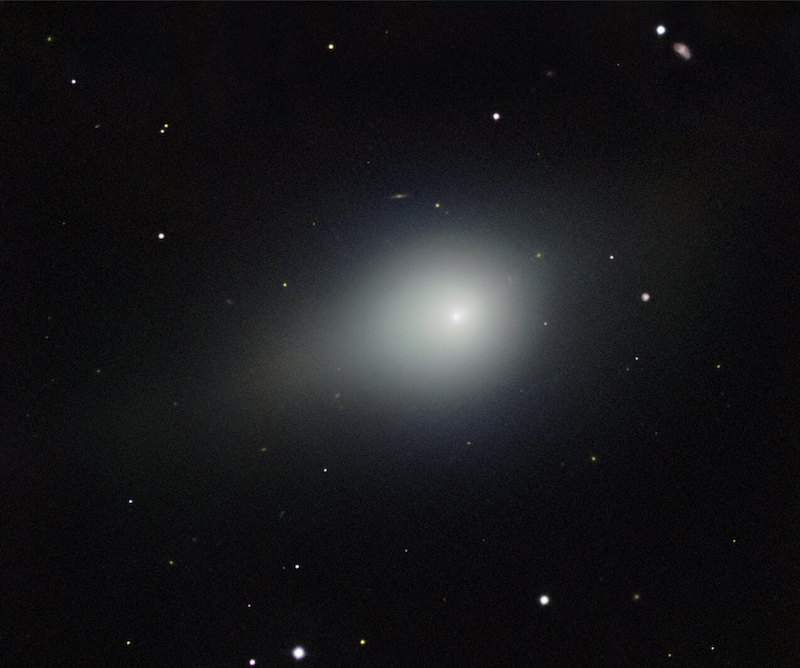
- Interstellar comet 3I/ATLAS is only the 3rd interstellar object known. It came from another star system.
- So astronomers are eager to learn more. And recently they learned it contains 30 times more water with a different chemical makeup than in our solar system’s comets.
- This finding is clue to where 3I/ATLAS formed. It suggests its home star formed in a much colder environment than the one that created our sun.
Comet 3I/ATLAS is raising new questions about star formation
Astronomers first spied this object in July 2025, at about three times Mars’ distance from our sun. And, once they had tracked its path through space, they knew it originated in another star system. 3I/ATLAS, as it’s come to be called, is only the 3rd such interstellar object known. We don’t know where or how it escaped that distant star system in order to pass through our solar system. But astronomers said this month they have new clues about its past. They said it formed in an environment much colder than the one that created our sun and planets.
Radio telescope observations detected high levels of water containing deuterium – an isotope of hydrogen – in the comet. That’s often called “heavy water.” And it’s a sign of cold conditions in the star-forming molecular cloud that birthed 3I/ATLAS’ star. It’s colder than conditions that formed our sun. This is an intriguing finding because it shows that star formation can occur under different physical and chemical conditions than those that created our solar system.
Luis Salazar Manzano is the lead author of a paper on this study. He said, in a statement:
Our new observations show that the conditions that led to the formation of our solar system are much different from how planetary systems evolved in different parts of our galaxy.

The researchers published their findings in the peer-reviewed journal Nature Astronomy on April 23, 2026.
Comets are icy leftovers from planetary formation
Astronomers sometimes refer to comets as “dirty snowballs” because they contain a lot of water. They’re icy remnants from the formation of our solar system, 4.6 billion years ago. Therefore, comets contain a record of the early conditions from which our sun and planets emerged.
Comets in our solar system come from distant reservoirs of icy objects called the Kuiper Belt and Oort Cloud. Sometimes, gravitational perturbations jostle some of these objects from their stable orbits. As a result, they fall into highly elliptical orbits that bring them close to the sun. Near the sun, sunlight heats these objects causing the release of gas and dust that form a tail.
Interstellar visitors
Astronomers know of three objects that are interstellar visitors. Besides 3I/ATLAS, the only other known interstellar comet is 2I/Borisov, that appeared in 2019. And there’s 1I/Oumuamua, not a comet but a cigar-shaped object that passed through in 2017.
3I/ATLAS and 2I/Borisov most likely formed in the far outskirts of their home systems, just like comets in our solar system. Therefore, they too contain a record of the early environment that formed their stellar systems.
3I/ATLAS has a high abundance of water containing deuterium
Water, chemically called H20, is made of two hydrogen atoms and one oxygen atom. Hydrogen, which formed shortly after the Big Bang, has one proton in its nucleus. However, the Big Bang also created another type of hydrogen, but in much smaller quantities. It’s called deuterium, and it has one neutron and one proton in its nucleus.
Most water on Earth contains hydrogen but there is a small amount of naturally occurring water containing deuterium, called deuterated water or heavy water. (Its chemical name is HDO, one atom each of hydrogen, deuterium, and oxygen.)
When astronomers looked at 3I/ATLAS with radio telescopes, they discovered, to their surprise, that it had a lot more deuterated water compared to comets in our solar system.
Salazar Manzano commented:
The amount of deuterium with respect to ordinary hydrogen in water is higher than anything we’ve seen before in other planetary systems and planetary comets.
Comets in our solar system have one molecule of deuterated water for every 10,000 molecules of ordinary water. However, in 3I/ATLAS, that ratio was 30 times higher. And compared to water in our oceans, that ratio was 40 times higher.
Star formation under different conditions
Molecular clouds are where stars form. There is a higher ratio of deuterium to hydrogen in cold molecular clouds, compared to the ratio created in the Big Bang. That’s due to a complex series of chemical reactions.
Molecules containing deuterium instead of hydrogen are more stable at low temperatures. So when molecular interactions replace hydrogen with deuterium in water molecules, that’s called “deuterated.” Those water molecules sticking to dust grains form deuterated ice, which is more likely to last in a colder environment.
This new study shows that conditions under which stars are created can vary. In 3I/ATLAS, the higher ratio of deuterated water suggests that the environment where its star formed was colder and had lower levels of radiation, compared to the environment in which our sun was born.
Salazar Manzano said:
The chemical processes that lead to the enhancement of deuterated water are really sensitive to temperature and usually require environments colder than about 30 Kelvin, or about minus 406 degrees Fahrenheit.
Radio telescope observations of 3I/ATLAS
For this study of 3I/ATLAS, the researchers used radio telescopes at the Atacama Large Millimeter/submillimeter Array (ALMA) in Chile.
The radio telescopes detected the distinct signature of deuterated water in the comet. But the telescopes could not directly detect ordinary water. Therefore, the researchers used a mathematical model to determine the amount of ordinary water present based on methanol measurements.
They observed the comet on November 4, 2025, just six days after its closest approach to the sun. Teresa Paneque Carreño, a paper co-author, noted:
Most instruments can’t point toward the sun, but radio telescopes like ALMA can. We were able to observe the comet within days after perihelion, just as it peeked out from its transit behind the sun. This gave us a constraint on these molecules that’s not possible using other instruments.

She also added:
Each interstellar comet brings a little bit of its history, its fossils, from elsewhere. We don’t know exactly where, but with instruments like ALMA we can begin to understand the conditions of that place and compare them to our own.
Bottom line: The chemistry of water in interstellar comet 3I/ATLAS indicates that its home star formed in colder conditions compared to that of our sun.
Source: Water D/H in 3I/ATLAS as a probe of formation conditions in another planetary system
Via Atacama Large Millimeter/submillimeter Array (ALMA)
Read more:
5 insights on interstellar comet 3I/ATLAS from ESA’s Juice mission
Surprise! Interstellar comet 3I/ATLAS bursting with alcohol
Is the 3rd interstellar visitor – 3I/ATLAS – an alien probe?
Search
RECENT PRESS RELEASES
Related Post

![Electric haul trucks could save Fortescue over $400 million in fuel per year [update]](https://stockwatchindex.com/wp-content/uploads/2026/04/liebherr-t264-PVnOOS-500x383.jpg)