Is Amazon (AMZN) a Buy, Sell, or Hold in 2026?
December 4, 2025
Key Points
-
Amazon’s stock underperformed the S&P 500 and Nasdaq 100 in 2025, gaining just 6.8% compared to their double-digit returns.
-
The company plans to spend more than $125 billion on capital expenses in 2026, with further increases expected in the following years.
-
The stock remains a hold for most investors, with dollar-cost averaging the safest strategy for riding out the AI investment cycle.
- 10 stocks we like better than Amazon ›
Amazon (NASDAQ: AMZN) didn’t exactly knock it out of the park in 2025. As I write this on Dec. 2, the e-commerce giant’s stock has gained just 6.8% since the last round of fireworks and “Auld Lang Syne.” Meanwhile, the S&P 500 (SNPINDEX: ^GSPC) index gained 16.1%, and the Nasdaq-100 portfolio raced ahead with a 21.6% jump.
Can Amazon turn it around next year, or will 2026 be another disappointing period for its investors?
Where to invest $1,000 right now? Our analyst team just revealed what they believe are the 10 best stocks to buy right now, when you join Stock Advisor. See the stocks »
The good, the bad, and the pricey
First, let’s check out the market footprint. By the end of 2024, Amazon carried a $2.32 trillion market cap and lofty valuation ratios. Those figures have changed dramatically in 2025 and not all for the better:
|
Amazon Metric |
12/31/2024 |
12/2/2025 |
|---|---|---|
|
Market capitalization |
$2.32 trillion |
$2.50 trillion |
|
TTM Price-to-Earnings ratio (P/E) |
39.7 |
33.1 |
|
TTM Price-to-Sales ratio (P/S) |
3.7 |
3.7 |
|
TTM Price-to-Free-Cash-Flow ratio (P/FCF) |
71.5 |
239.6 |
Data collected from YCharts on Dec. 2, 2025. TTM = trailing twelve months.
Amazon’s stock price rose about as quickly as its total sales, so the P/S ratio didn’t change much. But the P/E ratio inched lower, and the cash-flow-based ratio skyrocketed. That’s an unfortunate side effect of Amazon’s plunging cash flows.
The AI spending spree behind Amazon’s cash crunch
The business itself is humming right along. Amazon’s overall sales rose 11.9% year-over-year in the third quarter of 2025. Amazon Web Services (AWS) led the charge with an 18.2% sales jump. But AWS also raised its operating expenses by 21%, while the two e-commerce divisions hovered near the 10% level. And Amazon is investing a ton of money in the AWS segment.
You see, large AWS clients are ready to pay a premium for as much artificial intelligence (AI) processing power as possible. Over the last four quarters, Amazon spent $120 billion on purchases of property and equipment, also known as capital expenses (capex). That’s up from $69.8 billion in the comparable year-ago period.
And it’s no secret where the cash is going. On the Q3 2025 earnings call, Amazon CFO Brian Olsavsky explained that the heavy cash investment supported AWS’ AI computing capacity and basic infrastructure. Capex is expected to hit $125 billion in fiscal year 2025, followed by further increases in 2026 and beyond.
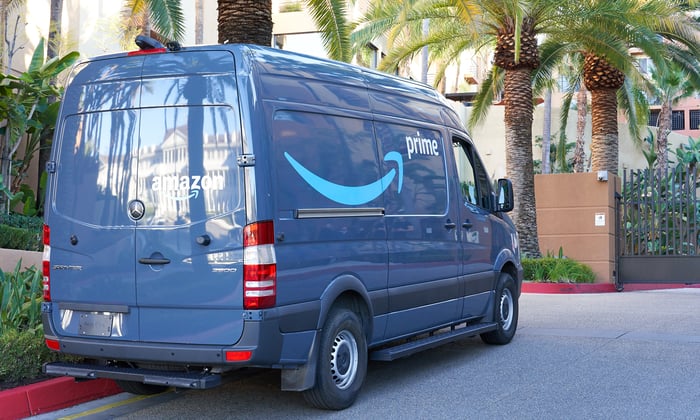
Image source: Amazon.
The trillion-dollar question: Is AI worth it?
No surprises, right? Like most of its peers in the Magnificent Seven group of tech giants, Amazon is leaning into the AI boom with verve and enthusiasm. Cash expenses are way up, but so are Amazon’s AWS revenues. The empire that Jeff Bezos built is setting up the computing infrastructure of a long-term winner in the cloud-based AI computing space.
The company might be overspending on AI hardware today, but will it be worth the effort by 2030 or perhaps 2035? Only time will tell, and it will certainly take years to make up for the beefy cash expenses with AI-driven profit gains. Again, Amazon can’t win the AI game if it doesn’t play.
It’s not cheap, but those are the table stakes to stay competitive in this AI-hungry economy.
Your Amazon investing playbook for 2026
The same trends will probably remain relevant in 2026. Amazon will spend more than $125 billion on capex with a heavy focus on AI number-crunching capacity. Investors will watch this effort closely, basing the stock’s daily market price on Amazon’s success in the AI business.
Amazon’s valuation multiples will vary as Wall Street adjusts to the latest twists and turns of the American economy. On a good day, when Federal interest rates are going down and consumer spending is up, Amazon will add to its lofty P/E and P/FCF ratios. In a more bearish market mood, Amazon investors are likely to lower the share price as they go looking for low-risk safe havens instead.
Your move: Making sense of Amazon’s volatility
There are too many variables in this equation to figure out a likely price target or shareholder return for Amazon across 2026. But I can promise that the stock will be volatile again. Shrewd investors should keep an eye out for sudden price drops before buying Amazon stock next year.
The rest of us can simply keep adding to our existing positions as usual, trusting that Amazon’s stock chart should match its financial success in the long run. That’s how it got to this multitrillion-dollar plateau in the first place. Dollar-cost averaging is often the right move when your favorite stock is jumping around like a cat on a hot tin roof.
Should you invest $1,000 in Amazon right now?
Before you buy stock in Amazon, consider this:
The Motley Fool Stock Advisor analyst team just identified what they believe are the 10 best stocks for investors to buy now… and Amazon wasn’t one of them. The 10 stocks that made the cut could produce monster returns in the coming years.
Consider when Netflix made this list on December 17, 2004… if you invested $1,000 at the time of our recommendation, you’d have $560,649!* Or when Nvidia made this list on April 15, 2005… if you invested $1,000 at the time of our recommendation, you’d have $1,100,862!*
Now, it’s worth noting Stock Advisor’s total average return is 999% — a market-crushing outperformance compared to 194% for the S&P 500. Don’t miss out on the latest top 10 list, available when you join Stock Advisor.
*Stock Advisor returns as of December 1, 2025
Anders Bylund has positions in Amazon. The Motley Fool has positions in and recommends Amazon. The Motley Fool has a disclosure policy.
The views and opinions expressed herein are the views and opinions of the author and do not necessarily reflect those of Nasdaq, Inc.
Search
RECENT PRESS RELEASES
Related Post