Is America Suffering from the “Resource Curse”?
March 29, 2026
Why the U.S. is the “last big petrostate” and why that’s bad for everyone
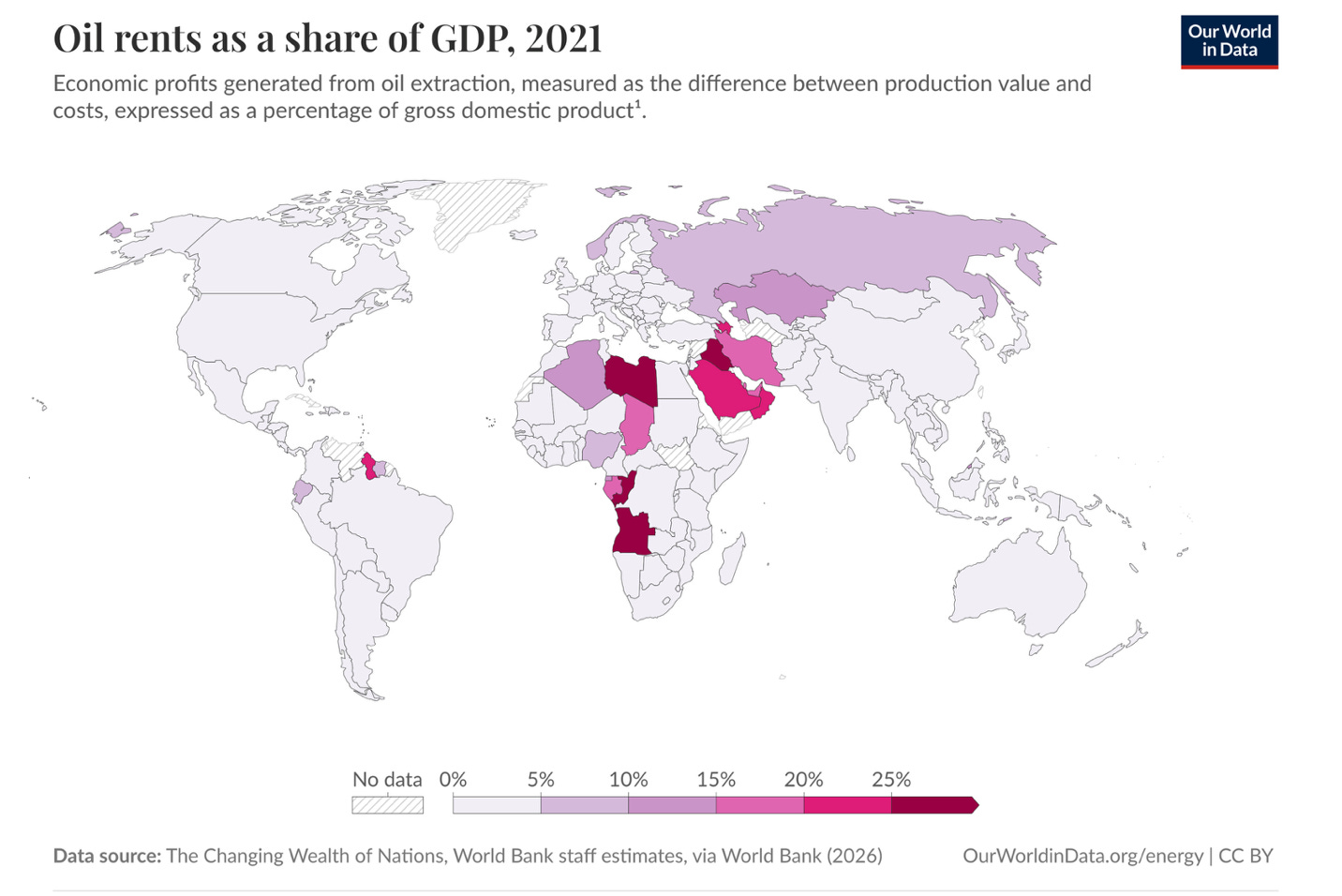
Oil rents are the difference between the value of oil produced and the cost of producing it
Kuwait, Saudi Arabia and the United Arab Emirates are petrostates — nations whose economies are driven by oil and gas. As a result, their politics are deeply shaped by their natural resource wealth. Iran is also a petrostate despite the fact that it exports significant quantities of manufactured goods. It’s a petrostate nonetheless because most of these are goods that make use of its oil and gas, like fertilizers and petrochemicals. The main exception has been Iran’s growing exports of military hardware, especially missiles and drones.
Russia is also widely considered a petrostate: John McCain famously called it “a gas station masquerading as a country,” although Matt Klein argues that this overstates the case. And critics of the Trump administration often accuse it of trying to convert the U.S. into a petrostate, at an especially inopportune moment. In my recent conversation with David Roberts, he declared that
the US is basically aligning itself as the last big petrostate. We’re going to go down with the fossil fuel ship, and China is aligning itself as the first electrostate.
Last month Rana Faroohar of the Financial Times basically said the same thing.
At this moment in history critiques of economic reliance on fossil fuels often focus on changing energy technology. At a time of rapid progress in renewable energy and general economic electrification, many argue, as Roberts does, that clinging to fossil fuels means missing the boat.
However, warnings that reliance on oil or other natural resources can be a trap have been prominent in economic discourse for decades. They were widespread long before the current renewable energy revolution began and were largely separate from concerns about the environment. The term resource curse, coined by Richard Auty in 1993, refers to a familiar though controversial proposition in development economics. It says that nations rich in natural resources, especially minerals including oil, tend to do worse in the long run than resource-poor nations. As we will see, the resource curse proposition claims that countries with economies heavily tilted towards natural resource extraction are afflicted by a tendency towards backwardness compared to countries less dependent on natural resource extraction.
Historically, most discussion of the resource curse has been concerned with small or poor nations. At this point, however, many are arguing that the United States faces some of the same issues and that our success in extracting oil and gas is actually hurting us. What’s the source of these arguments and how reasonable are they?
Beyond the paywall I will address the following:
1. The economic consequences of natural resource abundance
2. The political economy of resource wealth
3. The United States as a resource-curse nation
Search
RECENT PRESS RELEASES
Related Post