Is Finance Technology? How Founders Can Avoid the Mistakes That Kill Fintech Companies
April 1, 2026
This article is part of Fintech Leaders, a newsletter with 90,000+ builders, entrepreneurs, investors, regulators, and students of financial services. I invite you to share and sign up. If you enjoy this conversation, please consider leaving a review on Apple, Spotify, or Youtube.
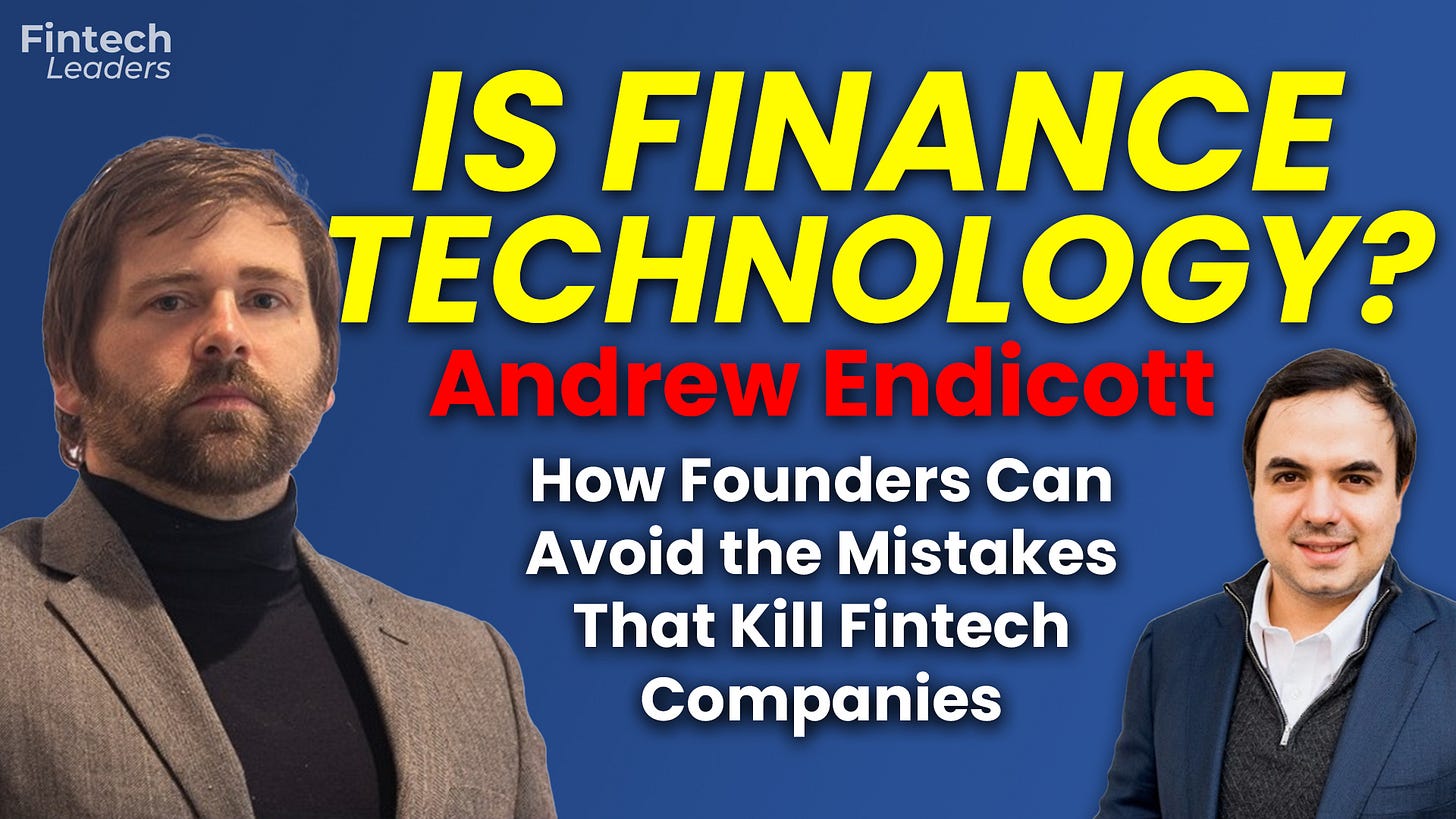
I sat down with Andrew Endicott, fintech entrepreneur and my co-founder at Gilgamesh Ventures. Andrew just published a great book on fintech: “Is Finance Technology?”, a practical guide for founders, operators, and investors in financial services. The book covers everything. From the common mistakes that kill fintech companies, to how to think about risk, fraud, and regulation across verticals. I highly recommend picking up a copy.
Few people have operated across as many roles and verticals as Andrew has. Having been a financial services lawyer, investment banker, entrepreneur, board member, and now investor, this book reflects that breadth.


Bridging Two Camps That Don’t Understand Each Other
Andrew’s career has been a deliberate split between two worlds that rarely talk to each other. He was a lawyer, then an investment banker on Wall Street, then an entrepreneur as co-founder of Petal and Gilgamesh Ventures where he invests in fintech companies. He also sits on the board of a bank and an insurance company. He has spent real time in both camps, the traditional finance world and the technology world, and one of his biggest takeaways is how dramatically different each camp’s worldviews are. The finance people see risk everywhere and move cautiously. The technology people see opportunity everywhere and move fast. Both are right, and, in fintech, both are dangerously incomplete without the other.
The book was born from that gap. Andrew has watched founders start fintech companies without understanding the structural features of the industry they were entering: risk, regulation, the peculiar economics of lending and insurance, the way that things that look good in other industries (like fast growth) can actually be destructive in many areas of fintech.
There is also a personal dimension behind the writing of this book. It taught him something about how he sees the world. His background is what he calls a mishmash: Southern US roots, Harvard law school, Wall Street, entrepreneurship, venture capital. That mishmash produced a specific lens for understanding fintech, one that he believes is genuinely different from how most people approach the topic. The book is not a how-to guide or a history textbook. It is a framework for operating in financial services that draws on both lived experience and a broader historical perspective.
Fast Growth Can Be a Weed: The Pitfalls Fintech Founders Miss
Andrew wrote his book in part because he saw investors and founders making the same avoidable mistakes over and over again, mistakes that are specific to financial services and that do not get enough attention. The first and biggest: mistaking fast growth for a sign of health. In most industries, fast growth is unambiguously good. In fintech, it can be a weed. Growth in lending, payments, deposits, and insurance can be fueled by all kinds of things that are not good, things that can be devastating in the short run or the long run. The numbers look great until they don’t, and by then it is often too late.
-
A lending company can grow quickly by underpricing risk.
-
A payments company can grow by ignoring fraud.
-
An insurance company can grow by under-reserving.
The second pitfall is underestimating fraud and adverse selection. Fraud pervades almost every area of fintech: payments, deposits, credit, insurance. Andrew has direct experience from his time at Petal, where synthetic fraud was a growing threat in the late 2010s, pre-COVID. He describes sleepless nights, not from carelessness but from the sheer difficulty of staying ahead of sophisticated bad actors. The people who commit fraud are intelligent, well-resourced, and spend all day thinking about how to exploit weaknesses. As an operator, you spend a portion of your day on fraud while they spend all of theirs.
The third pitfall Andrew calls it the silent killer, and it’s choosing the wrong partners. The platforms, banks, and service providers you build on top of can either scale with you or prevent you from scaling, for contractual, operational, or capability reasons. He uses the three little pigs metaphor from his book: you need to build your house out of bricks, not straw. Bad partnerships rarely make the news, but they show up constantly in the data. Companies that get out of the gate well and then plateau sideways, often it is because they hit a ceiling imposed by a partner that simply cannot grow with them. The wheels eventually fall off and it’s not built to last.
The Banking License Question: The Answer Depends on When You Ask It
The regulatory window for fintechs to obtain banking licenses is more open today than it has been in decades in the US. Under previous administrations, new bank charters were vanishingly rare, and the Industrial Bank model in Utah, which is particularly important to fintech, was essentially shut off. That has changed. There is now a genuine openness to new entrants, driven largely by political shifts. Andrew shared that when he wrote this section of his book, his opinion that many fintechs should pursue bank charters was in the minority. Now, it seems like every week another fintech announces it is pursuing a charter, both publicly and privately.
Andrew’s framework for whether a fintech should pursue a banking license is straightforward. If your business involves lending, the logic is clear. For the first many years of their existence, most fintech lenders fund their loan portfolios through bank credit lines, private credit, or securitizations, all of which are expensive. You end up with a large book of loans but limited profit. Once you become a bank, you can take deposits, which is a fundamentally cheaper form of funding, and use those deposits to make loans. You can change your margins overnight. That is the core economic argument, but there is a significant trade-off. Once you become a bank, you are regulated directly and comprehensively. Before becoming a bank, regulation is pushed down to you through your banking partners. It is still burdensome, but it is mediated. Direct regulation changes your operations, your leadership and headcount requirements, and your strategic flexibility.
There is also the valuation question. Banks are valued at multiples of book value, typically in the low single digits, while tech companies are valued on revenue or profitability multiples. A VC-backed company making that transition is implicitly telling the market it believes it will become so large that the valuation framework no longer matters for early investors. According to Andrew, most fintechs should not become banks overnight. Scale first, then convert to a bank once profitability and margin improvement become the priority. The exception may be companies building as banks from day zero, which is a different model entirely and raises an unanswered question about whether that is truly a venture-backable investment, given the natural constraints on growth and valuation that come with being a regulated bank.
What Changes and What Stays the Same in the Age of AI
The so-called eternal truths of operating in financial services, the things he describes in his book as defining features of the industry, are not really eternal. They do change over time, and new capabilities can alter or eliminate them entirely. The structural features remain, but how you manage them is evolving in real time.
Generative AI is the clearest example. Take, for example, KYC. It’s one of the biggest stumbling blocks for fintech companies and it requires collecting the right information from customers. That process was painful, requiring customers to type in or otherwise deliver large amounts of personal and financial data. AI agents can now pre-populate forms, reduce friction, and in some cases nearly circumvent entire steps in the onboarding process. The friction is not gone, but it has changed and mostly been absorbed by AI agents. It is no longer the same bottleneck it was even two or three years ago.
What the best entrepreneurs do, is maintain the context of these structural features, risk, fraud, compliance, the business model quirks of each vertical, while knowing when new technologies create genuine openings to do things differently. Renaud Laplanche is his primary example: someone who understood the big, important aspects of building a financial services company but knew exactly when new technologies allowed him to compete in a fundamentally different way. The structural features of fintech will remain. Risk, fraud, compliance, and the economics of each vertical are not going away. But how founders manage them will change, and that is where the opportunity lives right now.
Book Recommendations
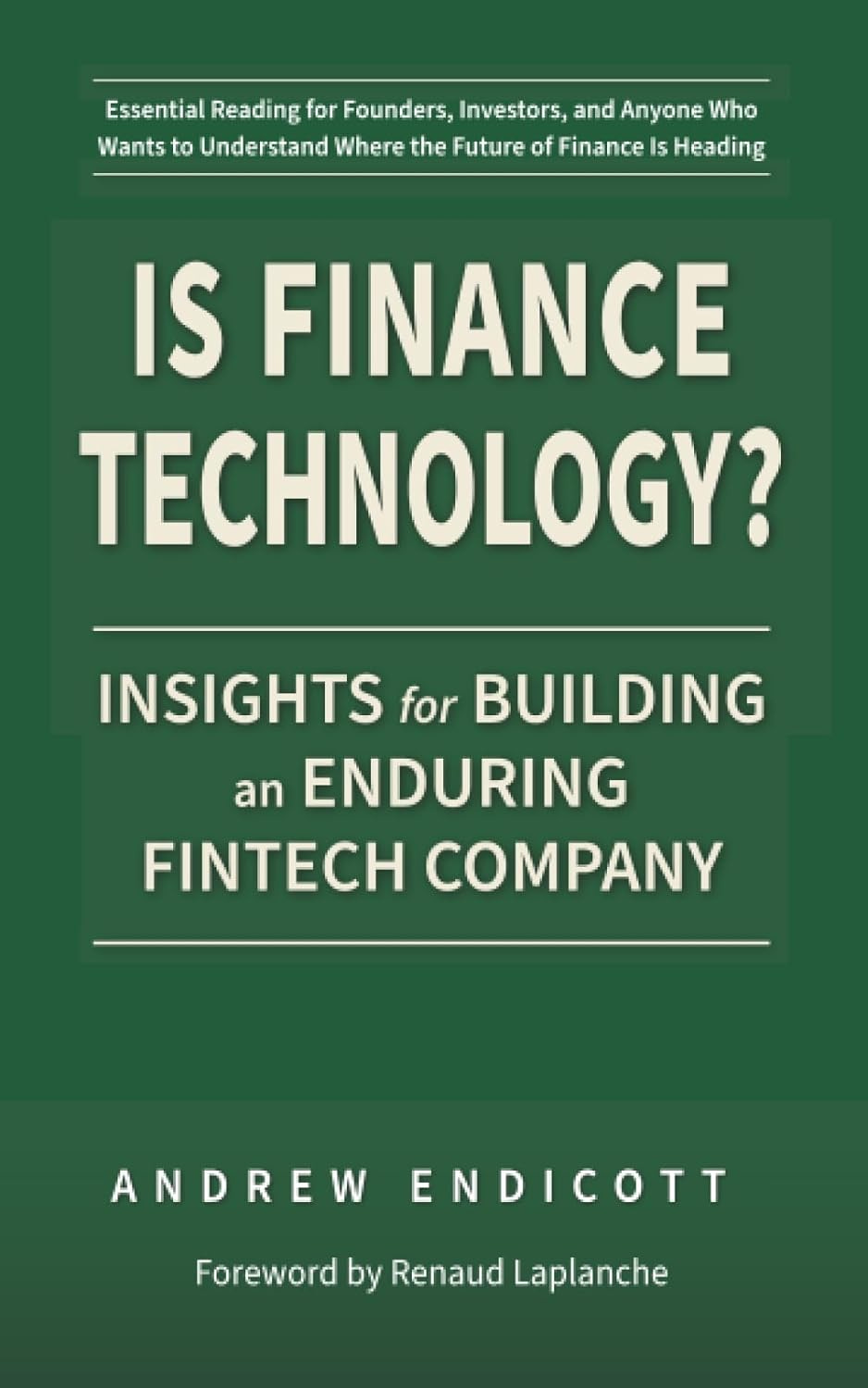
“Is Finance Technology?” by Andrew Endicott, a practical guide for anyone building or investing in financial services. If you are a founder, operator, or investor in this space, this one belongs on your shelf.
The Unfiltered Q&A with Andrew Endicott
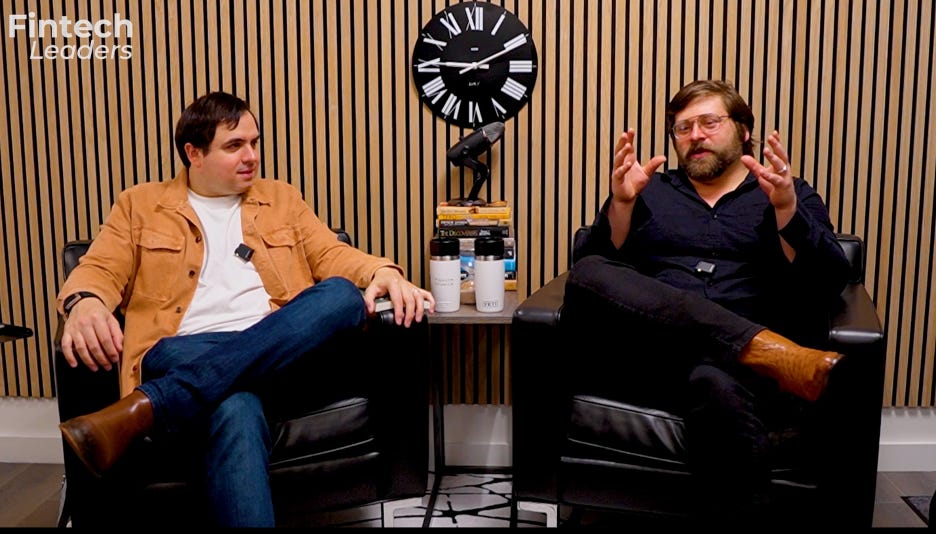
Miguel Armaza: Your book makes the argument that fintech is not a decades-old concept but thousands of years old. Why is that?
Andrew Endicott: When you get down to the entirety of finance, whether you’re looking at banking, insurance, or payments, all of it was at one time really cutting-edge technology. You really can’t have finance without technology. It’s a human creation that amplifies what people are doing in different verticals, whether it’s through writing or accounting or the calculation of interest, which if you go back was extremely cutting edge. The Mesopotamians really are the guys who came up with interest. There’s an ancient Mesopotamian Sumerian tablet that, if you took an investment banking analyst today and looked at it, it truly is a financial model. But instead of using money, it’s using cattle. There’s compounding interest rates, there’s a time value of money with cattle, because currency hadn’t really been invented yet. Lending preceded coinage. What we’re doing today with fintech, and I think in cryptocurrency this is the most obvious example, we’re using the best means we have to make economies function in a better way. Currency did that thousands of years ago when the Lydians developed it. And today the folks with Ethereum, Bitcoin, and Solana are doing the same thing. They created something out of thin air, which was true for coinage a long time ago as well, all in the pursuit of making commerce function more effectively. In the world of fintech, it’s easy to look at what incumbents do today as just the norm. But not very long ago, that was actually quite cutting edge. And what we’re doing today will probably be seen in a similar light.
Miguel Armaza: What were the forcing functions that drove these financial innovations to be invented?
Andrew Endicott: A lot of times it was just a problem. Necessity is the mother of invention. I also like saying the same thing a different way: creativity thrives within constraints. A really good example of a forcing function is the emergence of international trade. If you’re in ancient Greece and you have extra wheat you want to trade with someone in Troy, currency FX markets didn’t exist and there was a lot of risk being taken. So you see the beginnings of insurance in the same period, and also secured finance, what we call asset-based lending. Economic participants create new arrangements using new means. Back then it was writing, which was pretty cutting-edge for most societies. They used this new means to solve a problem: how do I manage the risk? How do I efficiently trade with somebody in a different place who may speak a different language and have different coinage? Today we have a lot of similar problems. In the last decade, there were a lot of people who couldn’t get bank accounts, and we had the creation of businesses to make it easier for a consumer to get one. You have a lot of people who can’t qualify for credit. Likewise, you have the emergence of models to help people qualify for credit. Humans are really good at creating novel ways of solving challenges, and they typically pick up the best tools available to do it.
Miguel Armaza: Why did you write this book?
Andrew Endicott: I’ve spent my career in two very different but related camps. I’ve spent a lot of time in the finance world, worked on Wall Street, worked in M&A, and I’m on the board of a bank as well as an insurance company. And I’ve been deeply involved in the technology side. I co-founded Pedal in the credit card space, and Miguel and I invest in fintech companies. Those two camps really don’t understand each other very well, and the ways they see the world are so dramatically different. Starting a fintech company is very different than doing almost anything else. You have major themes completely absent from other parts of the economy, the biggest one being risk. Regulation is huge too. Those features in finance end up almost turning things upside down when it comes to running a fintech company. Often something you would see as a good thing in any other business is actually a bad thing in finance. Fast growth, for instance. As a venture capitalist, I love fast growth. But if you’re starting a fintech company, you need to think critically about whether fast growth is actually good, because it can be fueled by all kinds of things that are not good in the short or long run. I hadn’t seen a huge amount of writing and thought on this point, probably because fintech, still in the grand scheme of things, is somewhat new. I wanted to contribute that to the discussion.
Miguel Armaza: What are some of the common mistakes you’ve seen early-stage fintech founders make? What are pitfalls that aren’t considered pitfalls in other parts of tech?
Andrew Endicott: The first one is the notion that if it grows like a weed, it might be a weed. Fast growth can be an illusion in terms of being a good thing. Related to that is not giving enough credence to the risks coming from fraud, credit, and adverse selection, which impacts both insurance and credit. Fraud pervades most things: payments, deposits, credit, insurance. Not giving enough credence to those downside possibilities is a big one. The problem is that you often realize it too late. Sometimes you build your business in a way where the foundation is kind of going after that type of customer, that type of risk, which is not the risk you ultimately want. You just don’t know it yet. Companies need to think a lot about who their customer is. Do you really want them? Are you really pricing them correctly given the risk they present? Another big one is a bad foundation, which typically manifests in picking bad partners. People who not only can’t scale with you, but that prevent you from scaling. You need to choose the people and platforms you’re setting your business up upon and make sure it’s a house of bricks, not a house of straw. That’s a silent killer. You’ll have a company that gets out of the gate well, and something just goes sideways after a certain level of scale. Often that’s because they reach a point of friction and conflict, or just incapacity, of the partners they have.
Miguel Armaza: Were there any particular instances where you learned the fraud and risk lesson the hard way?
Andrew Endicott: Anyone who has built a business in the lending space, or really most parts of fintech, probably has a lot of stories that reflect this. On fraud specifically, I definitely have memories of a lot of sleepless nights. In my entrepreneurial journey, synthetic fraud was a pretty big deal in the late teens, pre-COVID. That was relatively cutting edge at the time. We didn’t have great understanding of it, didn’t have controls, didn’t have the tools in place to detect it, and as a result incurred real losses because of it. With fraud in particular, something that is always true: people who commit fraud are quite intelligent. They spend all day thinking about it, whereas you as an operator spend a portion of your day thinking about it. They are definitely finding the best tools, the best technology, the best techniques available to take a slice out of your bank account. These are hard problems to solve, and because of that, they’re also sources of opportunity. Many smart founders now and in the future will build businesses specifically targeting these defining challenges. Fraud is one of them, compliance is another.
Miguel Armaza: You talk about the Four Horsemen of fintech: banking, payments, insurance, and infrastructure. Rank them in order of difficulty to disrupt. And which are the most profitable?
Andrew Endicott: If you look at the last decade, payments has been a really fertile region to build a company. Some of the biggest exits in fintech have been on the payment side. Stripe hasn’t exited yet, but it’s an example. Checkout.com, Bill.com, there are others. People build very big businesses in payments. One of the reasons it’s a good place to build is that there’s a ton of first-mover advantage, a lot of network effects, and a lot of switching costs. People don’t like to change their payment rails once they’re set up. These are some of the reasons why Visa and Mastercard are such highly valued companies. If you look at Stripe, the founders are brilliant, but fundamentally what they were doing for the first decade was enabling credit card payments on the internet. That’s it. They made it easy for a merchant to do that, and that is a huge company today. I also want to touch on infrastructure because it also competes for the best place to build. One of my favorite companies in the world is Bloomberg. They have had an amazing run, an enormously profitable business, dominant position, basically powering Wall Street. But building infrastructure is the opposite of payments. It’s less right place, right time. It’s more about being the right team, having the right network, the right credibility, particularly if it’s enterprise. Insurance is the curious one. The size of the insurance industry is just bafflingly big, and the greatest fortunes on earth arguably come from insurance. Warren Buffett basically built his entire wealth through insurance. But we haven’t seen a whole lot of successes in insurtech. It’s a nut that kind of hasn’t been cracked yet, as far as I’m concerned.
Miguel Armaza: On payments, you say it’s the laziest way to get rich, but only if you’re lucky. What do you mean by that?
Andrew Endicott: That subtitle is meant to be a little controversial and a little smirky. What I’m trying to convey is that first-mover part. The companies that were successful in payments were often not successful because they had a brilliant design for what they wanted to do. They saw an opportunity in the market, built a great mousetrap for it, were the first ones to do it, and then just did a good job running a business thereafter. And they became incredibly huge. It’s not lazy, it’s hard. You’ve got to know what you’re doing to build a payments business. But if you can build it at the right time in the right place, you can build a tremendously large business. Visa was enabling payments not on the internet but just generally with a credit card. If you can build it at the right time and right place, the network effects and switching costs do a lot of the work for you thereafter.
Miguel Armaza: Should fintechs get a banking license?
Andrew Endicott: You have an openness today to opening up the banking system to new entrants, whereas if you go back through the last several administrations, that really hasn’t been the case, particularly starting with Obama. There were vanishingly few bank licenses granted. It was really hard to acquire a bank as well. The Industrial Bank model in Utah was kind of shut off to new entrants. Now you’re really having movement between the two worlds. I think it makes tremendous sense, particularly if your business involves lending. The logic is very straightforward. Fintech companies for the first many years of their existence are having to go to Wall Street, private credit, and securitization to fund their loan portfolios, and that tends to be very expensive. You have a large book of loans but you’re making very little profit off it, which hurts your ability to grow. Once you become a bank, deposits are a much cheaper form of funding. That’s why banks exist. If you can become a bank, you can overnight change your margins. Now there is a disadvantage. Once you’re a bank, you’re regulated directly. Your operation changes, your team is different. You suddenly have someone who, in a way, signs off on what your plan is. So if you’re a fintech starting out, you probably don’t want to become a bank overnight. Most of the time you’re better off getting to a certain level of scale and then converting once you really care about profitability.
Miguel Armaza: When a VC-backed company decides to pursue a banking charter, are they signaling that they expect to become so large that even a two to three times book value multiple will still generate a fantastic return for investors?
Andrew Endicott: Yes, I think that is the bet people are making. You’re going to be so large that it doesn’t matter. Book value is a balance sheet item, the net worth of the company. That’s how banks are valued. Tech companies, including fintech companies, are usually valued off revenue, which doesn’t worry about profitability in nearly the same way. If you’re growing fast, you’re probably going to be unprofitable, so it’s better to be valued off revenue than book value. If you’re doing this later in your lifecycle, you don’t really have to make the argument too aggressively, because you’re probably already big. If you’re starting at day zero and becoming a bank, there’s an unanswered question as to whether that really is a traditional venture-backable investment. Venture capital funds usually need the potential to make many multiples on their money. It’s harder to do that with a bank because you have natural constraints on what a book value multiple is going to value the business at. It’s more mathematical. It’s not just about how many customers you have. It’s about the cumulative accumulation of profits the business has had. I also think part of the reason you’re seeing venture capital dollars make these bets is because venture capital itself is changing. It’s becoming more of a private equity model. The required hurdle rate on an investment is potentially falling. It’s more about deploying large amounts of money and getting a good return, rather than deploying smaller amounts of money and getting great return. We’re going to learn that in the next couple of years.
Miguel Armaza: What do you hope readers will take away after reading the book?
Andrew Endicott: I hope they learn something. That’s why most people read. I learned writing this book that I have a specific way of seeing the world that I haven’t seen in other people approaching this topic. I kind of hope that other people are able to see fintech in a broader landscape of finance, building a future industry that doesn’t exist yet but serving the same needs that have always existed. On a more practical level, I’d like operators, founders, and investors to be more successful. I talk about things in the book that are real issues people forget or don’t take seriously enough, largely because no one with authority or experience tells them to worry about those things. I would love for people, particularly entrepreneurs, to read this book and maybe keep the car on the road a little bit better, and avoid going off in the ditch for ways that are preventable. That’s probably the main thing.
This interview has been edited and condensed for clarity.


Want more podcast episodes? Join me and follow Fintech Leaders today on Apple, Spotify, Youtube or your favorite podcast app for weekly conversations with today’s global leaders that will dominate the 21st century in fintech, business, and beyond.
Don’t forget to subscribe so you don’t miss big conversations and insights with the giants of Fintech.
Previous Episodes You May Enjoy:


Sequoia’s George Robson: An Inside Look at Sequoia and What it Takes to Build Generational Companies

Anré Williams, American Express – From Intern to Bank CEO, a 35-Year Journey at a Global Powerhouse


Nigel Morris, QED and Capital One Co-Founder – Transforming Financial Services for a Billion People

FinTech’s Multi-Billion Comeback: Steve McLaughlin (FT Partners), From Darkest Days to Record Deals
Find us on Youtube:
Miguel Armazais Co-Founder & General Partner ofGilgamesh Ventures, a fintech seed-stage investment fund focused. He also hosts and writes theFintech Leaderspodcast and newsletter.
Search
RECENT PRESS RELEASES
Related Post