It’s Time for New York to Take On Amazon
December 17, 2025
It’s Time for New York to Take On Amazon
Amazon has long evaded unionization of its last-mile delivery drivers by subcontracting them to third-party companies. Legislation introduced by socialist New York City Council member Tiffany Cabán could put an end to that.
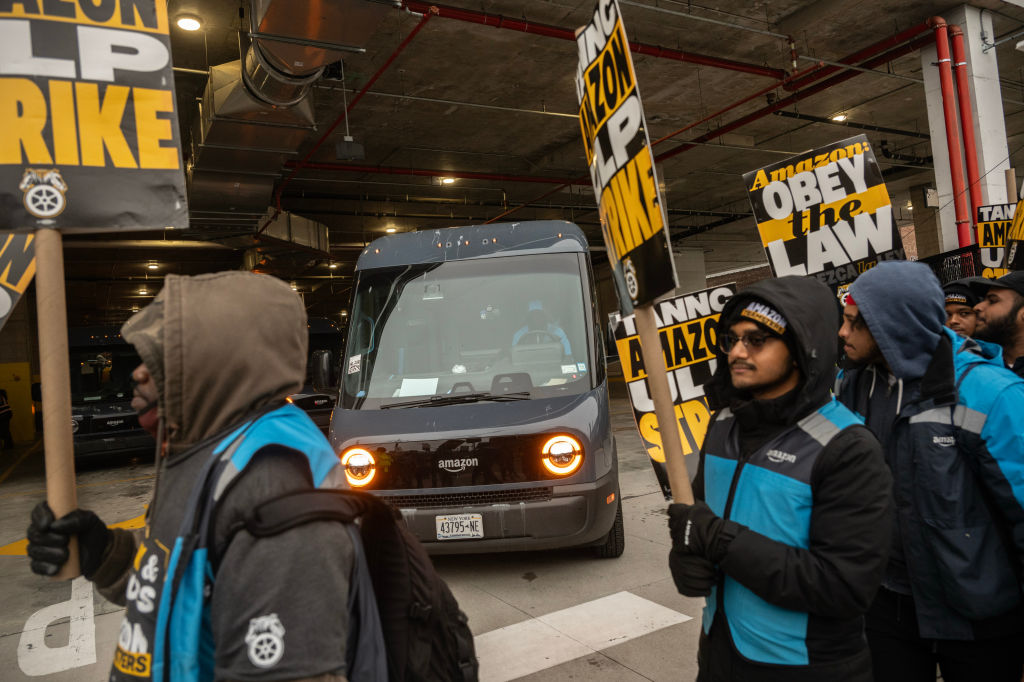
On a rainy day in August of this year, 105 Amazon delivery drivers employed by Cornucopia Logistics, one of the 4,400 delivery service partners (DSPs) with which the e-commerce company contracts, were told that they had worked their final shift. As Cornucopia Logistics representatives explained this to the workers as they returned from their routes, Amazon had decided to cancel its contract with the company.
Drivers at the DSP, one of eight contractors operating out of DBK4, an Amazon facility in Maspeth, Queens, unionized with the International Brotherhood of Teamsters (IBT) a year earlier. In response to Amazon’s failure to voluntarily recognize their union, they went on a multiday strike beginning on December 14, the height of the company’s busy holiday season.
“I believe because of the strike we had last year, that was part of it,” Lamont Hopewell, one of the fired drivers, said at a September rally for the fired drivers as explanation for the firings. “We’re coming into peak season right now, and I believe they wanted to stop any momentum we had.”
This isn’t the first time Amazon allegedly responded to worker organizing by parting ways with a DSP. The company has been doing so since 2017, when forty-six Silver Star drivers unionized with the IBT; the union claimed that Silver Star and Amazon responded by illegally firing the workers. Shortly after the campaign, Amazon held a meeting in Chicago with the management of some of the city’s DSPs. As one attendee told Buzzfeed News, “The whole purpose of the meeting was to say to you, ‘Here’s how to not get unionized. Because if you do, we pretty much don’t want anything to do with a union.’”
But as organizing efforts are ramping up nationwide with support from the IBT, so too are contract cancellations. Amazon claims nonrenewal of a DSP’s contract is not retaliation against workers’ legally protected activities but rather is based on poor performance. It is sheer coincidence that this keeps happening to DSPs whose workers unionize.
Amazon’s DSP model has thus far allowed the company to get away with the firings. Amazon isn’t retaliating, the claim goes, because it isn’t their employer.
It’s a ludicrous argument. Drivers are Amazon employees by any common understanding of the word: wearing Amazon-branded clothing, driving Amazon-branded trucks, adhering to Amazon’s rules and requirements. Many DSPs exist solely to service Amazon, meaning that when Amazon cancels or fails to renew a contract, it effectively shuts the DSP down. In National Labor Relations Board (NLRB) filings to represent Amazon drivers in recent years, the IBT argues that this means Amazon constitutes drivers’ “joint employer,” a status that requires the company to recognize and bargain with them. Last year, the board issued rulings agreeing with that interpretation. Yet Amazon continues to retaliate against drivers, refusing to comply with labor law.
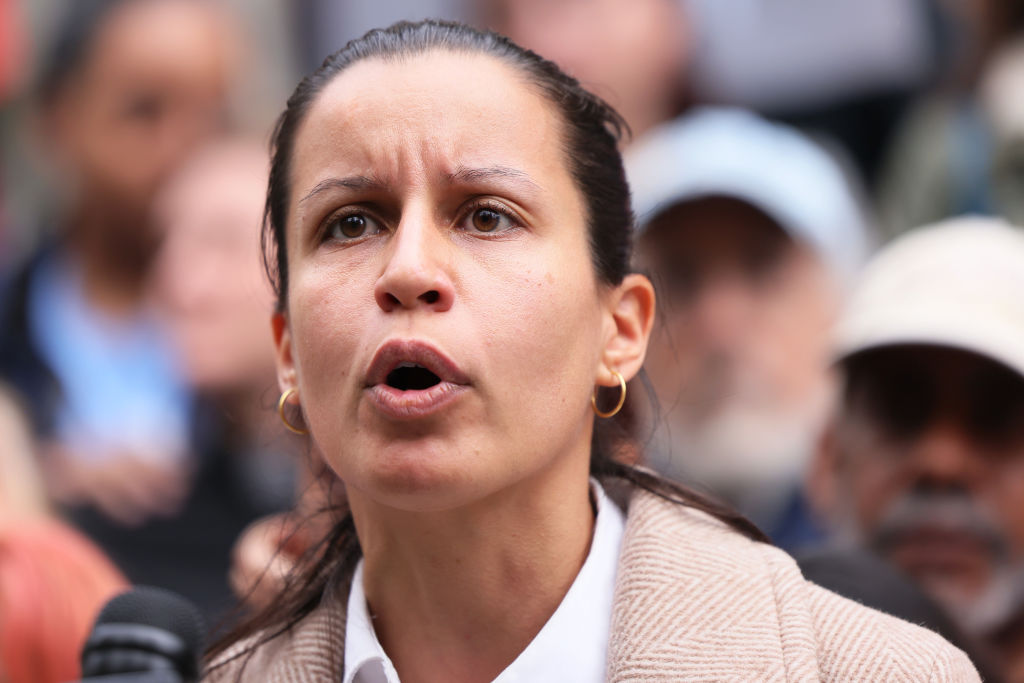
Legislation introduced by Queens city councilmember Tiffany Cabán in October looks to force an end to driver subcontracting. The Delivery Protection Act would require Amazon to directly employ its last-mile driver workforce, the people who handle the final stretch of package delivery to customers’ doors. It would also mandate safety training, make companies directly responsible for driver safety, and require last-mile delivery centers to be licensed with the city.
Safety training is sorely needed. Under the DSP model, some drivers’ training consists only of watching videos and practicing in a parking lot. The consequences are dangerous for all of us.
A recent report on last-mile delivery from the comptroller’s office examines the eighteen large last-mile delivery facilities that have opened since 2017. It finds that “78% of nearby areas saw more injury-causing crashes, with injuries within a half-mile radius rising by an average of 16%. Truck-related crashes increased by 146%, and truck-injury crashes rose by 137%.”
Accidents aren’t the only crisis facing the 45,400 New Yorkers employed in last-mile delivery. (The bulk of these workers deliver Amazon packages, but the number also includes FedEx and UPS last-mile facilities). “Between 2022 and 2024, 38 of 50 facilities (76%) identified by the New York City Department of City Planning reported injuries to the Occupational Safety and Health Administration (OSHA), totaling over 2,000 injuries, or an average of 678 per year,” the report finds. That is more than triple the national average for all private employers. When one looks solely at serious injuries, the rate is nearly five times that of the national average.
Transportation is a heavily unionized industry for a reason. Driving is dangerous work, and without a say over how the job is organized, workers can be forced into unsustainable, injurious, or even deadly situations. Training will help, but until these workers have unions, a means of creating and enforcing safety standards, they will continue shouldering the cost of fast delivery.
The majority of the city’s fifty-one councilmembers have signed on to consponsor the Delivery Protection Act, with supporters including everyone from Democratic Socialists of America members like Cabán and Councilmember Alexa Avilés from Sunset Park to MAGA-supporting Councilmember Inna Vernikov from Sheepshead Bay. It has broad support from the city’s labor movement too.
“This bill is being backed emphatically by the labor movement and our allies because it’s a critical part of how our city is finally addressing income inequality,” New York City Central Labor Council, AFL-CIO president Brendan Griffith said. “The energy, momentum, and will of the people are on our side, and there’s no reason we can’t get this done quickly.”
Mayor-elect Zohran Mamdani has called for Amazon to stop violating workers’ rights and voiced support for the DBK4 drivers during their strike. Lina Khan, a cochair of Mamdani’s transition team, is one of Amazon’s strongest critics. The comptroller’s office published its report not long after the Delivery Protection Act began gaining steam, suggesting a growing recognition of the need to scrutinize a company whose New York operation has ballooned in recent years. Workers’ efforts raised the alarm as to how Amazon runs roughshod over New Yorkers’ rights, and now there is a growing political appetite to do something about it.
It will be a brutal fight. Amazon will view the Delivery Protection Act as an existential threat. It designed the DSP model from the start to evade the risk and responsibilities of employer status, and it won’t willingly accept incursions on this business model.
As early as 2013, when the company wanted to find an alternative to relying on FedEx and UPS for package delivery, executives were concerned about the risk of worker organizing.
“A primary concern was whether getting into the transportation business would expose them to unions,” Amazon executives who were in planning meetings for the company’s venture into delivery as far back as 2013 told journalist Brad Stone. “Delivery stations would have to be placed in urban areas where most of Amazon’s customers lived — places like New York City and New Jersey that were the locus of the organized labor movement.”
The DSP program was their solution, a means of indemnifying Amazon from workers’ demands. No longer would wages, workers’ compensation, discrimination cases, or union drives be the company’s problem, nor would poor driver behavior or car accidents. But while this model has helped make Amazon founder Jeff Bezos one of the richest people on earth, the cost to the rest of us is too high.
Amazon will not hesitate to file lawsuits to oppose the Delivery Protection Act should the bill pass into law. One can imagine the company threatening to suspend its lucrative operations in New York to get its way. Such moneyed opposition will require the type of unity and aggressive action that has become vanishingly rare in the labor movement and among elected officials. Delivery drivers like those from DBK4 will need support, as will the nascent organizing efforts at other Amazon facilities in the metro area. But if New Yorkers are ever going to put a stop to Amazon’s flagrant violations of their rights, the time is now.
Search
RECENT PRESS RELEASES
Related Post