Japan Car Export Database 2025: Japan Car Exports by Country & Car Production Data
May 18, 2026
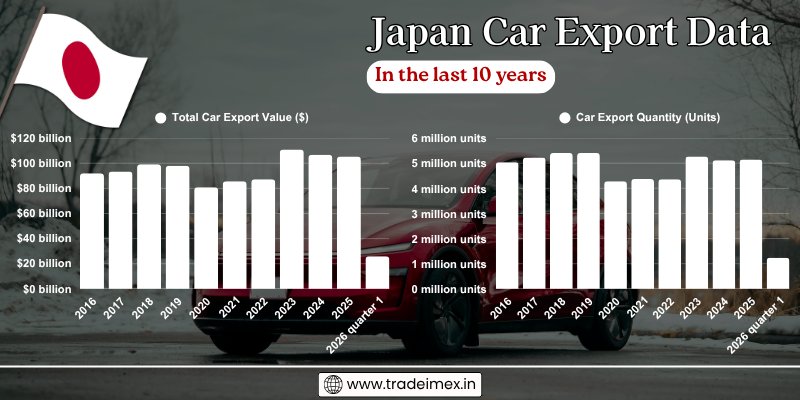
Japan remains one of the world’s most influential automotive powers in 2025. Despite growing competition from China, rising trade barriers, and the rapid transition to electric vehicles, Japanese automakers continue to dominate global automotive exports through a combination of high-quality manufacturing, leadership in hybrid technology, and an unmatched reputation for reliability. According to the latest Japan export data andJapan car export data, the total value of Japan car exports reached $105.39 billion in 2025, a 1%decline from the previous year. Japan’s car exports totaled 5.15 million units in 2025 and 1.24 million units in the first quarter of 2026. Japan exported cars worth $25.89 billion in the first quarter of 2026, as per Japan’s statistical export data of cars under HS code 8703.
With 5.6 million cars sold worldwide in 2025, Japan solidified its position as a major exporter of automobiles. About 4 million new cars and 1.6 million secondhand cars made up this total. The Japanese auto industry is still the backbone of the country’s manufacturing economy. Brands such as Toyota, Honda, Nissan, Suzuki, and Mazda continue exporting millions of vehicles annually to North America, Europe, Asia, Africa, Oceania, and the Middle East. Toyota Yarisemerged as Japan’s best-selling model. In 2025, Japan’s automotive export ecosystem includes both brand-new vehicles and a massive used-car export market. Together, they form one of the largest automotive trade networks in the world.
This article breaks down:
-
Japan car exports by country in 2025
-
Total vehicle production & Japan auto export figures
-
New vs used vehicle export trends
-
Top destination markets
-
Production shifts affecting global trade
-
Emerging opportunities and challenges in the Japanese automotive sector
Japan’s Automotive Industry in 2025
Japan is the 3rd largest car exporter in the world, according to global trade data. Japan continues to rank among the top vehicle-producing countries globally. As one of the top car-exporting countries, Japan produces millions of passenger cars, commercial vehicles, hybrids, and increasingly, electrified vehicles every year. According to industry estimates and production tracking data, Japan produced around 6.2 million vehicles in recent annual output figures, maintaining its place among the top three global car manufacturing nations. Japanese automakers remain heavily export-oriented, as per Japan auto export data. Domestic demand in Japan has gradually declined due to:
-
An ageing population
-
Urbanization
-
Reduced car ownership among younger consumers
-
Expanding overseas manufacturing operations
As a result, exports remain essential for Japanese carmakers.
Japan Car Export Statistics 2025: How Many Cars Does Japan Export
Industry export reports & Japan car export statistics show that Japan exported more than 5.6 million vehicles globally in the latest 2025 reporting cycle, including both new and used vehicles.
Breakdown of Japan Vehicle Exports
|
Category |
Approx. Units |
|
New Vehicle Exports |
3.9 to 4 million |
|
Used Vehicle Exports |
1.7 million |
|
Total Vehicle Exports |
5.6 million |
The used car segment has become especially important. Japanese used vehicles are in high demand because they are known for:
-
Low mileage
-
Strong maintenance records
-
High manufacturing quality
-
Strict Japanese inspection standards
-
Affordable resale pricing
Used car exports from Japan reached record highs in recent years.
Japan Car Exports by Country: Where Does Japan Export Cars?
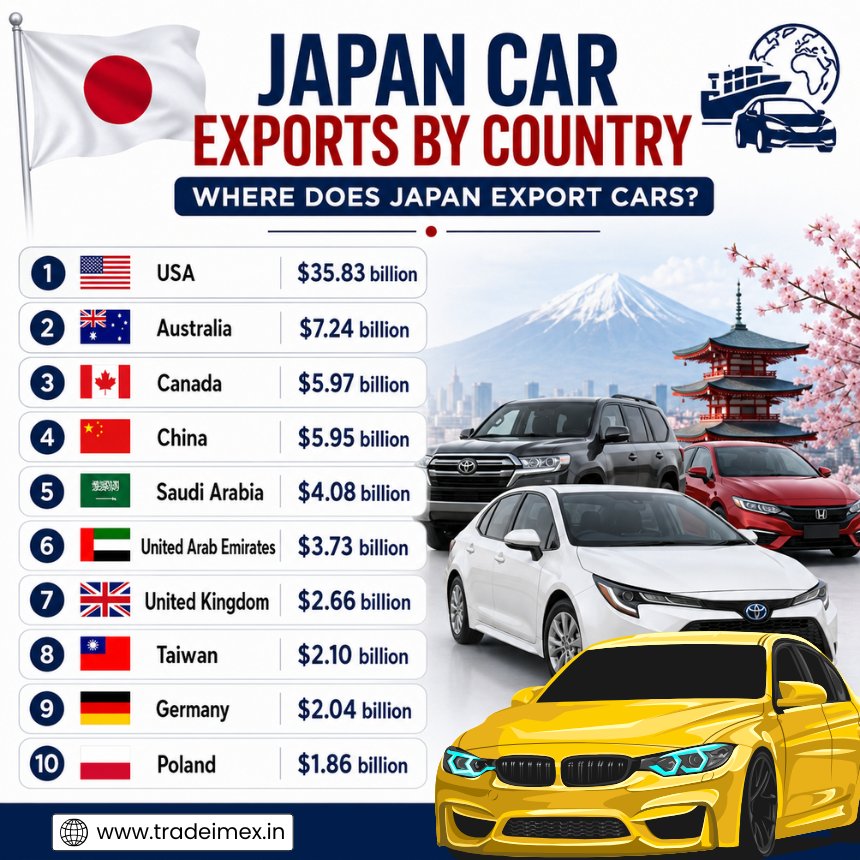
In the global automotive industry, Japan is known for producing high-quality vehicles that are exported to countries all over the world. Japan is one of the world’s leading exporters of cars, with a diverse range of countries serving as important destinations for its automotive exports. Some of the primary destinations for Japan’s car exports include the United States, Canada, Australia, and various countries in Europe and Asia. The high quality, reliability, & innovation of Japanese car manufacturers have contributed significantly to their global success. The top 10 export destinations for Japanese car exports, as per the Japan car exports by country & Japan car shipment data for 2025, include:
1. USA: $35.83 billion (34%)
The United States is the largest market for Japanese car exports, accounting for a whopping 34% of the total export value, as per the data onJapan car exports to the USA. Japanese automakers like Toyota, Honda, and Nissan have a strong presence in the US market, offering a wide range of vehicles from compact cars to luxury SUVs. Japanese automakers offer a wide range of options to meet the diverse needs of the US market.
2. Australia: $7.24 billion (6.9%)
Australia is another important market for Japan’s car exports, accounting for 6.9% of the total export value, as per the data on Japan car exports to Australia by HS code. Japanese cars are popular in Australia due to their reliability, fuel efficiency, and innovative features. Models like the Toyota Corolla and Mazda CX-5 are among the best-selling vehicles in the country.
3. Canada: $5.97 billion (5.7%)
Canada is a key market for Japanese car exports, accounting for 5.7% of the total export value. Car exporters in Japan have a strong presence in Canada, with popular models like the Honda Civic and Toyota RAV4 being among the top-selling vehicles in the country.
4. China: $5.95 billion (5.6%)
China is a rapidly growing market for Japanese car exports, accounting for 5.6% of the total export value. Japanese automakers are capitalizing on the demand for vehicles in China, with models like the Toyota Camry and Honda CR-V gaining popularity among Chinese consumers.
5. Saudi Arabia: $4.08 billion (3.9%)
Saudi Arabia is a significant market for Japanese car exports, accounting for 3.9% of the total export value. Japanese cars are well-received in Saudi Arabia for their durability, performance, and advanced safety features. Models like the Nissan Patrol and Toyota Land Cruiser are popular choices among Saudi consumers.
6. United Arab Emirates: $3.73 billion (3.5%)
The United Arab Emirates is another important market for Japan’s car exports, accounting for 3.5% of the total export value. Car exporters in Japan have a strong presence in the UAE, with models like the Toyota Land Cruiser and Mitsubishi Pajero being popular among Emirati consumers.
7. United Kingdom: $2.66 billion (2.5%)
The United Kingdom is a key market for Japanese car exports, accounting for 2.5% of the total export value. Japanese automakers have a long history in the UK market, with models like the Honda Jazz and Nissan Qashqai being well-received by British consumers.
8. Taiwan: $2.10 billion (2%)
Taiwan is a growing market for Japanese car exports, accounting for 2% of the total export value. Japanese automakers are expanding their presence in Taiwan, with models like the Toyota Yaris and Honda Fit gaining popularity among Taiwanese consumers.
9. Germany: $2.04 billion (1.9%)
Germany is a competitive market for Japanese car exports, accounting for 1.9% of the total export value. Japanese automakers are known for their engineering prowess and innovative technology, with models like the Toyota Prius and Subaru Outback appealing to German consumers.
10. Poland: $1.86 billion (1.8%)
Poland is an emerging market for Japanese car exports, accounting for 1.8% of the total export value. Japanese automakers are establishing a foothold in Poland, with models like the Mazda3 and Suzuki Swift attracting attention from Polish consumers.
Japan Car Export Data in The Last 10 Years
|
Year of Exports |
Total Car Export Value ($) |
Car Export Quantity (Units) |
|
2016 |
$91.99 billion |
5.04 million units |
|
2017 |
$93.36 billion |
5.23 million units |
|
2018 |
$99.12 billion |
5.40 million units |
|
2019 |
$98.04 billion |
5.40 million units |
|
2020 |
$80.91 billion |
4.28 million units |
|
2021 |
$85.58 billion |
4.37 million units |
|
2022 |
$87.19 billion |
4.36 million units |
|
2023 |
$110.93 billion |
5.27 million units |
|
2024 |
$106.81 billion |
5.12 million units |
|
2025 |
$105.39 billion |
5.15 million units |
|
2026 quarter 1 |
$25.89 billion |
1.24 million units |

Japan’s Used Car Export Boom: Why Japanese Used Cars Are So Popular
One of the biggest developments in the Japanese automotive industry is the explosive growth of used car exports. Japan exported over 1.5 million used vehicles recently, with some 2025 industry projections approaching 1.7 million units. Several factors explain global demand:
1. Strict Japanese Inspection Laws
Japan’s “Shaken” vehicle inspection system makes older vehicles expensive to maintain domestically. Many owners sell relatively low-mileage vehicles earlier than consumers in other countries would.
2. Excellent Condition
Japanese roads and maintenance standards generally preserve vehicles well.
3. Hybrid Leadership
Japan pioneered affordable hybrid technology. Models like the Toyota Prius and Toyota Aqua dominate export demand.
4. Exchange Rate Advantages
A weaker yen has made Japanese exports more affordable internationally.
Top Exported Japanese Car Models
The most commonly exported Japanese vehicles vary by region.
Most Exported New Cars
-
Toyota RAV4
-
Toyota Corolla
-
Toyota Prius
-
Honda CR-V
-
Subaru Crosstrek
-
Lexus RX
Most Exported Used Cars
-
Toyota Aqua
-
Honda Fit
-
Nissan Note
-
Toyota Noah
-
Nissan Serena
-
Mazda CX-5
Industry shipment data shows hybrids and compact SUVs dominate export growth.
Japan Car Production Data 2025
Japan’s domestic automotive production remains highly sophisticated despite overseas manufacturing expansion, as per the Japan car production data and Japan Automobile Manufacturers Association (JAMA).
Total Production Output
|
Segment |
Annual Production |
|
Passenger Vehicles |
5 million+ |
|
Commercial Vehicles |
1 million |
|
Hybrid Vehicles |
Rapidly increasing |
|
EV Production |
Growing but behind China |
Japanese automakers continue balancing domestic production with overseas assembly plants. Toyota alone maintains a long-term strategy of preserving roughly 3 million units of annual domestic production capacity in Japan.
The Shift Toward Overseas Manufacturing
One important trend in 2025 is the increasing localization of Japanese vehicle production abroad.
Many Japanese brands now manufacture vehicles directly in:
-
United States
-
Mexico
-
Thailand
-
India
-
Indonesia
-
China
This reduces:
-
Shipping costs
-
Tariff exposure
-
Currency risks
For example, Japanese-brand automakers produced over 3.2 million vehicles inside the United States recently.
India’s Rising Role in Japanese Automotive Supply Chains
India is becoming increasingly important for Japanese automakers. Companies like Suzuki and Honda are now exporting India-manufactured vehicles back into Japan itself. This marks a major shift in global automotive production patterns. India offers:
-
Lower manufacturing costs
-
Growing engineering capabilities
-
Strong supplier ecosystems
-
Expanding export infrastructure
Suzuki’s India-made SUVs have already become top-selling imported vehicles in Japan.
Electric Cars: Japan’s Biggest Challenge
While Japan dominates hybrid technology, it faces growing pressure in fully electric vehicles. Chinese automakers are aggressively scaling EV exports worldwide. Analysts increasingly warn that Japan risks losing market share if it transitions too slowly toward battery EVs.
Japanese companies have historically prioritized:
-
Hybrid technology
-
Hydrogen fuel cells
-
Reliability over rapid EV disruption
However, 2025 is forcing strategic adjustments. Toyota, Honda, Nissan, and Mazda are now investing heavily in:
-
Battery production
-
EV platforms
-
Software integration
-
Advanced driver-assistance systems
Supply Chain Challenges in 2025
Japan’s automotive industry still faces several structural risks.
1. Semiconductor Dependency
Chip shortages continue to affect global automotive manufacturing. Recent reports warned that semiconductor disruptions involving European suppliers could threaten Japanese vehicle production schedules.
2. Trade Tensions
Tariff uncertainty remains a major concern, especially regarding the U.S. market. Potential import restrictions could significantly impact Japanese exports because the U.S. remains Japan’s most profitable overseas automotive market.
3. Aging Domestic Workforce
Japan’s shrinking labor force presents long-term manufacturing challenges.
Automakers increasingly rely on:
-
Automation
-
Robotics
-
AI-driven production systems
-
Overseas labor expansion
Why Japan Still Dominates Global Car Exports
Despite rising competition, Japan still holds several key advantages.
1. Reliability Reputation
Japanese vehicles consistently rank among the world’s most reliable.
2. Hybrid Leadership
Toyota and Honda dominate global hybrid adoption.
3. Global Dealer Networks
Japanese brands maintain massive international service ecosystems.
4. Strong Resale Value
Used Japanese vehicles retain excellent resale performance globally.
5. Production Efficiency
Japanese manufacturing systems remain among the most advanced worldwide.
Outlook for Japan Car Exports Beyond 2026
The next decade will likely redefine Japan’s automotive industry. Key trends to watch include:
-
EV transition acceleration
-
Hybrid export growth
-
Expansion into emerging markets
-
Increased production localization abroad
-
AI-enabled vehicle manufacturing
-
Autonomous driving technology
Japan may no longer dominate global automotive production as completely as it once did, but it remains one of the most resilient and technologically advanced automotive exporters in the world. The industry’s ability to adapt will determine whether Japanese automakers can maintain leadership against rapidly expanding Chinese and global EV competitors.
Conclusion and Final Thoughts
In conclusion, Japan’s car export machine remains enormous in 2025. The country exports millions of new and used vehicles annually while maintaining one of the world’s most efficient automotive manufacturing ecosystems. The United States remains the largest export destination, but strong growth continues across Africa, Oceania, Southeast Asia, and the Middle East. At the same time, the industry is undergoing a major transformation:
-
EV competition is intensifying
-
Supply chains are evolving
-
Production is becoming more globalized
-
Emerging markets are reshaping demand
Still, Japanese automakers continue to command trust worldwide through quality engineering, fuel efficiency, and reliability. For importers, dealers, and automotive analysts, Japan’s car export database in 2025 remains one of the most important indicators of global automotive trade trends.
Frequently Asked Questions
1. Which country imports the most cars from Japan in 2025?
The United States remains the largest importer of Japanese vehicles in 2025. Japanese automakers export millions of passenger cars, SUVs, hybrids, and luxury vehicles to the U.S. market every year due to strong demand for reliable and fuel-efficient automobiles.
2. What are the top exported cars from Japan?
Some of the top exported Japanese vehicles include the Toyota Corolla, Toyota RAV4, Toyota Prius, Honda CR-V, Subaru Forester, Nissan Note, and Toyota Aqua. Hybrid vehicles and compact SUVs continue to dominate global demand.
3. Why are Japanese used cars so popular worldwide?
Japanese used cars are highly popular because they are known for low mileage, excellent maintenance, fuel efficiency, and long-term reliability. Japan’s strict vehicle inspection system also encourages owners to sell cars earlier, resulting in high-quality used vehicles entering export markets.
4. How many cars did Japan export in 2025?
Japan exported around 5.6 million vehicles globally in 2025, worth $105.39 billion, including both new and used cars. The country remains one of the world’s largest automobile exporters, supplying vehicles to major markets such as the United States, Australia, Canada, China, Africa, and Southeast Asia.
5. How is the electric vehicle (EV) transition affecting Japan’s car exports?
The global shift toward EVs is creating both opportunities and challenges for Japanese automakers. While Japan continues to lead in hybrid technology, companies like Toyota, Honda, and Nissan are now increasing investments in battery EV production, EV platforms, and advanced automotive technologies to stay competitive in global export markets.
Note For Our Readers
We hope this blog has helped you gain a clearer, data-driven understanding of Japan’s car export market in 2025, including Japan’s car exports by country, vehicle production trends, used-car export growth, and the evolving dynamics of the global automotive trade industry. As the automotive sector continues shifting toward electric vehicles, hybrid technology, localized manufacturing, and changing international trade policies, access to accurate automotive trade intelligence & Japan import-export data is becoming more important than ever for importers, exporters, manufacturers, dealers, and market analysts worldwide.
If you’re looking for customized automotive trade reports,live Japan car export data by country, HS code-level vehicle trade statistics, shipment records, importer-exporter databases, country-wise automobile trade insights, used car export trends, competitor analysis, or global automotive market intelligence, TradeImeX can help you make faster and smarter business decisions with reliable international trade data. To learn more, connect with us at info@tradeimex.in and discover how we can support your global automotive trade and market expansion strategy.
Also Read About:
Disclaimer: TradeImeX provides global trade database, including import-export data of 100+ countries and customized data report. We do NOT buy or sell any products. For purchasing or selling inquiries, please contact the actual importers/exporters listed in our database reports.
Search
RECENT PRESS RELEASES
Related Post