Live coverage: SpaceX to launch South Korean Earth observation satellite, plus 44 more payloads on overnight Falcon 9 rideshare mission
May 2, 2026
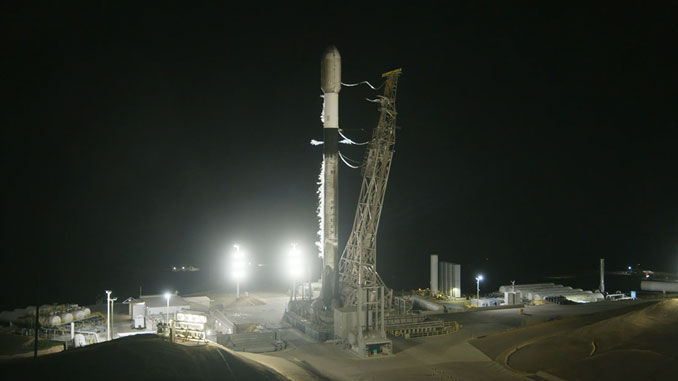
SpaceX will launch 45 payloads on an overnight rideshare mission aboard a Falcon 9 rocket from Vandenberg Space Force Station early Sunday morning.
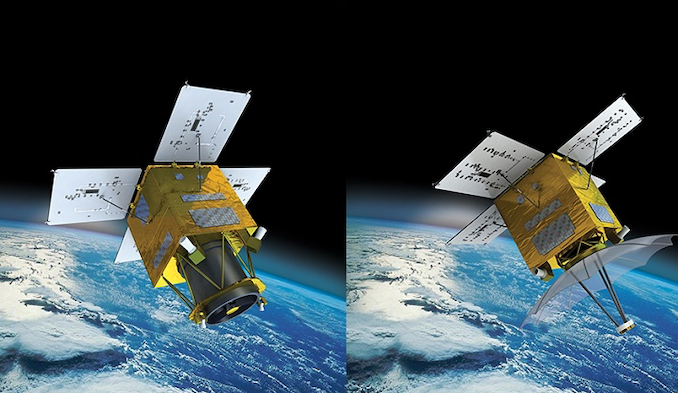
The mission, dubbed CAS500-2, is named for the primary payload called Compact Advanced Satellite 500-2 from the Korea Aerospace Industries, Ltd. (KAI). It’s the second of two satellites that KAI calls Phase 1 of its CAS500 program, which is designed for “precision ground-based observation.”
Liftoff from Space Launch Complex 4 East is scheduled for 11:59 p.m. PDT (2:59 a.m. EDT / 0659 UTC). The rocket will deploy the CAS500-2 satellite into a Sun-synchronous orbit about 60 minutes after launch.
“This mission reflects the strength of the U.S.–Republic of Korea alliance and Vandenberg’s enduring role in assuring access to space for our nation, allies and partners,” Space Launch Delta 30 said in a pre-launch statement. “By enabling trusted international partners to place capabilities on orbit, the Vandenberg Spaceport supports peaceful space cooperation, regional stability and a free and open Indo-Pacific.”
Spaceflight Now will have live coverage beginning about 30 minutes prior to launch.
Falcon 9 first stage booster B1071 will by making its 33rd flight on this mission. It previously launched the SARah-1 satellite for Germany, NASA’s Surface Water and Ocean Topography mission, five times the National Reconnaissance Office, five SmallSat rideshare missions, and 20 deliveries of Starlink satellites.
Less than 7.5 minutes after liftoff, B1071 will target a touchdown at Landing Zone 4 (LZ-4), adjacent to the pad it launched from. If successful, this will be the 34th landing at this site and the 608th booster landing for SpaceX to date.
According to Korea JoongAng Daily, a South Korean publication, the CAS500-2 satellite was originally scheduled to launch in 2022 on a Russian rocket, but the mission faced years of delays due to Russia’s war against Ukraine.
“Additional delays occurred after SpaceX changed plans for a joint launch with another satellite, resulting in a separate launch,” reporter Yoon Seung-Jin wrote. “As a result, CAS500-2 will launch later than CAS500-3, which was sent into space aboard Korea’s Nuri rocket in November last year.”
CAS500-4 and CAS500-5 round out Phase 2 of KAI’s CAS500 program. Those satellites were slated to launch in 2025, but a new launch date for those has not been announced.
Along for the ride
The Falcon 9 rocket carries with it a series of 44 other payloads manifested by multiple partners. The vast majority of the satellites were manifested by Exolaunch, using a variety of deployment mechanisms.
The company is responsible for deploying 21 CubeSats and 18 MicroSats across two deployment sequences.
The first batch of satellites will be released beginning about an hour and 16 minutes after liftoff, over a period of six minutes, and the second batch about two hours and 22 minutes after liftoff, in a sequence lasting about eight minutes.
“This mission reflects how Exolaunch is scaling alongside growing launch demand,” said Jeanne Allarie, chief investor relations officer at Exolaunch, in statement. “As we quickly expand the number of missions we support each year, we’re strengthening our sales pipeline and deepening collaboration with SpaceX to deliver consistent, reliable access to orbit for our global customers.”
We are delighted to continue our collaboration with @AistechSpace, ready to deploy their Hydra-3 satellite developed together with @EnduroSat, aboard @SpaceX’s CAS500-2 rideshare mission 🚀
🔗 Watch the full manifest: https://t.co/PnoEzhqPJz pic.twitter.com/KDUP1RbUDM
— Exolaunch (@Exolaunch) April 27, 2026
Argotec, an Italian company that opened a new satellite integration facility in Melbourne, Florida, in April 2026, manifested seven of its HEO (Hawk for Earth Observation) MicroSats, which are part of the IRIDE (Iniziativi di Resilienza per l’Italia Dalle Emergenze) constellation. IRIDE also has support from the European Space Agency (ESA).
There are currently eight HEO satellites on orbit, which launched on two previous Falcon 9 rockets.
IRIDE is described by participant company Telespazio, a Leonardo and Thales company, as a “constellation of constellations.” There are more than 73 Italian companies participating in its construction and operation.
Another series of Earth observation satellites hitching a ride on this Falcon 9 rocket come from Loft Orbital and EarthDaily Analytics. It’s flying six satellites, which will be part of a constellation of more than 20 satellites in total, designed to deliver “high-frequency, calibrated, analysis-ready data designed for AI-driven insight and real-world decision making across governments and commercial industries.”
“This next launch represents a step-change in both scale and execution for Loft,” said Pierre-Damien Vaujour, CEO and Co-founder of Loft in a statement. “We’re moving from deploying individual missions to delivering full constellations, a culmination of the strategic investments we’ve made over the years in production scale, platform reliability, flight heritage, and persistent mission operations.”
With six satellites launching together very soon, we’ve achieved our next milestone for Loft and our partnership with @EarthDailyA .
Read more: https://t.co/XWgVgg8SOI
We’re proud to support this mission, doubling our on-orbit fleet while accelerating the buildout of… pic.twitter.com/w772M9P752
— Loft (@LoftOrbital) April 22, 2026
Another one of the payloads onboard is True Anomaly’s Jackal spacecraft, the fourth flight of what it described as an “autonomous orbital vehicle” that can serve in multiple orbits. True Anomaly was one of 14 companies chosen to participate in the U.S. Space Force’s Andromeda IDIQ (Indefinite Delivery/Indefinite Quantity) contract that will build a $1.8 billion Geosynchronous Reconnaissance Constellation (RG-XX).
The first two Jackal satellites launched onboard SpaceX’s Transporter-10 mission in March 2024 and the third launched onboard the Bandwagon-2 rideshare in December 2024. This upcoming Jackal satellite won’t be a part of that future work in GEO.
Other payloads include Planet Labs’ Pelican Earth-observing satellites; two of Lynk Global Lynk Tower satellites, designed for direct-to-device connectivity; and the GalaxEye Mission Drishti, billed as India’s “largest privately built Earth observation satellite”, and features a combination of synthetic aperture radar (SAR) imaging and multi-spectral imaging sensors.
Search
RECENT PRESS RELEASES
Related Post