Mamdani and Technology: What New York’s Built Environment Might Expect
December 2, 2025
Mamdani and Technology: What New York’s Built Environment Might Expect
From new rules for sidewalk sheds and drones for building inspections, to streamlining compliance, to bulk buys of climate-friendly equipment to cut carbon, it’s a target-rich municipal environment for proptech
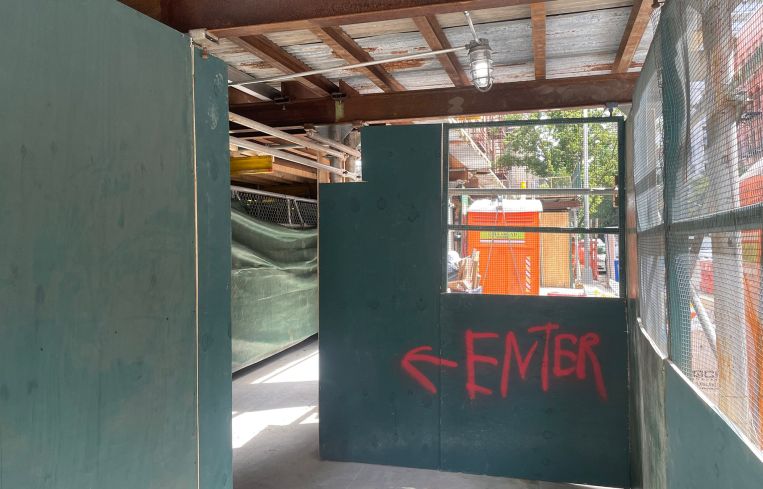
Scaffolding surrounds a new residential building under construction in Manhattan. PHOTO: Edward B. Colby/Newsday RM via Getty Images
Mayor-elect Zohran Mamdani is coming into office based on his successful campaign mantra of greater affordability for New Yorkers. Mandani’s administration will be challenged to make good on his big-swing promises of a rent freeze, free buses and building more affordable housing.
While there is no doubt that embracing technology — particularly proptech — can aid in making those promises a reality, there are more issues to be tackled as well, including the city’s seemingly eternal eyesore of sidewalk shedding and the specter of Local Law 97 for reducing carbon emissions from most larger buildings.
SEE ALSO: BuiltAI Secures $6M Seed Round
Jonathan Erhlich, CEO at T2D2, a Manhattan-based artificial intelligence software company with drone inspection capabilities specializing in building facade analysis, has been on the proptech frontline in dealing with shedding and facades.
“We use the power of AI and computer vision machine learning to automatically perform facade inspections and create facade inspection reports that contribute to easier and more comprehensive compliance with those types of regulations, whether it’s in New York City or any of the other approximately 15 cities around the United States that require those periodic facade inspections,” said Erhlich.
In November, T2D2 completed a year-long engagement with the New York City Department of Buildings (DOB) to identify how state-of-the-art drone and AI technologies can streamline and strengthen the cCity’s Façade Inspection and Safety Program (FISP), formerly known as Local Law 11.
The engagement sprang from a DOB update of Mayor Eric Adams’s “year-old “Get Sheds Down” to reduce the number of sidewalk sheds.
“Part of that initiative was to contract with a large engineering company,” Erhlich said. “We were part of the initiative that looked at the rules of FISP, which culminated in a report that is going to be released within the next few weeks, recommending various changes the city and DOB can adopt that ultimately will reduce sidewalk sheds across the city through different adjustments and amendments, including the adoption of more technology in the compliance regime.”
Ehrlich sees the Mamdani administration continuing the war on shedding and adopting technology in general. T2D2 has been selected as a pilot technology partner by the NYC Office of Technology & Innovation, which is the city’s IT department, he added.
“One of the things that we know the Mamdani administration is interested in is the adoption of more technology to make the city and city administration better and more efficient in what it does and how it handles compliance,” said Ehrlich. “So we definitely see this as an agenda item that will carry forward through administrations. One of the things that’s really great is with this report being released right toward the end of the Adams administration, it will serve as a playbook for the next administration to take up and move forward in terms of taking action and actually implementing the recommendations.”
In addition to shedding, facade inspections are a daunting issue for any city government, with New York City facade inspections required every five years for every building that’s more than six stories tall, which is approximately 17,000 buildings, Ehrlich said, noting that the next largest city in the U.S. has fewer than 3,000 such buildings.
Housing, too, is a huge issue that technology can aid, at least to some extent.
“We’ve tangentially noticed that there’s an interest in zoning and planning from the housing perspective, which is very interesting from the technology perspective,” Ehrlich said. “Over the past few years, we were very familiar with efforts that have been undertaken by the New York City government, and other governments as well, to make bureaucratic administration more efficient.”
That housing-technology intersection includes the DOB updating its building and construction codes, as well as risk-based compliance, the latter of which involves understanding compliance priorities and using data as a tool for more efficient enforcement.
“There are so many areas right now that intersect technology and the built environment,” Ehrlich said. “You have proptech, you have construction tech — we would even differentiate engineering and architecture tech. You have planning and zoning tech, and you also have gov tech, or different types of government technology. The Venn diagram of all of these things really has come together within the past 10, and even in the past five years, to make a difference in how the city is approaching its perspective on compliance and administration.”
Vardhan Mehta, co-founder and CEO of Manhattan-based AceLab, an AI-powered architecture and construction materials startup, is another proptech entrepreneur looking forward to how Mamdani uses technology to further his administration’s goals.
“Mamdani had a particularly interesting take on Local Law 97 — a persistent challenge with no viable solution yet,” Mehta said in an email. “His recommendation: Have the government procure building [equipment] at bulk prices to make the 2030 transition more affordable and achievable. Rather than skewing benefits toward real estate owners or occupants, I found this approach elegant and pragmatic. No surprise why I paid close attention — I’d love Acelab to facilitate that program.”
While saying that he has no direct connection to the incoming administration, Michael Samuelian, founding director of the Urban Technology Hub and of campus planning and sustainability at Cornell Tech on Roosevelt Island, speculated a bit about Mamdani’s technology initiatives.
“I guess I’m optimistic or hopeful,” said Samuelian, an urban planner, architect, real estate developer and educator who has been a central figure in community development in Lower Manhattan, the creation of Hudson Yards and the activation of Governors Island. “We’ve heard some good things about optimizing government, making it work better. So, to the extent that proptech advances building and management systems, I think it could be a good thing. But I think on some level, it’s a little early to tell. Until we see who the deputy mayors and building commissioners are, it’s kind of reading tea leaves. What is their mandate?”
Samuelian then took a 30,000-foot view of what technology use might look like in the new administration.
“The things that I’m interested in, if you’re thinking about something from the building maintenance standpoint, drones or building inspections should be a priority,” he said. “And I think we’re behind in other places, like scaffolding. Just taking on these quality of life issues that intersect with the built environment. So I think it’s a no-brainer to deploy drones to inspect buildings more safely and reduce the amount of scaffolding. And that’s more of a private sector role than a public sector role.”
Samuelian also pointed toward using technology to optimize how buildings operate.
“Many of our buildings are very old,” he said. “It’s one thing to have a modern building that operates efficiently. We need to focus not just on historic buildings, but buildings that need to come into the 21st century. I think lots of established real estate developers are really advanced on this, but I worry, or I wonder, who is really taking care of the little guy, particularly around the issue of Local Law 97.
“How are small and medium-sized co-ops going to deal with this? How are small B and C class buildings going to deal with it? I’m not so worried that Class A super premium buildings are going to be on the advanced side of technology and experimenting when there’s a positive return on investment in it, but we need to think about how this affects small building owners and people who happen to own in a co-op or a condo. I would hate for there to be another czar, but someone who was a decarbonization czar — like the same way we had a rats czar — and their singular focus would be on decarbonizing the built environment.”
When looking at technology and housing issues — particularly with the New York City Housing Authority (NYCHA), the nation’s largest public housing system — Samuelian also sees actionable programs to be tested.
“We have a program called the Urban Innovation Fellows Program, where we actually have a fellow working in NYCHA, and she’s working on using wastewater for heat recovery,” said Samuelian. “So I think there are really innovative ways in the urban tech world. We call it optimization.”
He added that Local Law 97 is an opportunity to push people to think creatively about using their systems much more efficiently and taking advantage of a lot of waste that occurs.
“There’s really interesting things that can happen in terms of making buildings more efficient,” Samuelian said. “I’m really interested in what companies we could look into, like thermal imaging for buildings, to see where they are leaking energy. We can’t just tax carbon, but I think we need to address the envelope, so to speak.”
Having worked at the Department of City Planning, after 9/11, Samuelian said he saw how government, when focused, can do incredible things. “I call it mission-oriented government, where everyone is growing in the same direction and you’re all moving in one way, coordinating horizontally between agencies.”
T2D2’s Ehrlich took a similar view of technology and city government opportunities in the next administration.
“We’re inspired by other announcements, like recently from the New York City Economic Development Corporation, which launched just this month what they call their new challenge-based procurement initiative, which allows technology companies to come in and propose-innovative solutions to complex challenges, starting with the city’s initiative to do laser scanning of the its waterfront, which is quite expensive and quite large,” Ehrlich said at the end of November. “That’s one example where we are inspired when it comes to thinking about how the city continues to increase their engagement with not just proptech companies, but technology companies in general.”
Philip Russo can be reached at prusso@commercialobserver.com.


Search
RECENT PRESS RELEASES
Related Post