Meta business AI reaches 10 million weekly conversations
May 8, 2026
Meta’s AI business tools are scaling rapidly across messaging, ads, and customer engagement
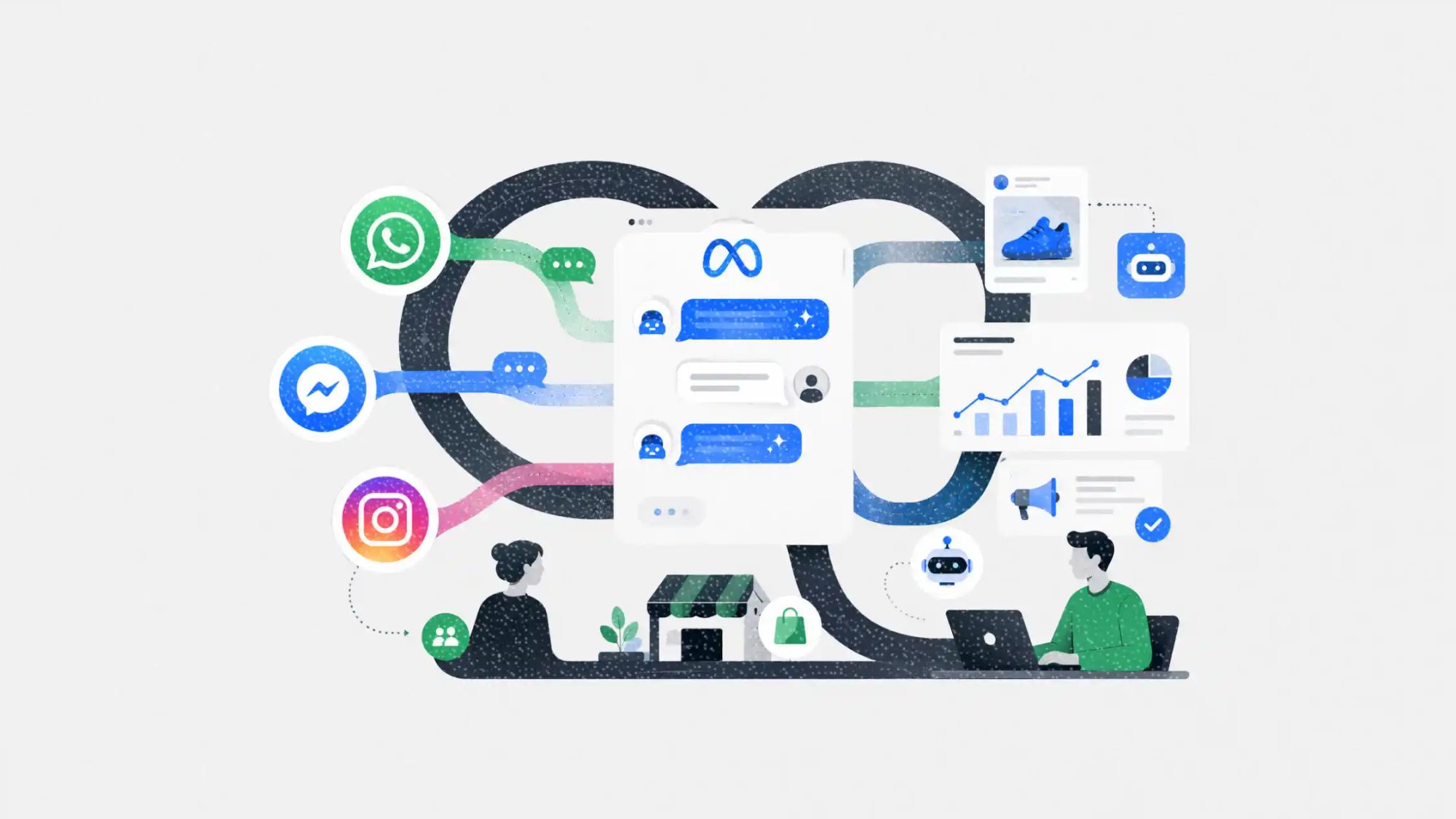
Meta’s AI ambitions are starting to look more commercially serious for marketers and advertisers, especially inside messaging. During its latest earnings call, the company revealed that its business AI tools are now facilitating around 10 million conversations per week, a major jump from just 1 million at the start of the year.
The update signals that Meta is rapidly scaling AI-powered customer interactions across WhatsApp, Messenger, and Instagram. While the company is still offering these tools free to many small businesses, CEO Mark Zuckerberg made it clear that monetization is on the roadmap.
For marketers, this is less about experimental AI chatbots and more about the growing reality of AI-assisted customer acquisition, support, creative generation, and conversion optimization happening directly inside Meta’s ecosystem.
Table of contents
Jump to each section:
Meta said its business AI tools are now facilitating approximately 10 million conversations every week, up sharply from around 1 million weekly conversations earlier this year.
The company recently expanded the beta availability of its business AI assistant across the US, EMEA, APAC, and LATAM regions. The tools are designed to help businesses automate customer interactions across Meta’s messaging ecosystem.
Meta is also integrating AI capabilities deeper into its advertising stack and business products. According to the company, more than 8 million advertisers are already using at least one generative AI ad creative tool.
Susan Li, Meta’s CFO, said advertisers using the company’s video generation features saw over 3% higher conversion rates during testing.
At the same time, Meta announced the open beta launch of Meta Ads AI Connectors, allowing advertisers to connect their Meta ad accounts directly to AI agents and external systems.
The broader financial picture also gives Meta room to aggressively scale AI adoption. The company reported US$26.8 billion in quarterly profit and US$56.3 billion in revenue, up 33% year over year.
Meta’s strategy increasingly centers around owning the full AI-powered marketing loop: discovery, engagement, creative generation, and conversion.
Messaging is a particularly valuable piece of that strategy.
WhatsApp already generates meaningful revenue through paid business messaging, especially in regions where conversational commerce is more mature. AI agents could dramatically increase the scale of those interactions while reducing the operational burden on brands.
The company is also developing its AI products around Muse Spark, a large language model released under Meta Superintelligence Labs.
For Meta, the goal is clear:
- Keep businesses inside Meta’s ecosystem longer
- Reduce friction in ad creation and campaign management
- Expand AI-assisted commerce directly inside messaging apps
- Create future subscription and usage-based AI revenue streams
This is especially important as advertisers continue demanding measurable performance improvements instead of experimental AI features with unclear ROI.
Meta’s AI tools may still be free for many businesses today, but marketers should expect platform monetization to follow quickly once adoption stabilizes.
Here are a few key implications:
- AI-assisted customer service will become expected: Faster response times and automated conversational support are quickly becoming baseline expectations on messaging platforms.
- Creative automation is becoming operational infrastructure: AI-generated ad creative is shifting from novelty to standard workflow optimization.
- Messaging commerce is evolving fast: Businesses relying heavily on WhatsApp or Instagram DMs should expect deeper AI integrations around sales, support, and retargeting.
- Performance data will matter even more: Meta is positioning AI tools around measurable outcomes like conversion lift, not just productivity claims.
Marketers should also pay attention to dependency risks. As Meta embeds more AI workflows directly into its platforms, brands could become increasingly tied to Meta’s pricing, policies, and AI ecosystem decisions.
For B2B marketers and agencies, this may also accelerate demand for cross-platform AI orchestration tools that reduce reliance on any single ecosystem.
What this means for AI-powered advertising and customer engagement
Meta’s latest numbers show that conversational AI at scale is no longer hypothetical inside mainstream advertising platforms.
The jump from 1 million to 10 million weekly business AI conversations in just a few months suggests that brands are already experimenting heavily with automated engagement, especially in messaging-first environments.
The bigger story, though, is infrastructure.
Meta is steadily turning AI into a built-in operational layer across ads, messaging, customer support, and creative workflows. If adoption continues at this pace, AI-powered campaign management and conversational commerce may soon become default expectations rather than competitive advantages.
For marketers, the challenge now is less about whether to adopt AI and more about how to maintain flexibility while platforms race to lock businesses deeper into their ecosystems. The next phase of AI marketing will likely belong to brands that can balance automation efficiency with platform diversification.
This article is created by humans with AI assistance, powered by ContentGrow. Ready to explore full-service content solutions starting at $2,000/month? Book a discovery call today.
Search
RECENT PRESS RELEASES
Related Post