Metro Board of directors to recertify environmental documents for Dodgers gondola
December 4, 2025

Metro Board of directors to recertify environmental documents for Dodgers gondola
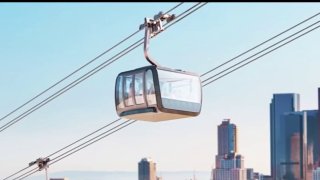
The Metro Board of Directors is expected to recertify a court-ordered supplemental environmental impact report for a proposed gondola project that would run from Union Station to Dodger Stadium.
The board will decide whether to finalize and recertify a report that breaks down the impact on the environment should the sky-high project be built.
 WATCH HERE
The 500 million dollar gondola was proposed seven years ago by Frank McCourt, a former Dodgers owner and part-time owner of the Dodger stadium parking lot.
Last month, the agency’s Executive Management Committee approved the 437-page supplemental EIR in a 4-1 vote with L.A. County Supervisor and board member Janice Hahn voting against the item. Jacquelyn Dupont-Walker, a member of the committee, was absent during the vote.
The project would operate with zero emissions and would be the first permanent mass transit connecting Dodger stadium to the broader la transit system running from the stadium to Union Station.
The matter now comes to the full 13-member Board of Directors for consideration. Recertifying environmental documents for the project will allow the nonprofit leading the project to continue pursuing approvals required for construction such as from the California State Park and Recreation Commission, Caltrans, the Federal Highway Authority and city of Los Angeles.
Those who are for it, including hundreds of businesses in Chinatown, El Pueblo, and Lincoln Heights, say it would be great for the local economy, and public transportation.
Local
Get Los Angeles’s latest local news on crime, entertainment, weather, schools, cost of living and more. Here’s your go-to source for today’s LA news.
But those against it, including the Los Angeles City Council, argue that it won’t be good for the environment or the people who live and work in the impacted areas and would take away public land.
While the item is scheduled to be approved under the consent calendar, the agency has issued a reminder for attendees ahead of its Thursday meeting.
“Due to the want for overwhelming public participation on consent calendar Item 16 (Los Angeles Rapid Transit) it is likely that each person will only be given 30 seconds to speak during their turn for public comment under general public comment to ensure the maximum number of speakers are heard,” according to Metro.
The rule will be enforced for both in-person and call-in speakers at the discretion of the chair, Fernando Dutra, a Whittier City Council member.
Los Angeles City Council members Eunisses Hernandez and Ysabel Jurado. Phyllis Ling, founder of Stop the Gondola coalition, and Jon Christensen, a UCLA professor in the Institute of the Environment and Sustainability, are expected to urge the board to deny the supplemental environmental impact report.
Hernandez, Jurado, and Councilman Hugo Soto-Martinez were able to get a resolution approved by the City Council to formally oppose the proposed gondola project.
“The proposed gondola is not a public transportation project but rather a private tourist attraction that would benefit Frank McCourt and the entertainment complex he wants to build at Dodger Stadium,” according to a statement from Stop the Gondola.
Critics argue there is no guarantee taxpayers won’t be stuck with the bill for the project’s estimated $500 million construction costs, as well as potentially $8 million to $10 million in annual maintenance and operations. Critics also cite a UCLA Mobility Lab study that showed data the gondola would not reduce traffic or emissions.
Zero Emissions Transit, a nonprofit organization with an independent board of directors, is leading the project, formerly known as the Los Angeles Aerial Rapid Transit, after it was donated to it by former Dodger owner Frank McCourt.
The nonprofit bills itself as an organization committed to all efforts accelerating zero emission technology of any kind into the transportation space.
Project specs consist of a 1.2-mile route passing through Chinatown and the Los Angeles State Historic Park to connect Union Station and Dodger Stadium via three stations — Alameda Station, Chinatown/State Park Station, and the Dodger Stadium Station — a non-passenger junction, and three cable-supporting towers.
Zero Emissions Transit and other proponents of the aerial tram say it will provide the first permanent mass transit connection linking Dodger Stadium to the broader Los Angeles transit system.
They say the gondola would operate with zero emissions and be the first aerial gondola transit system to include a battery-electric backup system, and that the project’s approved environmental study found that it could reduce emissions by over 150,000 metric tons of greenhouse gasses over its lifetime.
The gondola is backed by several groups such as the Chinese American Museum, Coalition for Clean Air, Los Angeles and Orange County Building Trades Council, the Los Angeles County Business Federation and Los Angeles Chamber of Commerce.
Nearly 15,000 individuals and more than 400 businesses in Chinatown, El Pueblo and Lincoln Heights have signed up to support the project, which also has the backing of organized labor, business and environmental advocates, according to Zero Emissions Transit.
The supplemental EIR incorporates a community benefits package that county Supervisor and board member Hilda Solis previously negotiated with ZET.
It encompasses robust labor standards, apprenticeships and local hiring promises, a business interruption fund to protect small businesses during construction, free and unlimited rides for Chinatown residents and businesses, and a prohibition on eminent domain and fair market compensation for any public property rights, as well as a new community advisory committee,
according to Solis.
Solis has made a commitment to ensure affordable housing, senior housing, small business support and the expansion of transit options such as Dodger Stadium Express, if the project is approved by all regulatory agencies. “I can only see myself supporting this because of the attachment of the community benefits,” Solis previously said.
Search
RECENT PRESS RELEASES
Related Post