Musk abandoned his own ‘solar electric economy’ to burn gas for an AI chatbot no one uses
May 25, 2026
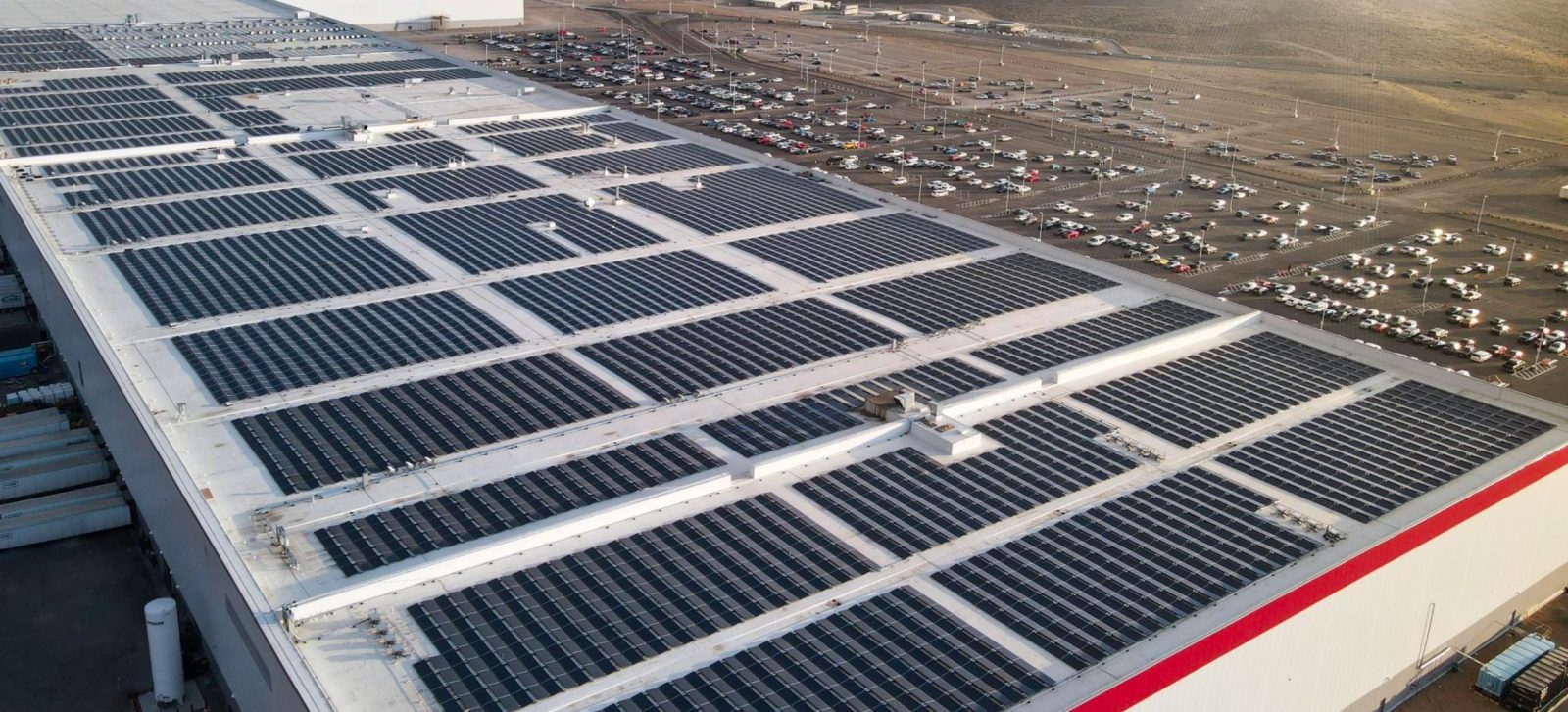
Elon Musk spent years telling the world that solar power was the obvious answer to Earth’s energy needs — that a small patch of desert could power the entire United States. Now, he’s burning millions of tons of fossil fuels to run an AI chatbot that has lost 60% of its downloads, selling the unused compute to a company he called “misanthropic and evil” three months ago, and pitching space-based solar panels right as SpaceX files for a $2 trillion IPO.
The contradictions are stacking up faster than xAI’s unpermitted gas turbines.
In July 2017, Musk stood before the National Governors Association and made the case for solar with the kind of clarity that made him an icon of the clean energy movement. “If you wanted to power the entire US with solar panels, it would take a fairly small corner of Nevada or Texas or Utah; you only need about 100 miles by 100 miles of solar panels to power the entire United States,” he said.
He added that the battery storage needed for 24/7 power was “1 mile by 1 mile. One square-mile. That’s it.” He called the sun “a giant fusion reactor in the sky” that is “really reliable.”
Advertisement – scroll for more content
This was not a one-off comment. It was the foundation of his entire business thesis. Tesla’s original 2006 Master Plan stated that the company’s “overarching purpose” was “to help expedite the move from a mine-and-burn hydrocarbon economy towards a solar electric economy.” That was the stated reason Tesla existed. He made Tesla acquire SolarCity in 2016 for $2.6 billion to prove it. And as recently as 2023, Tesla’s Master Plan Part 3 laid out a detailed path to “eliminate fossil fuels.”
He repeated the desert solar pitch again in 2019 on X, writing: “Which means a small corner of Texas (or anywhere) with solar panels could power the entire United States.”
The math checked out. Multiple independent analyses confirmed it. And crucially, the point was that solar on Earth was so abundant, so simple, and so cheap that the energy transition was just an execution problem, not a technology problem.
Fast forward to 2026, and Musk’s xAI, now folded into SpaceX, is operating 62 unpermitted methane gas turbines across two data centers in Memphis, Tennessee, and Southaven, Mississippi. The turbines power xAI’s Colossus supercomputers, which trains and runs Grok, Musk’s AI chatbot, or at least used to.
According to xAI’s own permit applications, the combined facilities could emit more than 6 million tons of greenhouse gases per year, along with over 1,300 tons of health-harming air pollutants. The EPA closed the regulatory loophole xAI was exploiting in January 2026, but thermal drone footage from February showed the turbines still running. The NAACP and Earthjustice have asked courts for emergency action to stop the illegal pollution. And xAI wasn’t slowing down — it was buying $2.8 billion more gas turbines.
As we noted in March, xAI is actively undoing Tesla’s climate work, all to power AI slop. The man who built a brand around making fossil fuels obsolete is now one of America’s most aggressive new consumers of natural gas.
And here’s the kicker: while xAI has spent $697 million on Tesla Megapacks for its data centers, it hasn’t bought a materially significant amount of solar panels from Tesla, according to the SpaceX S-1 filing. SpaceX spent $131 million on 1,279 Cybertrucks. But solar panels for the data center burning gas? Apparently not a priority.
All of this might be easier to stomach if Grok were actually a market-leading product. It’s not.
Grok entered 2026 as the second most-popular AI chatbot globally — thanks to inflated numbers through X auto-replies. By April, it had plummeted to fifth place, behind ChatGPT, Claude, Gemini, and DeepSeek. Monthly active users dropped 12.5% in a single month to 12.2 million, while Claude surged 44% to 23 million users. Downloads crashed 60%.
In the enterprise market, only 7% of companies reported using Grok in March 2026, compared to 48% for Claude and 40% for Gemini. A survey of 260,000 Americans found that just 0.174% paid for Grok in Q2 2026.
So Musk is burning 6 million tons of greenhouse gases per year to power a chatbot that fewer and fewer people actually use. The 2017 version of Elon Musk would have had a field day with that math.
With Grok unable to fill the Colossus data center’s 220,000 Nvidia GPUs, Musk did what any principled AI safety advocate would do: he leased the entire thing to the company he had publicly called “misanthropic and evil” three months earlier.
In February 2026, Musk wrote on X that Anthropic’s AI “hates Whites & Asians, especially Chinese, heterosexuals and men” and that the company was “doomed” by its own name. He said Anthropic “hates Western civilization” and accused it of stealing training data at “massive scale.”
By May, Anthropic was paying xAI $1.25 billion per month for the Colossus compute, a deal worth over $40 billion through 2029. Musk then claimed he had “spent a lot of time last week with senior members of the Anthropic team” and came away “impressed,” saying “no one set off my evil detector.”
As Fortune reported, the deal has little to do with Anthropic and everything to do with SpaceX’s upcoming IPO. The $40 billion in revenue over the next 3 years help salvage what was supposed to be Grok’s compute. The compute is already built, the capital expense is sunk, and electricity is the only major operating cost.
Musk even wrote that SpaceX “reserves the right to reclaim the compute” if Anthropic’s AI “engages in actions that harm humanity” — giving him a kill switch over one of the three leading AI labs in the world, right as he was suing OpenAI in federal court.
Now, here’s where it gets truly cynical. SpaceX filed its S-1 with the SEC on May 20, targeting a valuation between $1.75 trillion and $2 trillion — the largest IPO in history with a planned $75 to $80 billion raise. And in the filing is Musk’s new energy thesis: space-based solar power.
SpaceX claims that space-based solar arrays can generate “more than five-times the energy” of terrestrial ones thanks to 24/7 illumination. The company filed with the FCC for an “orbital data center” constellation that could include up to one million satellites in low Earth orbit. Musk now says that within two to three years, the lowest cost way to generate AI compute will be in space.
The problem? This is the same man who spent a decade telling everyone the answer was already on the ground.
If a 100-by-100-mile patch of desert can power the entire United States, his words, repeated for years, then why are we now talking about launching solar panels on rockets? The sun hasn’t moved. The math hasn’t changed. Solar panel efficiency has only gotten better. The cost has only come down.
What changed is that SpaceX is about to go public and needs to justify a $2 trillion valuation. A space-based solar thesis creates future demand for Starship launches and turns SpaceX from a rocket company into an energy infrastructure company, and energy infrastructure companies trade at much higher multiples than aerospace contractors.
As TechCrunch noted, terrestrial solar barely gets a mention in the SpaceX S-1, and when it does, it’s only to argue how much better space solar would be. The filing argues that “third-party estimates on data center demand are constrained by the practical supply limitations that exist in a terrestrial context.” Translation: we need you to believe Earth-based solar isn’t enough so that space solar sounds like a necessity.
Meanwhile, the economics of orbital data centers are challenging at best. Power costs for Starlink satellites already run multiples higher than terrestrial data centers. Radiation shielding for AI chips in orbit is expensive and unproven at scale. And it remains unclear whether AI training workloads can be distributed across satellite constellations at all.
Shipping solar panels on a flatbed truck uses less energy than launching them into orbit. That’s not a complex engineering insight, it’s just common sense.
In fact, it would be more sensible to place data centers underwater for cooling than in space. But the idea won’t get any traction because it doesn’t do anything to justify SpaceX’s valuation.
The 2017 Elon Musk, the one standing before governors telling them solar was the obvious answer, would be horrified by the 2026 version. That Musk understood something profound: the sun delivers free energy every day, the technology to capture it already exists, and the only barrier is execution. He was right.
What happened since then is a familiar story. Musk got distracted by the AI arms race, built a chatbot that nobody wants, powered it with the very fossil fuels he built his brand fighting, and is now selling the spare compute to a company he publicly insulted because his product can’t generate enough demand to fill the servers.
And the space solar pitch is the most transparent part. We’ve barely scratched the surface of terrestrial solar potential, the United States installed just 37 GW of solar in 2024 against a theoretical need in the thousands. The land is available. The panels are cheap. The storage technology is there. Musk himself proved this case a hundred times over. It’s literally Tesla’s best business unit at the moment.
But terrestrial solar doesn’t create demand for Starship launches. It doesn’t justify a $2 trillion SpaceX valuation. And it doesn’t require a million-satellite constellation with recurring launch revenue. Space solar solves a SpaceX business model problem, not an energy problem.
We’re not saying space-based solar will never make sense. But the idea that we need to launch panels into orbit before we’ve even covered a meaningful fraction of our energy needs with ground solar, which Musk himself said would power the whole country, reveals that this isn’t about clean energy anymore. It’s about financial engineering for an IPO.
The man who wanted to move us from a “mine-and-burn hydrocarbon economy” to a “solar electric economy” is now mining natural gas to burn for AI, selling compute to his so-called enemies, and launching the solar panels into space because it fits the business plan. The 2017 Elon Musk would call this exactly what it is.
If you want to actually follow through on Musk’s original vision and power your home with solar, without launching anything into orbit, there’s never been a better time. With electricity rates climbing nearly 10% last year, home solar protects you against future rate increases. And with lease and PPA options, you can go solar with zero upfront cost and start saving immediately. If you want to find the best deal, check out EnergySage. It’s a free service with hundreds of pre-vetted installers competing for your business, so you save 20 to 30% compared to going it alone. No sales calls until you pick an installer. Get your free quotes here.


Search
RECENT PRESS RELEASES
Related Post