Negative emissions technologies and practices could challenge global resource supply and environmental limits
March 6, 2026
Abstract
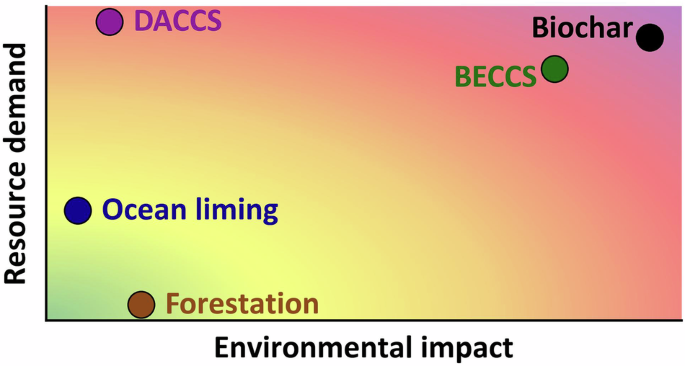
Meeting climate goals will most likely require large-scale carbon dioxide removal, yet its sustainability implications remain poorly understood. Here, we conduct a prospective life cycle assessment of multiple negative emissions technologies and practices, integrating mineral resource, health, and absolute sustainability indicators to quantify impacts between 2030 and 2050. Our comprehensive analysis reveals previously overlooked bottlenecks: biochar and bioenergy with carbon capture and storage could sharply raise nutrient demand, further compromising food security, while direct air carbon capture and storage and ocean liming could critically exacerbate the mining levels of key mineral resources, despite their lower collateral damage. These findings will help guide the sustainable and safe expansion of the carbon dioxide removal industry by balancing multiple risks, thereby minimizing unintended environmental and resource-related consequences.
Data availability
The model parameters and life cycle inventories supporting these findings are available in https://doi.org/10.5281/zenodo.17574760.
Code availability
Code to quantify resource extraction is available in https://doi.org/10.5281/zenodo.15084711.
References
-
United Nations Environment Programme. Emissions Gap Report 2025: Off Target – Continued Collective Inaction Puts Global Temperature Goal at Risk. https://doi.org/10.59117/20.500.11822/48854 (2025).
-
IPCC. Climate Change 2022: Mitigation of Climate Change. Contribution of Working Group III to the Sixth Assessment Report of the Intergovernmental Panel on Climate Change. https://doi.org/10.1017/9781009157926 (2022).
-
Liu, Z., Deng, Z., Davis, S. J. & Ciais, P. Global carbon emissions in 2023. Nat. Rev. Earth Environ. 5, 253–254 (2024).
-
Smith, S. M. et al. The State of Carbon Dioxide Removal 2024 – 2nd Eddition. https://doi.org/10.17605/OSF.IO/F85QJ (2024).
-
Nemet, G. F. et al. Near-term deployment of novel carbon removal to facilitate longer-term deployment. Joule 7, 2653–2659 (2023).
-
Galán-MartÃn, Ã� et al. Delaying carbon dioxide removal in the European Union puts climate targets at risk. Nat. Commun. 12, 6490 (2021).
-
Smith, S. M. et al. The State of Carbon Dioxide Removal – 1st Edition. https://doi.org/10.17605/OSF.IO/W3B4Z (2023).
-
Bednar, J. et al. Operationalizing the net-negative carbon economy. Nature 596, 377–383 (2021).
-
World Commission on Environment and Development. Our Common Future. https://sustainabledevelopment.un.org/content/documents/5987our-common-future.pdf (1987).
-
Cobo, S. et al. Sustainable scale-up of negative emissions technologies and practices: where to focus. Environ. Res. Lett. 18, 02301 (2023).
-
Terlouw, T., Bauer, C., Rosa, L. & Mazzotti, M. Life cycle assessment of carbon dioxide removal technologies: a critical review. Energy Environ. Sci. 14, 1701–1721 (2021).
-
Deutz, S. & Bardow, A. Life-cycle assessment of an industrial direct air capture process based on temperature–vacuum swing adsorption. Nat. Energy 6, 203–213 (2021).
-
Madhu, K., Pauliuk, S., Dhathri, S. & Creutzig, F. Understanding environmental trade-offs and resource demand of direct air capture technologies through comparative life-cycle assessment. Nat. Energy 6, 1035–1044 (2021).
-
Terlouw, T., Treyer, K., Bauer, C. & Mazzotti, M. Life cycle assessment of direct air carbon capture and storage with low-carbon energy sources. Environ. Sci. Technol. 55, 11397–11411 (2021).
-
Ottenbros, A. B. et al. Prospective environmental burdens and benefits of fast-swing direct air carbon capture and storage. Sci. Rep. 14, 16549 (2024).
-
Bouaboula, H., Belmabkhout, Y. & Zaabout, A. Life cycle assessment of electrochemical pH-swing direct air capture. Energy Convers. Manag. 342, 120134 (2025).
-
Zhang, B., Kroeger, J., Planavsky, N. & Yao, Y. Techno-economic and life cycle assessment of enhanced rock weathering: a case study from the Midwestern United States. Environ. Sci. Technol. 57, 13828–13837 (2023).
-
Lefebvre, D. et al. Assessing the potential of soil carbonation and enhanced weathering through life cycle assessment: a case study for Sao Paulo State, Brazil. J. Clean. Prod. 233, 468–481 (2019).
-
Eufrasio, R. M. et al. Environmental and health impacts of atmospheric CO2 removal by enhanced rock weathering depend on nations energy mix. Commun. Earth Environ. 3, 106 (2022).
-
Foteinis, S., Campbell, J. S. & Renforth, P. Life cycle assessment of coastal enhanced weathering for carbon dioxide removal from air. Environ. Sci. Technol. 57, 6169–6178 (2023).
-
Shi, L. et al. Carbon capture and storage via enhanced carbonate weathering coupled with aquatic photosynthesis: potential, cost, and advantages. Earth Sci. Rev. 266, 105149 (2025).
-
Foteinis, S., Andresen, J., Campo, F., Caserini, S. & Renforth, P. Life cycle assessment of ocean liming for carbon dioxide removal from the atmosphere. J. Clean. Prod. 370, 133309 (2022).
-
Yan, Q., Zheng, L., Zhuang, W. & Liu, J. Alkalinity factory can achieve positive climate benefits within decades. J. Clean. Prod. 504, 145406 (2025).
-
Full, J. et al. Carbon-negative hydrogen production (HyBECCS): an exemplary techno-economic and environmental assessment. Int. J. Hydrog. Energy 52, 594–609 (2024).
-
Lask, J. et al. Lignocellulosic ethanol production combined with CCS—A study of GHG reductions and potential environmental trade-offs. GCB Bioenergy 13, 336–347 (2021).
-
Rojas Michaga, M. F. et al. Bioenergy with carbon capture and storage (BECCS) potential in jet fuel production from forestry residues: a combined techno-economic and life cycle assessment approach. Energy Convers. Manag. 255, 115346 (2022).
-
Wu, N., Lan, K. & Yao, Y. An integrated techno-economic and environmental assessment for carbon capture in hydrogen production by biomass gasification. Resour. Conserv. Recycl. 188, 106693 (2023).
-
Zakrisson, L., Azzi, E. S. & Sundberg, C. Climate impact of bioenergy with or without carbon dioxide removal: influence of functional unit and parameter variability. Int. J. Life Cycle Assess. 28, 907–923 (2023).
-
Bello, S., Galán-MartÃn, Ã�, Feijoo, G., Moreira, M. T. & Guillén-Gosálbez, G. BECCS based on bioethanol from wood residues: potential towards a carbon-negative transport and side-effects. Appl. Energy 279, 115884 (2020).
-
Susmozas, A., Iribarren, D., Zapp, P., Linβen, J. & Dufour, J. Life-cycle performance of hydrogen production via indirect biomass gasification with CO2 capture. Int. J. Hydrog. Energy 41, 19484–19491 (2016).
-
Peters, J. F., Iribarren, D. & Dufour, J. Biomass pyrolysis for biochar or energy applications? A life cycle assessment. Environ. Sci. Technol. 49, 5195–5202 (2015).
-
Azzi, E. S., Karltun, E. & Sundberg, C. Prospective life cycle assessment of large-scale biochar production and use for negative emissions in Stockholm. Environ. Sci. Technol. 53, 8466–8476 (2019).
-
Roberts, K. G., Gloy, B. A., Joseph, S., Scott, N. R. & Lehmann, J. Life cycle assessment of biochar systems: estimating the energetic, economic, and climate change potential. Environ. Sci. Technol. 44, 827–833 (2010).
-
Hammond, J., Shackley, S., Sohi, S. & Brownsort, P. Prospective life cycle carbon abatement for pyrolysis biochar systems in the UK. Energy Policy 39, 2646–2655 (2011).
-
Kane, S. et al. Uncertainty in determining carbon dioxide removal potential of biochar. Environ. Res. Lett. 20, 014062 (2025).
-
Kavindi, G. A. G., Tang, L. & Sasaki, Y. Assessing GHG emission reduction in biomass-derived biochar production via slow pyrolysis: a cradle-to-gate LCA approach. Resour. Conserv. Recycl. 212, 107900 (2025).
-
Forster, E. J., Healey, J. R., Dymond, C. & Styles, D. Commercial afforestation can deliver effective climate change mitigation under multiple decarbonisation pathways. Nat. Commun. 12, 1–12 (2021).
-
Liu, Y. & Guo, M. Environmental load analysis of forestation and management process of Larix olgensis plantation by life cycle analysis. J. Clean. Prod. 142, 2463–2470 (2017).
-
GarcÃa-Quijano, J. F. et al. Carbon sequestration and environmental effects of afforestation with Pinus radiata D. Don in the Western Cape, South Africa. Clim. Change 83, 323–355 (2007).
-
Brunori, A. M. E. et al. Carbon balance and life cycle assessment in an oak plantation for mined area reclamation. J. Clean. Prod. 144, 69–78 (2017).
-
Lefebvre, D. et al. Assessing the carbon capture potential of a reforestation project. Sci. Rep. 11, 2–11 (2021).
-
Saharudin, D. M., Jeswani, H. K. & Azapagic, A. Reforestation of tropical rainforests as a negative emissions technology in Malaysia: an environmental and economic sustainability assessment. J. Environ. Manag. 371, 123250 (2024).
-
Zhao, J., Smith, W., Wang, J., Zhang, X. & Bergman, R. Life-cycle impact assessment of hardwood forest resources in the eastern United States. Sci. Total Environ. 909, 168458 (2024).
-
Levasseur, A., Lesage, P., Margni, M. & Samson, R. Biogenic carbon and temporary storage addressed with dynamic life cycle assessment. J. Ind. Ecol. 17, 117–128 (2013).
-
Khatri, P. et al. California’s harvested wood products: a time-dependent assessment of life cycle greenhouse gas emissions. Sci. Total Environ. 886, 163918 (2023).
-
Saharudin, D. M., Jeswani, H. K. & Azapagic, A. Building with biomass using tropical timber as a negative emissions technology (NET): sustainability assessment, comparison with other bio-based NETs and their potential in Malaysia. Sustain. Prod. Consum. 58, 293–318 (2025).
-
Shen, Z., Tiruta-Barna, L. & Hamelin, L. From hemp grown on carbon-vulnerable lands to long-lasting bio-based products: uncovering trade-offs between overall environmental impacts, sequestration in soil, and dynamic influences on global temperature. Sci. Total Environ. 846, 157331 (2022).
-
Babakhani, P. et al. Potential use of engineered nanoparticles in ocean fertilization for large-scale atmospheric carbon dioxide removal. Nat. Nanotechnol. 17, 1342–1351 (2022).
-
Jeswani, H. K., Saharudin, D. M. & Azapagic, A. Environmental sustainability of negative emissions technologies: a review. Sustain. Prod. Consum. 33, 608–635 (2022).
-
Cooper, J., Dubey, L. & Hawkes, A. The life cycle environmental impacts of negative emission technologies in North America. Sustain. Prod. Consum. 32, 880–894 (2022).
-
Qiu, Y. et al. Environmental trade-offs of direct air capture technologies in climate change mitigation toward 2100. Nat. Commun. 13, 3635 (2022).
-
Cobo, S., Galán-MartÃn, Ã�, Tulus, V., Huijbregts, M. A. J. & Guillén-Gosálbez, G. Human and planetary health implications of negative emissions technologies. Nat. Commun. 13, 2535 (2022).
-
Heck, V., Gerten, D., Lucht, W. & Popp, A. Biomass-based negative emissions difficult to reconcile with planetary boundaries. Nat. Clim. Change 8, 151–155 (2018).
-
Lade, S. J. et al. Human impacts on planetary boundaries amplified by Earth system interactions. Nat. Sustain. 3, 119–128 (2020).
-
Keith, D. W., Holmes, G., St. Angelo, D. & Heidel, K. A process for capturing CO2 from the atmosphere. Joule 2, 1573–1594 (2018).
-
Beuttler, C., Charles, L. & Wurzbacher, J. The role of direct air capture in mitigation of anthropogenic greenhouse gas emissions. Front. Clim. 1, 10 (2019).
-
Renforth, P., Jenkins, B. G. & Kruger, T. Engineering challenges of ocean liming. Energy 60, 442–452 (2013).
-
Stanton, B. J., Neale, D. B. & Li, S. Populus breeding: from the classical to the genomic approach. Genet. Genom. Popul. https://doi.org/10.1007/978-1-4419-1541-2_14 (2010).
-
Heaton, E. A. et al. Miscanthus: a promising biomass crop. in Advances in Botanical Research, Vol 56, Ch 3, 75–137 (Academic Press, 2010).
-
Biomass CCS Study. https://www.globalccsinstitute.com/archive/hub/publications/98606/biomass-ccs-study.pdf (2009).
-
Cabral, R. P., Bui, M. & Mac Dowell, N. A synergistic approach for the simultaneous decarbonisation of power and industry via bioenergy with carbon capture and storage (BECCS). Int. J. Greenh. Gas. Control 87, 221–237 (2019).
-
Braakhekke, M. C. et al. Modeling forest plantations for carbon uptake with the LPJmL dynamic global vegetation model. Earth Syst. Dyn. 10, 617–630 (2019).
-
Aalde, H. et al. Forest Land. In: IPCC Guidelines for National Greenhouse Gas Inventories. Ch 4 (IPCC, 2006).
-
Ye, L. et al. Biochar effects on crop yields with and without fertilizer: a meta-analysis of field studies using separate controls. Soil Use Manag 36, 2–18 (2020).
-
Gupta, S. & Kua, H. W. Factors determining the potential of biochar as a carbon capturing and sequestering construction material: critical review. J. Mater. Civ. Eng. 29, 04017086 (2017).
-
Cobo, S. NETPs LCI datasets. Zenodo https://doi.org/10.5281/zenodo.17574760 (2025).
-
Van Der Hulst, M. K., Hauck, M., Hoeks, S., Van Zelm, R. & Huijbregts, M. A. J. Learning curves in prospective life cycle assessment. Environ. Sci. Technol. 59, 16501–16512 (2025).
-
Woolf, D. et al. Greenhouse gas inventory model for biochar additions to soil. Environ. Sci. Technol. 55, 14795–14805 (2021).
-
United Nations Environmental Programme. Spreading like Wildfire – The Rising Threat of Extraordinary Landscape Fires. 48–50 https://www.unep.org/resources/report/spreading-wildfire-rising-threat-extraordinary-landscape-fires (2022).
-
Rhodes, J. S. & Keith, D. W. Engineering economic analysis of biomass IGCC with carbon capture and storage. Biomass Bioenergy 29, 440–450 (2005).
-
World Health Organization. Global health estimates: leading causes of DALYs. https://www.who.int/data/gho/data/themes/mortality-and-global-health-estimates/global-health-estimates-leading-causes-of-dalys.
-
Huijbregts, M. A. J. et al. ReCiPe 2016 v1.1. A Harmonized Life Cycle Impact Assessment Method at Midpoint and Endpoint Level. Report I: Characterization (National Institute for Public Health and the Environment. The Netherlands, 2017).
-
Richardson, K. et al. Earth beyond six of nine planetary boundaries. Sci. Adv. 9, eadh2458 (2023).
-
Steffen, W. et al. Planetary boundaries: guiding human development on a changing planet. Science 347, 1259855 (2015).
-
European Commission. Study on the Critical Raw Materials for the EU 2023 – Final Report. European Commission. https://doi.org/10.2873/725585 (2023).
-
Lebling, K. et al. Direct Air Capture: Assessing Impacts to Enable Responsible Scaling. World Resources Institute. https://doi.org/10.46830/wriwp.21.00058 (2022).
-
Bobba, S., Carrara, S., Huisman, J., Mathieux, F. & Pavel, C. Critical Raw Materials for Strategic Technologies and Sectors in the EU – a Foresight Study. (European Commission, 2020).
-
Erans, M. et al. Direct air capture: process technology, techno-economic and socio-political challenges. Energy Environ. Sci. 15, 1360–1405 (2022).
-
Campbell, J. S. et al. Geochemical negative emissions technologies: part I. Rev. Front. Clim. 4, 879133 (2022).
-
Camatti, E. et al. Short-term impact assessment of ocean liming: a copepod exposure test. Mar. Pollut. Bull. 198, 115833 (2024).
-
Ho, D. T. et al. Monitoring, Reporting, and Verification for Ocean Alkalinity Enhancement. in State of the Planet, Ch12 (Copernicus Publications, 2023).
-
Lv, W. et al. Enhancing classification and recovery of barite from waste drilling fluid by inlet particle arranging of hydrocyclone. J. Water Process Eng. 56, 104341 (2023).
-
Xia, Y. et al. Application and mechanistic insights of a washing/microwave/ultrasonic ternary pretreatment for enhancing barite flotation in waste drilling fluids. Sci. Rep. 14, 20887 (2024).
-
Van Der Voet, E., Van Oers, L., Verboon, M. & Kuipers, K. Environmental implications of future demand scenarios for metals: methodology and application to the case of seven major metals. J. Ind. Ecol. 23, 141–155 (2019).
-
Raabe, D., Tasan, C. C. & Olivetti, E. A. Strategies for improving the sustainability of structural metals. Nature 575, 64–74 (2019).
-
International Energy Agency. Recycling of Critical Minerals. Strategies to Scale up Recycling and Urban Mining. https://www.iea.org/reports/recycling-of-critical-minerals (2024).
-
Fajardy, M. & Mac Dowell, N. Can BECCS deliver sustainable and resource efficient negative emissions? Energy Environ. Sci. 10, 1389–1426 (2017).
-
Rosa, L., Sanchez, D. L. & Mazzotti, M. Assessment of carbon dioxide removal potential via BECCS in a carbon-neutral Europe. Energy Environ. Sci. 14, 3086–3097 (2021).
-
Braun, J. et al. Multiple planetary boundaries preclude biomass crops for carbon capture and storage outside of agricultural areas. Commun. Earth Environ. 6, 102 (2025).
-
Pett-Ridge, J. et al. Roads to Removal: Options for Carbon Dioxide Removal in the United States. https://doi.org/10.2172/2301853 (2023).
-
Smith, P. et al. Biophysical and economic limits to negative CO2 emissions. Nat. Clim. Change 6, 42–50 (2016).
-
Cobo, S., Dominguez-Ramos, A. & Irabien, A. Trade-offs between nutrient circularity and environmental impacts in the management of organic waste. Environ. Sci. Technol. 52, 10923–10933 (2018).
-
Schmidt, H. et al. Biochar in agriculture – A systematic review of 26 global meta-analyses. GCB Bioenergy 13, 1708–1730 (2021).
-
Smith, H. B., Vaughan, N. E. & Forster, J. Long-term national climate strategies bet on forests and soils to reach net-zero. Commun. Earth Environ. 3, 1–12 (2022).
-
Hickey, C., Fankhauser, S., Smith, S. M. & Allen, M. A review of commercialisation mechanisms for carbon dioxide removal. Front. Clim. 4, 1101525 (2023).
-
National Academies of Sciences Engineering and Medicine. A Research Strategy for Ocean-Based Carbon Dioxide Removal and Sequestration. https://doi.org/10.17226/26278 (The National Academies Press, 2021).
-
International Standards Organization. Environmental Management – Life Cycle Assessment – Principles and Framework. ISO 14040 https://www.iso.org/standard/37456.html#amendment (2006).
-
International Standards Organization. Environmental Management – Life Cycle Assessment – Requirements and Guidelines. ISO 14044 https://www.iso.org/standard/38498.html (2006).
-
European Commission – Joint Research Centre – Institute for Environment and Sustainability. in International Reference Life Cycle Data System (ILCD) Handbook – General Guide for Life Cycle Assessment – Detailed Guidance https://doi.org/10.2788/38479 (2010).
-
McKay, D. I. A. et al. Exceeding 1.5 °C global warming could trigger multiple climate tipping points. Science 377, 1171 (2022).
-
Mutel, C. Brightway: An open source framework for life cycle assessment. J. Open Source Softw. 2, 236 (2017).
-
Arvidsson, R. et al. Environmental assessment of emerging technologies: recommendations for prospective LCA. J. Ind. Ecol. 22, 1286–1294 (2018).
-
Sacchi, R. et al. PRospective EnvironMental Impact asSEment (premise): a streamlined approach to producing databases for prospective life cycle assessment using integrated assessment models. Renew. Sustain. Energy Rev. 160, 112311 (2022).
-
Mendoza Beltran, A. et al. When the background matters: using scenarios from integrated assessment models in prospective life cycle assessment. J. Ind. Ecol. 24, 64–79 (2020).
-
Wernet, G. et al. The ecoinvent database version 3 (part I): overview and methodology. Int. J. Life Cycle Assess. 21, 1218–1230 (2016).
-
Baumstark, L. et al. REMIND2.1: transformation and innovation dynamics of the energy-economic system within climate and sustainability limits. Geosci. Model Dev. 14, 6571–6603 (2021).
-
Riahi, K. et al. The shared socioeconomic pathways and their energy, land use, and greenhouse gas emissions implications: an overview. Glob. Environ. Change 42, 153–168 (2017).
-
van Vuuren, D. P. et al. RCP2.6: Exploring the possibility to keep global mean temperature increase below 2. C. Clim. Change 109, 95–116 (2011).
-
Byers, E. et al. AR6 Scenarios Database. Zenodo https://doi.org/10.5281/zenodo.5886911 (2022).
-
Levasseur, A., Lesage, P., Margni, M., Deschěnes, L. & Samson, R. Considering time in LCA: dynamic LCA and its application to global warming impact assessments. Environ. Sci. Technol. 44, 3169–3174 (2010).
-
Smith, C. et al. The Earth’s energy budget, climate feedbacks and climate sensitivity-supplementary material. in Climate Change 2021: The Physical Science Basis. Contribution of Working Group I to the Sixth Assessment Report of the Intergovernmental Panel on Climate Change (IPCC, 2021).
-
Millar, J. R., Nicholls, Z. R., Friedlingstein, P. & Allen, M. R. A modified impulse-response representation of the global near-surface air temperature and atmospheric concentration response to carbon dioxide emissions. Atmos. Chem. Phys. 17, 7213–7228 (2017).
-
Ryberg, M. W., Owsianiak, M., Richardson, K. & Hauschild, M. Z. Development of a life-cycle impact assessment methodology linked to the Planetary Boundaries framework. Ecol. Indic. 88, 250–262 (2018).
-
Cobo, S. Method to quantify metal extraction in life cycle models, showing supply risk levels for the EU. Zenodo https://doi.org/10.5281/zenodo.15084711 (2025).
-
U.S. Geological Survey Miner. Commod. Summ. 2023 https://doi.org/10.3133/mcs2023 (2023).
Acknowledgements
S.C. acknowledges financial support from grant RYC2022-035377, funded by MICIU/AEI/10.13039/501100011033 and the ESF+. �.G.M. acknowledges financial support from project PID2023-151855OA-I00, funded by MCIN/AEI/10.13039/501100011033. The project received funding from the Horizon 2020 under grant agreement No 869192.
Funding
Open access funding provided by Swiss Federal Institute of Technology Zurich.
Author information
Authors and Affiliations
Contributions
S.C. contributed to conceptualization, data curation, formal analysis, writing of the original draft, reviewing, editing, and funding acquisition. �.G.M. contributed to reviewing and editing. G.G.G. contributed to funding acquisition, conceptualization, reviewing and editing.
Corresponding authors
Ethics declarations
Competing interests
The authors declare no competing interests.
Peer review
Peer review information
Communications Earth & Environment thanks Gopa Nandikes, Anna Schomberg and the other anonymous reviewer(s) for their contribution to the peer review of this work. Primary handling editors: Sadia Ilyas and Martina Grecequet. A peer review file is available.
Additional information
Publisher’s note Springer Nature remains neutral with regard to jurisdictional claims in published maps and institutional affiliations.
Supplementary information
Rights and permissions
Open Access This article is licensed under a Creative Commons Attribution 4.0 International License, which permits use, sharing, adaptation, distribution and reproduction in any medium or format, as long as you give appropriate credit to the original author(s) and the source, provide a link to the Creative Commons licence, and indicate if changes were made. The images or other third party material in this article are included in the article’s Creative Commons licence, unless indicated otherwise in a credit line to the material. If material is not included in the article’s Creative Commons licence and your intended use is not permitted by statutory regulation or exceeds the permitted use, you will need to obtain permission directly from the copyright holder. To view a copy of this licence, visit http://creativecommons.org/licenses/by/4.0/.
About this article
Cite this article
Cobo, S., Galán-MartÃn, Ã�. & Guillén-Gosálbez, G. Negative emissions technologies and practices could challenge global resource supply and environmental limits.
Commun Earth Environ (2026). https://doi.org/10.1038/s43247-026-03348-8
-
Received:
-
Accepted:
-
Published:
-
DOI: https://doi.org/10.1038/s43247-026-03348-8
Search
RECENT PRESS RELEASES
Related Post