New federal water regulations draw North Dakota, industry praise; environmental groups con
December 14, 2025
BISMARCK — North Dakota officials along with agriculture and business groups praised the Trump administration’s proposal to limit the federal government’s authority over wetlands and other water bodies at a public listening session on Friday, but environmental groups said the move will be harmful for water quality and wildlife.
The federal Environmental Protection Agency has had regulatory authority over the “Waters of the United States” (WOTUS) since 1972 when Congress passed the Clean Water Act.
How those waters are defined, however, has gone back and forth in the decades since, with Democratic presidential administrations generally interpreting federal authority broader than Republicans.
At question is which wetlands, ditches and smaller streams count as being connected to larger interstate and “navigable” water bodies.
The new rule would limit Clean Water Act protections to about 19% of wetlands across the U.S., according to an
analysis by the EPA
.
There are more than 1 million wetland and lake basins in North Dakota, with densities of more than 150 wetlands per square mile in some areas, according to the state Game and Fish Department.
All prairie potholes in North Dakota are likely exempt from regulation under the proposed rule, according to Jess Kramer, an EPA official.
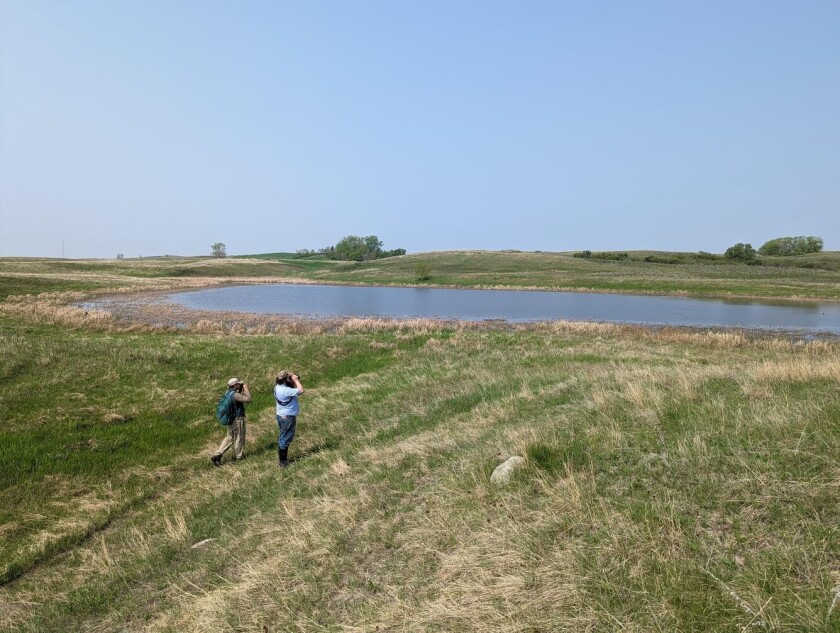
Contributed / Owen McKenna, Northern Prairie Wildlife Research Center
Scientists broadly understand that wetlands and smaller streams play an important role in providing flood protection, water filtration and habitat for wildlife.
“The intermittent streams, all the temporary wetlands, which make up a vast majority of North Dakota’s water, won’t have the same protections as they did, and that has pretty drastic impacts … we have a ton of water that will not have protections and will run off into our tributaries and will end up in the Missouri or Red River,” said John Bradley, executive director of the North Dakota Wildlife Federation.
North Dakota and federal officials on Friday said state agencies would continue to protect the environment, but many of these water bodies are outside of federal jurisdiction.
“Debates over whether something is a wetland or not is an academic exercise that does not practically matter (as it relates to the Clean Water Act),” said Acting Assistant Secretary of the Army D. Lee Forsgren.
The issue has been especially contentious since 2015 when the Obama administration issued the Clean Water Rule that expanded the scope of which wetlands and streams impacted navigable waters.
“More than 80% of North Dakota’s landmass would have been under federal jurisdiction because of our vast presence of prairie potholes and ephemeral features,” said U.S. Sen. Kevin Cramer, R-N.D.
In 2023,
the U.S. Supreme Court ruled that wetlands
could only be regulated under the Clean Water Act if they have a “continuous surface connection” to those larger bodies. The case was filed in 2007 by an Idaho couple, the Sacketts, who could not build a home near a lake because the EPA found the wetlands on their property were federally regulated.
Following the decision, the Biden administration implemented a new rule that it said complied with the Sackett case.
North Dakota state officials and industry disagreed.
Cramer said the new rule required that farmers, homebuilders, mining companies and other industries check first before making an impact to a wetland, which slowed down development and created confusion even in instances where it was very likely that the Clean Water Act did not apply. This in turn makes operating those businesses more expensive.
“What they said is ‘(Before) you drive the speed limit, ask us each time to make sure that you’re not violating the law,'” Cramer said. “The enforcement of all laws is largely based on the premise of people’s compliance with those laws; we don’t walk around looking for jaywalkers, or speeders or armed robbers … you presume that people comply with the laws.”
Critics of the Biden rule also said it was also overly broad in its interpretation of what waters had a continuous surface connection.
The Trump administration’s proposal is likely to end up in courts, Bradley with the Wildlife Federation said.
“WOTUS has been a political football over the last five years, probably longer than that, so I don’t see this as being an end-all, be-all,” he said.
At the listening session on Friday some state and industry leaders asked the EPA to go further in limiting federal authority including exclusions for roadside ditches and wetlands that only overflow once or twice a year.
“Relatively permanent should mean having water all year round and connected to a tributary,” said state Agriculture Commissioner Doug Goehring.
Environmental and wildlife advocates told the EPA on Friday that the agency should not go forward with the rule.
“The removal and degradation of wetlands ensures that more larger and expensive purification facilities will have to be constructed to supply healthy drinking water for all U.S. citizens,” Rick Warhurst of Bismarck said. “Wetlands also provide irreplaceable wildlife and fisheries habitat.”

Tanner Ecker / The Bismarck Tribune
State officials on Friday maintained that North Dakota would continue to have strong water and wildlife protections.
“My goal is I hope the (state Department of Environmental Quality) has 10 more people because that means we are doing more of the work here,” Gov. Kelly Armstrong said.
Bradley said North Dakota does have solid protections on the books, but he is worried about the state implementing them.
“The perfect example is the hog farm that is going through the (regulatory process) right now outside of Devils Lake, which is outside of a waterfowl management area, so right next to water. DEQ has all the tools to protect our wetlands, but they need to be empowered by the state to do that and right now the political pressures really limit that,” he said.
The EPA will take public comment through Jan. 5. To read the rule in full and comment, visit
bit.ly/4oRUDRV.
Search
RECENT PRESS RELEASES
Related Post