Not only is the token price weak—Ethereum is losing to itself.
February 4, 2026
Ethereum feels like a frail, elderly heiress who rejects all innovation while doling out money to the descendants parasitically clinging to her.
Author: Pavel Paramonov
Compiled by: TechFlow
TechFlow Editorial Note: Ethereum is undergoing a profound identity crisis. Veteran crypto researcher Pavel Paramonov issues a piercing challenge in this piece: Why is this former market leader gradually losing its appeal? From the much-criticized “rollup-centric” roadmap—accused of overpromising—to endless ideological debates within the community, and from core talent attrition to a lack of meaningful incentives, Ethereum appears trapped in a cycle of “being correct for correctness’ sake.” This article confronts Ethereum’s growth stagnation beneath its veneer of technical superiority, dissecting why even a visionary leader like Vitalik cannot mask the ecosystem’s fatigue. In this fiercely competitive landscape, will Ethereum rise from the ashes—or, as the author suggests, devolve into a stagnant “old rich auntie” resistant to innovation?
Full Text Below:
This essay was inspired primarily by Vitalik’s recent reflections on the current market state and its evolution. While the entire market is currently declining, it’s difficult to blame any single individual—and I’m certainly not here to assign blame.
My role here is that of someone who has collaborated with multiple Ethereum teams, represented venture capital funds investing in numerous protocols built on Ethereum, and, overall, been a die-hard fan of Ethereum and everything EVM-related.
Unfortunately, I can no longer say the same. I feel Ethereum has lost its sense of direction (a sentiment shared by many).
I won’t dwell on ETH’s price trajectory—but I can’t ignore the fact that the world’s second-largest cryptocurrency behaves with extreme volatility. Regardless of broader market conditions, ETH’s performance increasingly resembles that of a de-pegging stablecoin.
This essay explores what has happened to Ethereum over the past few years—and why many are losing hope, or have already given up entirely. Ethereum isn’t losing to Solana or other competitors; Ethereum is losing to itself.
The Rollup-Centric Roadmap
When Ethereum introduced its “rollup-centric” roadmap, nearly everyone was excited. The promise was clear: rollups (and validiums) would solve scalability, end-user transactions would happen on rollups, and Ethereum would serve as the verification layer—in other words, it would focus on being the L1 for rollups rather than directly serving users.
Building rollups is significantly faster and cheaper than building an L1, so the vision of “thousands of rollups” seemed both feasible and optimistic.
So where did things go wrong?
It turns out, everything went wrong: endless debates, prioritizing ideology over practical needs, infighting within the community, identity crises, and abandoning the “rollup-centric” vision far too late.
Every possible failure point failed. Much of the community once viewed Max Resnick as utterly incompetent and malicious—only to later discover he was almost entirely right.
While at Consensys, Max made numerous public statements about what Ethereum needed to do to progress—but faced near-universal criticism and virtually no support.
The peak of absurdity arrived when the entire industry began debating whether a given L2 “counts as Ethereum”—for example:
- View A: “Base is an extension of Ethereum—we’re making massive contributions to the Ethereum ecosystem.”
- View B: “Base is not an extension of Ethereum—it’s independent.”
What on earth are we even discussing?
How does this kind of dialogue foster a better future for Ethereum and its ecosystem? Why do people fight endlessly over “what counts as Ethereum and what doesn’t”? Don’t we have more urgent problems to solve?
If we define rollups as Ethereum extensions because they use ETH for gas, we’re on the right track. If instead we define them as applications benefiting from Ethereum—not extensions—we’re also on the right track.
Right? Absolutely not.
This ideological debate isn’t really a debate at all—it’s a contest between two “circlejerks,” each trying to prove they’re right. We don’t need PvP (player versus player); we need PvE (player versus environment). We must recognize this isn’t a battle among ourselves—it’s our shared confrontation with real problems and our collective future.
Unfortunately, many would rather indulge in intellectual self-gratification than consider their own views might be wrong.
Technical Superiority Beyond User Needs
Based rollups, booster rollups, native rollups, GigaGas rollups, keystore rollups.
- Which is better? What’s the future? How will they interconnect?
- “This type is the future.” “No—the other type is the future.”
- “There’s no reason not to build based rollups.”
- “Native rollups will dominate the ecosystem because they’re Ethereum-aligned.”
All these discussions… yet Arbitrum and Base continue sweeping the market.
Technical advantages do confer benefits—but only if you’re comparing apples to apples, not apples to pears or oranges to tangerines. They’re too similar for users to care about the distinction. Outside this bubble, nobody cares. One extra precompile or one fewer precompile—you won’t win on that.
“Oh, we’re actually ‘Ethereum-aligned,’ so we have an advantage—we’re deeply connected to Ethereum and embody its core values, so users will choose us.”
I ask: Which values? And which users?
@0xFacet became the first Stage 2 rollup—and they’re practically the textbook definition of “Ethereum-alignment.”
So where are they? Where are their users, developers, technical KOLs, and supporters of Ethereum’s ecosystem and alignment? Where did those people go? How many of you have even heard of Facet? How many usable apps exist on Facet?
I hold no personal bias against Facet. I’ve spoken with its founder many times—I respect him deeply. He’s an outstanding person. But where have all those people gone who used to loudly insist we needed more “Stage 2 rollups”? I don’t know—and neither do you.
Economic incentives vastly outweigh technical incentives. I was once a devoted fan of Taiko—especially its research on based rollups. This model offers many benefits: stronger censorship resistance, neutrality, no sequencer downtime risk, and higher earnings for L1 validators.
So where’s the catch?
The catch lies in the financial logic underpinning the model. You can’t force people to sacrifice income for the sake of “alignment.”
Arbitrum promised sequencer decentralization. Scroll promised it. So did Linea, zkSync, and Optimism. Yet where are those decentralized sequencers?
Every rollup team’s documentation contains this line: “We currently operate a centralized sequencer, but we strongly intend to decentralize it in the future.” Almost none have delivered. Metis did—but fortunately or unfortunately, nobody cares about Metis.
- Do I think they overpromised to curry favor with influential “ETH Maximalists”? Yes.
- Do I think they genuinely want sequencer decentralization? Yes—but it makes no strategic sense for them.
Coinbase (Base) has a legal obligation to maximize profit and create value for the company. Other teams face similar pressures. Why would you deliberately kill your own revenue stream? It makes zero logical sense.
Only about 5% of Base’s revenue flows back to Ethereum. Rollups were never Ethereum extensions.
Taiko once paid Ethereum more for sequencing than it collected from user transaction fees. Clearly, Taiko and others face numerous additional costs beyond paying Ethereum. Only teams willing to forgo revenue can realize the vision of based rollups—or any “Ethereum-aligned” rollup.
I’m not downplaying the importance of decentralization, security, or permissionlessness. But when your sole objective is ideological correctness—not user-centricity—everything becomes meaningless.
Unsurprisingly, this weakness—and the promise of “Ethereum-alignment”—has attracted grifters into the space.
Consequences of the Rollup-Centric Approach
Eclipse, Movement, Blast, Gasp (Mangata), Mantra: None of these protocols were built for long-term viability. Hiding behind masks like “Ethereum-alignment,” “making Ethereum better,” or “bringing SVM to Ethereum” has proven far too easy.
They all “rug-pulled” in one way or another. All rollups realized their tokens were nearly useless—lacking utility—because users pay fees in ETH. Grifters realized they could generate massive hype around the “rollup-centric” narrative, then profit by dumping worthless tokens onto retail investors.
Ethereum has never acknowledged Polygon as a true L2—even though Polygon played a crucial role in locking up ETH value. If you believe rollups are “cultural” extensions of Ethereum, why not acknowledge something tightly integrated with Ethereum’s security and usage?
Polygon was vital to Ethereum during the 2021 bull run, massively contributing to ETH’s growth as an asset. Yet yes—it’s not an L2, and it doesn’t deserve recognition from the Ethereum community. Had Polygon been an L1, its valuation would be significantly higher.
@ri5hitripathi tweeted: Ethereum Foundation (EF) ecosystem insiders labeled Polygon a sidechain because it prioritized scalability over L2 semantics and appeasing the Ethereum community. Seven years later, we see “Polygon was right all along.”
Even Paradigm—arguably the top crypto VC most committed to Ethereum’s ecosystem, having even developed its own L2 (Ithaca)—has pivoted to co-developing an L1 (Tempo) with Stripe.
I believe when even your most loyal believers defect to build your competitors, you’ve clearly done something wrong.
The Ethereum Foundation Has No Direction
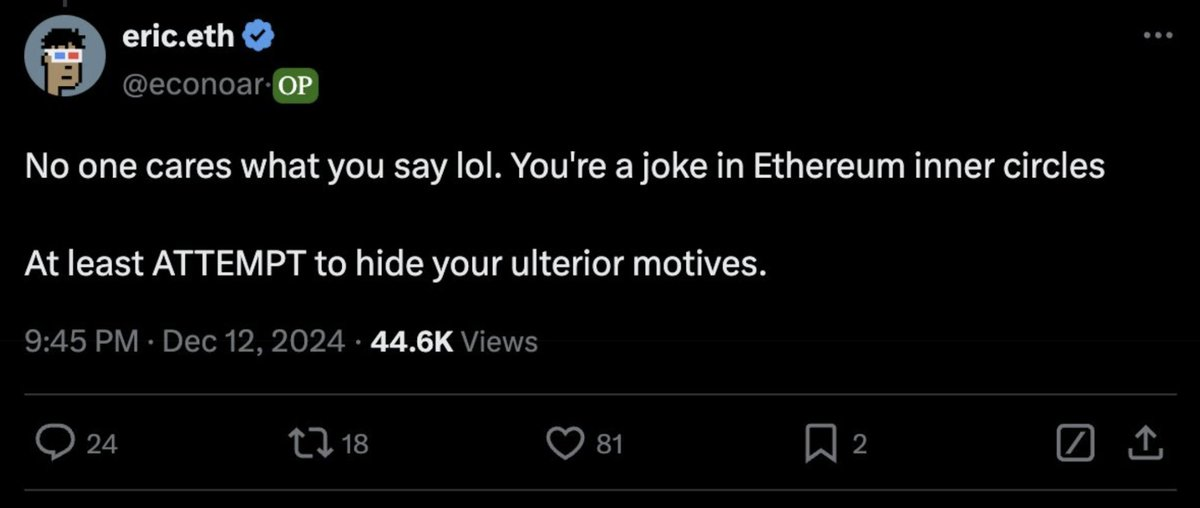
Though technically decentralized, Ethereum is culturally highly centralized around Vitalik. An “inner-circle culture” genuinely exists—as widely observed, success (however defined) hinges largely on gaining attention from Vitalik’s inner circle and endorsement from a handful of highly influential VCs.
I’m not saying you must agree with everything Vitalik says—but his views essentially define what’s “good” or “bad” for Ethereum, and you simply can’t oppose them.
Initially, the narrative was “Ultrasound Money.” Through EIP-1559 and The Merge, ETH’s economic model turned deflationary—positioning it as superior to Bitcoin for value storage. Yet by 2024, ETH’s annualized inflation rate turned positive.
So the “Ultrasound Money” vision lasted just three years? That’s unsustainable as a value store. The narrative has collapsed—and it never truly held water, since ETH was never designed for value storage; that’s Bitcoin’s mission, and ETH can’t compete there.
Then Ethereum got stuck in limbo: Is its token a commodity (but supply dynamics and staking make that imperfect)? Or more like a tech stock (yet insufficient revenue undermines such valuations)?
Some even argue ETH isn’t money at all. What’s going on? We need to pick a direction.
Ethereum can’t have it both ways—you either establish a globally recognized, coherent identity, or you fall behind.
Financial Inspiration
I still can’t fathom how Péter Szilágyi, a lead engineer who contributed so profoundly to Ethereum, earned only ~$100,000 annually. This person, present from day one, helped grow Ethereum’s market cap from near zero to $450 billion—receiving compensation equal to just 0.000001% of that value.
As the most influential and successful protocol in crypto history (after Bitcoin), it offered no equity or meaningful incentives. Hiding behind decentralization, open-source ideals, and permissionless ethos is easy: “We’re here to advance progress—not to get rich.”
But you must incentivize your most loyal contributors—or they’ll leave, or take freelance gigs elsewhere.
- Péter left. Danny Ryan left. Dankrad Feist went straight to Tempo.
- Justin Drake and Dankrad accepted advisory roles at EigenLayer in 2024—with token allocations—and were subsequently vilified by the community.
These underpaid EF staff—earning far less than FAANG engineers or AI lab researchers—were attacked simply for wanting to earn money while helping an independent protocol designed to improve Ethereum.
Are you insane? Sometimes I feel that if you’re an honest, hardworking person inside Ethereum, you’re not allowed to earn money—you’re only expected to slave away for Ethereum’s meager “recognition.”
EF continuously sells ETH to fund operations, initiatives, and research. But perhaps you should start by paying researchers adequately?
Zero Tolerance for Adaptability
“Day One. Ethereum will win. The most decentralized and longest-running blockchain.”
We hear these phrases daily—just as often as we hear Ethereum’s excuses:
- “Yes, Ethereum is expensive and slow—but we have rollups! Just use rollups; rollups *are* Ethereum!”
- “Yes, ETH lags in price—but Ethereum has the largest developer ecosystem, a solid foundation, and demand will come.”
- “Ethereum is the most decentralized blockchain! Solana is garbage—they lack client diversity.”
- “Ethereum runs 100% uptime! Solana is garbage—it’s crashed multiple times.”
- “Ethereum’s network activity is lower than Solana’s. Oh—that’s just spam and memecoin gamblers on Solana. We’re the ethical chain!”
The same excuses, answers, and responses—year after year. Everything except Ethereum and rollups is trash. If Ethereum underperforms on any metric, we declare it’s still “Day One,” assert we know what we’re doing, and insist there’s nowhere better than Ethereum.
Everyone is sick of hearing the community recycle the same excuses.
Ethereum feels like a stumbling, aging rich auntie—refusing all innovation while doling out money to parasitic descendants.
Can the Damage Be Undone?
Just hours before finishing this essay, Vitalik tweeted that the “rollup-centric” roadmap had failed—and that Ethereum needs to explore alternative paths, including scaling the L1.
You know what? I’m genuinely glad to see people acknowledge their mistakes publicly—it takes courage. But I fear it may already be too late. Ethereum has again identified a long-term path forward—but progress remains painfully slow.
Recent changes at EF include new leadership, treasury transparency, and R&D department restructuring. EF has begun hiring young talent from DevRel and marketing—Abbas Khan, Binji, Lou3e, and others.
But change must accelerate. Ethereum must sprint to prove everyone wrong.
We’ll wait and see. After these reforms and EF’s organizational shifts—can Ethereum once again become exciting, rather than merely synonymous with blind delusion and disappointment?
Search
RECENT PRESS RELEASES
Related Post