Nvidia CEO tries to explain why DLSS 5 isn’t just “AI slop”
March 23, 2026
If game makers don’t like it, “they could decide not to use it, you know?”
Credit:
Nvidia / Bethesda
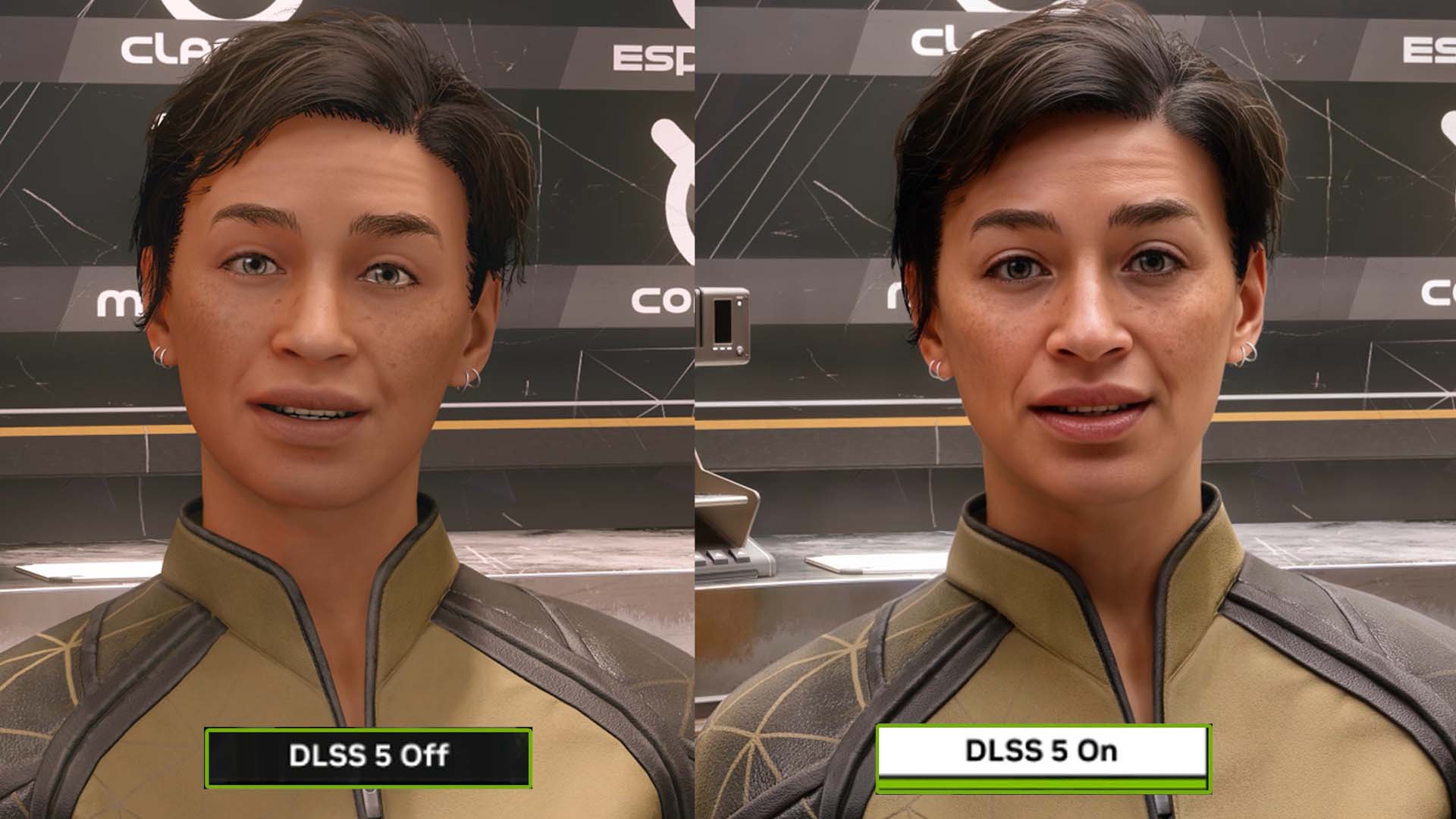
Last week, Nvidia’s public reveal of DLSS 5—and its “generative AI” enhanced glow-ups of gaming scenes—drew widespread condemnation from the gaming community. In a podcast published Monday, though, Nvidia CEO Jensen Huang tried to differentiate the technology’s optional, artist-guided graphical enhancements from the “AI slop” that Huang says he’s not a fan of.
As part of a nearly two-hour-long interview with the Lex Fridman Podcast, Huang was asked to explain the “drama” around DLSS 5 and “the gamers online [that] were concerned that it makes games look like AI slop.” Huang responded that he “could see where they’re coming from, because I don’t love AI slop myself… all of the AI-generated content increasingly looks similar and they’re all beautiful, so… I’m empathetic towards what they’re thinking.”
At the same time, Huang said DLSS 5 is decidedly separate that kind of “slop,” because it “is 3D conditioned, 3D guided.” The artists behind a game are still the ones creating the in-game structural geometry and textures that form the “ground truth structure” that DLSS 5 works from, Huang said. “And so every single frame, it enhances but it doesn’t change anything,” he said.
For the most part, though, gamers haven’t been worried about DLSS 5 creating trippy new content from the ground up like some generative AI world models. Instead, the worry is that DLSS 5’s visual “enhancements” could end up smoothing out many disparate games toward a single, flattened, homogenized photo-realism standard.
That’s a misunderstanding of how DLSS 5 works, Huang said. It’s not a technology where a game ships in one state and “then we’re gonna post-process it,” he said. Instead, DLSS 5 “is integrated with the artist, and so it’s about giving the artist the tool of AI, the tool of generative AI.”
Because DLSS 5 is “open,” Huang said artists can train the model for the specific kind of look they want. In the future, Huang said artists will also be able to prompt DLSS 5 with examples or a description of a desired look—“I want it to be a toon shader,” for instance. And if visual artists want to use DLSS 5’s models “to generate the opposite of photoreal, yeah, it’ll do that too,” he said.
The interview follows similar comments Huang gave in an interview with Tom’s Hardware last week, when he said “it’s not post-processing at the frame level, it’s generative control at the geometry level.”
But any “confusion” on this point from gamers is entirely understandable since previous versions of DLSS were explicitly sold as relatively turnkey post-processing to improve resolutions and/or frame rates by generating new frames that look like the ones rendered by the game itself. If Nvidia wanted to introduce a new artist-facing tool for using generative AI to create customizable shader-style effects, they could have done so without overturning the existing and well-known meaning and branding of DLSS.
Elsewhere in the new podcast, Huang threw in an aside that if artists don’t like the look of DLSS 5’s enhancements, “they could decide not to use it, you know?” Whether or not individual artists want to use DLSS 5, though, Nvidia’s announced partnerships with major publishers including Bethesda, Capcom, NetEase, NCSoft, Tencent, Ubisoft, and Warner Bros. Games. suggest that the companies behind many big-budget games will be pushing the technology’s use in their projects at least for the time being. And while gamers will also be able to disable DLSS 5’s “enhancements” if they don’t like the way they look, that’s not exactly the affirmative defense of the technology that generative AI boosters may have been hoping for out of Nvidia.
We still have months to go until Nvidia’s planned debut of DLSS 5 in any actual games. We expect Huang and others at Nvidia will be spending a good deal of that time trying to explain and justify the new technology to a skeptical gaming public.
Search
RECENT PRESS RELEASES
Related Post