Ohio has blocked a lot of wind and solar. Its residents pay the price.
June 5, 2026
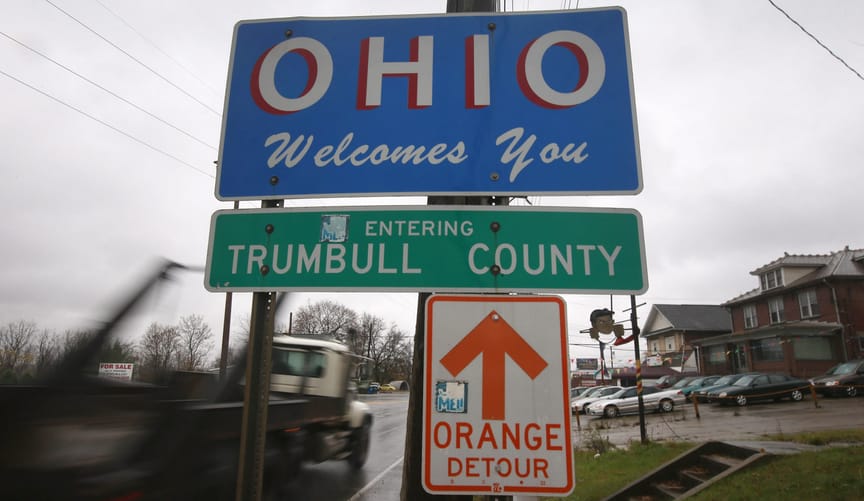
Last week, the Ohio Supreme Court blocked a permit for what would be the state’s largest solar installation. The 800-megawatt Oak Run Solar Project still has a pathway to completion — the court reversed only one part of the state siting board’s prior approval — but it remains unclear how things will play out.
This is just the latest example of how state lawmakers and other officials have obstructed renewable energy development in Ohio. In total, they have thwarted more than 5.3 gigawatts of solar and wind projects over the last dozen years.
So says a recent analysis released by Save Ohio Parks, which opposes fracking and oil and gas extraction from public lands.
“It’s a lot of inexpensive power that we don’t have available to us. And it means fewer choices for consumers,” said Tom Bullock, executive director for the Citizens Utility Board of Ohio. “Boy, would that come in handy right now when electricity prices keep going up, up, up.”
Ohio, like many other states, is facing rising utility bills as well as massive new energy demand due to a wave of proposed data centers. The Save Ohio Parks report contends that clean energy could have helped rein in those energy costs while meeting a huge chunk of data centers’ demand if Ohio had allowed more development. The 5.3 GW of blocked clean energy would have also avoided large amounts of greenhouse gas emissions and local air pollution.
The state stepped up its pushback on wind and solar as each of those clean energy sources became more cost-competitive with fossil fuels and nuclear power.
A 2014 law that more than doubled property-line setbacks for wind turbines effectively blocked over 3.3 GW of utility-scale projects in the state, the report notes. Efforts in 2017 to roll back those restrictions failed, leaving Ohio among the nation’s most restrictive states for wind power.
“The economics of a wind farm don’t work when you need that amount of setback from a property line,” said Rachel Kutzley, a Save Ohio Parks board member who worked on the report.
Seven years later, Gov. Mike DeWine signed Senate Bill 52, which lets counties ban new solar projects above 50 MW of capacity and “economically significant” wind farms able to produce more than 5 MW of electricity. SB 52 doesn’t let counties ban power plants that use fossil fuels or nuclear power.
Neither the Save Ohio Parks report nor a February 2026 paper in the journal Frontiers in Sustainable Energy Policy quantified how much clean energy generation the bans by Ohio counties have prevented.
Projects that were already in grid operator PJM Interconnection’s queue are not subject to outright bans under SB 52. The Ohio Power Siting Board, however, can deny permits for individual projects — and since 2021 it has rejected eight installations, making Ohio one of the toughest states for developing clean energy. The board has routinely referenced local government opposition when rejecting projects.
Those eight rulings alone have killed more than 1.1 GW of solar generation.
Developers withdrew five other applications for projects that would have added roughly another 1 GW, after adverse recommendations from the Power Siting Board’s staff or significant local pushback made it likely the full board would deny permits. The Kingwood Solar case, which challenges the board’s deference to local government opposition, is due to be decided soon.
Matt Schilling, a spokesperson for the Ohio Power Siting Board and Public Utilities Commission of Ohio, said he did not have a comment on the report from Save Ohio Parks. “However, I will observe OPSB has approved 49 solar projects across Ohio with nameplate capacity totaling 9,250 MW,” he added.
Only about one-third of those approvals were for permit applications filed after SB 52’s effective date.
It’s not just solar and wind — Ohio has also stymied energy-efficiency efforts over the years, which would have additionally cut down on pollution and saved money for residents. The Save Ohio Parks’ report doesn’t consider the effects of the state’s infamous House Bill 6, which eliminated utilities’ energy-efficiency requirements after 2020.
Those impacts would have been quite sizable, said Mike Specian, a utilities manager with the American Council for an Energy-Efficient Economy, who shared his separate analysis with Canary Media.
If utilities had continued to achieve energy savings for customers after 2020, the cumulative savings could have been as much as 70 terawatt-hours, or 70 million megawatt-hours, Specian said. That high number is partially because energy-efficiency investments provide benefits, on average, for nearly a decade. “Those savings deliver year over year over year,” he said.
The mix of thwarted solar and wind projects alone likely would have displaced 7.1 million metric tons of carbon dioxide emissions from fossil fuel plants, said Ben King, a director with research firm Rhodium Group’s energy and climate practice. Carbon dioxide is a major greenhouse gas that drives human-caused climate change.
King based that estimate on results from the Environmental Protection Agency’s Avoided Emissions and Generation Tool. Ohio’s lost clean energy generation could have cut millions of metric tons of pollution from sulfur dioxide, nitrogen oxides, and other pollutants with harmful health effects as well, the EPA tool shows.
The lost clean energy opportunities are also impacting consumers’ finances, although it’s hard to tell exactly how much because electricity prices reflect multiple components.
Ohio gets about 7.5% of its electricity from wind and solar, compared with 80.6% from coal and gas, according to federal data for 2025.
When it comes to the electricity dispatch market, “the generation we have less of is the least expensive in Ohio,” said Ashley Brown, a former member of the Public Utilities Commission of Ohio. Solar and wind have no fuel costs, so their marginal costs for producing energy are very low. That competition also reins in bidding by producers of other forms of electricity, particularly fossil fuels, whose prices have soared even higher because of the Trump administration’s war on Iran.
“It really does force enormous price pressure on other forms of generation,” Brown said.
Less solar and wind generation has some effect on the capacity market, the mechanism PJM uses to ensure it will have enough energy producers available to meet future demand spikes. Last year, capacity made up about 16% of the wholesale cost of electricity, noted Jeff Shields, PJM’s senior manager for external communications. Even though renewables count less toward capacity than other types of energy, “we can use all the capacity we can get,” he said.
Renewables’ ability to come online more quickly than other sources could do a lot to curb inflation, said Bullock at the Citizens Utility Board of Ohio. “Unless Ohio takes action, consumers are locked on this escalator. We’re strapped to the escalator that keeps going up.”
Nevertheless, some Ohio lawmakers seem intent on making it harder — not easier — to build new clean energy projects in the state.
SB 294, reported out of the Senate Energy Committee on June 2, would further cement the state’s preferences for natural gas and nuclear power — and potentially make it even harder to get approval from regulators for solar and wind.
{
if ($event.target.classList.contains(‘hs-richtext’)) {
if ($event.target.textContent === ‘+ more options’) {
$event.target.remove();
open = true;
}
}
}”
>
Search
RECENT PRESS RELEASES
Related Post