Oil and Gas=Peril and Poverty/ Solar and Wind=Prosperity and Protection
April 7, 2026
2026 has changed the psychological meaning of energy forever
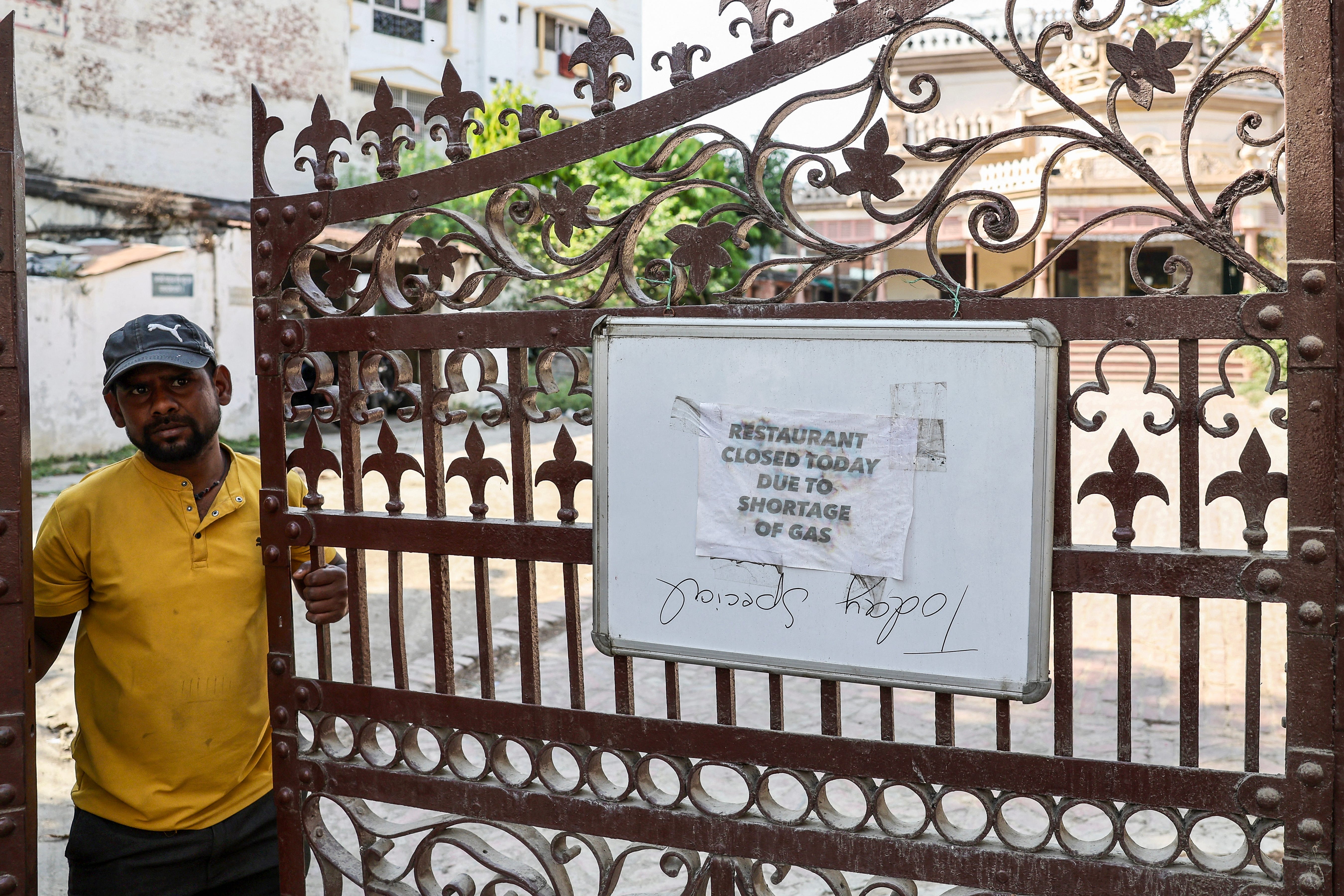
While we wait to see what variety of war crimes Donald Trump decides on following his 8 pm deadline tonight, I think we can assess one outcome of this stupid war already: both the emotional valence and the structural understanding of different energy sources has shifted, and for good. Meaning takes a very long time to erode, but when it does the switch can come quickly; we’re living at a hinge moment, and on the other side of the door is a different world. We tend to think about energy in hard terms—kilowatts, dollars—but in the end our visceral sense of the path forward is what matters most, because attitude informs decision without us even quite realizing it. The world between our ears has changed, decisively, in the direction of renewable power from the sun and wind
Let’s begin by understanding the deep, underpinning role that fossil fuel has played in modernity, both its reality and its psychology. What we call the Industrial Revolution means simply that we learned to control the combustion of coal, then oil, then gas, and in the process gave human life a sweeping set of new powers. Suddenly mobility—the train, the car, the plane—was easy; suddenly muscle power gave way to the genies in a barrel of petroleum, summonable at will to perform endless tasks. Fossil fuel was freedom and power, and this understanding—again, both emotional and structural—set in very deep.
Deep enough that it was able to survive the emerging problems it created. When pollution dimmed cities in the 1960s, that gave rise to the first Earth Day—and to the catalytic converters and the smokestack filters that reduced the problem enough that it never challenged hydrocarbon dominance: we could have our cake and breathe it too. The oil shocks of the 1970s threatened that dominance in the targeted U.S. but didn’t quite topple it; the Reagan program of dramatically increased drilling, and the extension of America’s military shield to the Middle East, gave us enough sense of safety that we stayed on course.
Rising fears about climate change seemed set to tarnish fossil fuel—after all, it now threatened an end to the physical future of our civilizations—but the effects of global warming have in the early stages been sporadic and local, and when the heatwave fades or the fire goes out or the flood recedes we’ve generally reverted back to the perceived and comforting inevitability of fossil fuel. It’s what we’ve known, and hence we’ve put up with a lot to keep the relationship going.
But there’s been nothing sporadic or local about the effects of this war. As tanker traffic through the Strait of Hormuz slowed and then stopped, the effects have been dramatic, immediate, and global. In Thailand farmers report they can’t find diesel to keep the pumps that irrigate rice paddies running; in Myanmar, as fertilizer prices soar, the World Food Program has warned that food production costs could double compared with last year’s harvest, in a country where a quarter of the population is already facing acute hunger. There are things we can change to cut energy use (the Thai prime minister said AC units should be set at 80 degrees, and that bureaucrats should stop wearing neckties “except for ceremonies”) but other customs are harder to rearrange: bodies are piling up at Thai temples because they’re out of fuel for cremations. In Bangladesh, the prime minister has turned off most of the lights in his office, and economic life is changing by the week.
“I used to do 15 trips a day. Now I spend hours just looking for a pump that’s open, and sometimes I go home empty,” said Sohel Sarker, 38, a ridesharing biker in Dhaka. “I don’t know from one day to the next whether I’ll find fuel.”
These anecdotes add up to much more. As a team from the Financial Times concluded after a global inventory of the shifts,
High fuel prices and shortages force consumers to buy fewer goods. Businesses invest less and governments conserve scarce resources, causing economies to experience weaker growth. The enduring disruption of an energy shock can trigger the destruction of demand, driving economies towards stagnation and recession.
But that’s the macro level. At the micro level, it’s as much about psychology as anything else. The Guardian published an excellent account of how fuel shortages are affecting daily life around the world, and I found myself thinking about the words of another Thai, Teerayut Ruenrerng, owner of a mobile grocery truck:
At about midday, I return home from my morning selling session. I’ll pass three gas stations on the way and stop at each one. Sometimes I can get fuel, sometimes I can’t. Sometimes they will only give me 300 baht or 500 baht (US$9.15 to US$15.25) worth. At lunchtime I take a break, and sleep for about an hour. I start work at midnight.
If I’m able to fill up a full tank, I can relax because I know I don’t need to search for gas for at least three days and it’s guaranteed I can go out and sell. But if I can’t find any, I start to get stressed and panic about what I’ll do if I can’t get fuel.
Here’s an interior designer in Sydney:
It’s frightening, because you don’t know how long it’s going to go on for.
I just started looking for jobs, because I don’t know whether people are even going to want to spend money on renovating right now, or are going to want a designer. I’m pretty much throwing everything at it, which I think is part of the panic setting in.
And here’s a warehouse worker in Delhi:
As I get ready for work, my eyes keep returning to the gas stove. I last ate yesterday afternoon, some lentils with chapatis. It has been more than a day. I am very hungry, but there is only enough gas left for four or five meals. I hold back, saving it for worse days. There are a couple of cucumbers and tomatoes. I will cut them, add salt, and eat that, and save one more day.
Now, just think of that for a moment. The gas stove, to an Indian, is suddenly a symbol of scarcity, deprivation, fear. The stuff that supplies it comes from somewhere distant over which he has no control—if Donald Trump gets an idea, or the Islamic Republican Guards get an idea, then the flow on which it depends can stop, and then he goes hungry, counting how many meals his canister might still contain. Multiply this by a few billion people and a few key facets of each life—dinner, commute, heat, cold—and you end up with a profoundly different mindset.
In the very short run, that may mean that countries like India lurch towards coal—fairly cheap, and fairly easily available. The forecast for May and June in India is even hotter than usual before the monsoon descends, and according to Bloomberg the country is preparing to burn more of the black rocks to keep air conditioners running. Even a few years ago, that would have been the country’s only real recourse: belt-tightening, and shifting to a different fossil fuel. But the Trumpian revelations about the undependability of fossil fuel come at a significant moment in human history, a moment when we have—again, suddenly—a very different choice. As David Fickling reports
With the LNG drought pushing up electricity prices and photovoltaics providing a cheaper, easier alternative, a boom in rooftop solar is far more likely than a return to coal. Don’t look under the ground for the solution to the LNG crisis. The answer is in the skies.
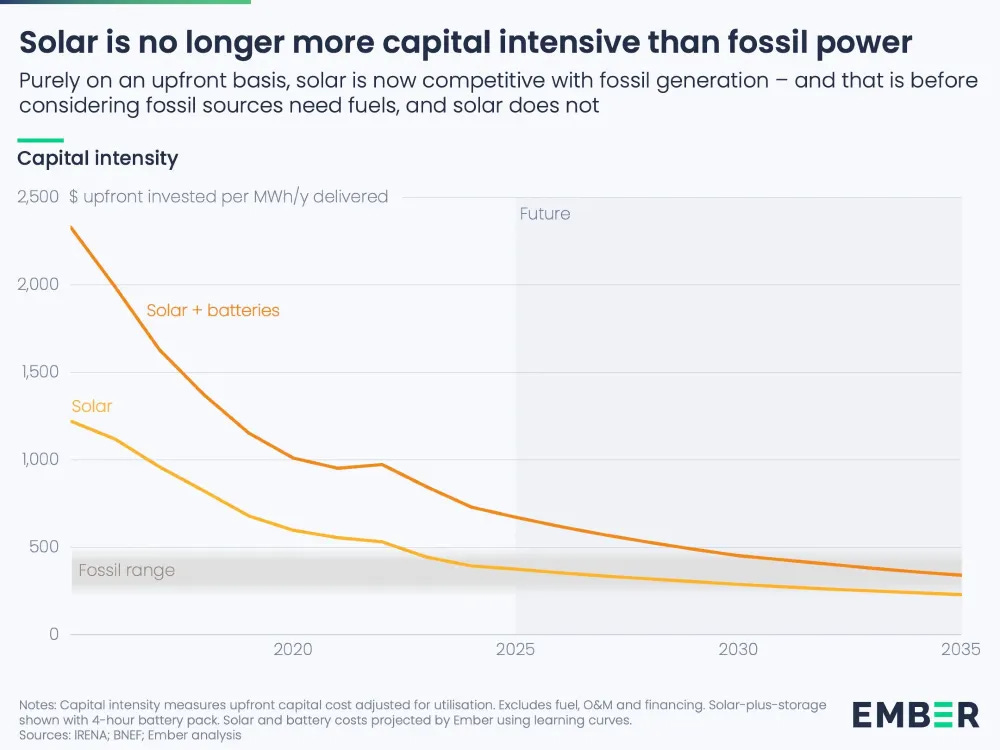
Here’s a chart worth looking at, from the thinktank Ember. It requires a bit of explaining. The old story about clean energy—that is, the story of the last five years—is that it was cheaper to operate than fossil fuel power, because the fuel (sunshine) was free, but that the upfront costs were higher because you had to build those solar panels. But now it’s so cheap to build the solar panels that from the jump it make sense to switch. That gray band at the bottom is the price of the fossil fuel system, and that orange line is solar with batteries, which provides the same reliable power. Again, this is the upfront cost—in the long run, of course, the solar system is hugely cheaper, because, again, the sun delivers the energy for free when it rises above the horizon.
Anyway, let’s think about India and stoves again. For a long time if you wanted to cook your food in India, you needed to go out and gather firewood or dung, something that took a long time (and was a chore usually assigned to women). When you burned it, you had to tend the fire carefully, and you (and your kids) breathed a lot of bad stuff. There have been many attempts to supply alternative cookstoves, but they never worked very well. But now—well, now, the government is moving quickly to boost production and import of induction cooktops. An induction cooktop—I’m simmering chowder on mine as I write—produces heat for cooking without much electricity, and that electricity can be supplied by solar panels and batteries, which are cheap. Suddenly the stuff we want from energy comes more easily, more dependably, and more affordably from the sun and wind.
This is happening, all of a sudden, everywhere and with everything. Here’s a Pakistani farmer explaining why, with a solar panel to run his irrigation pump, he no longer cares about the supply of gas from the Gulf:
“Now, I don’t care if the prices of diesel increase,” he says, proudly pointing to the sun above. “As long as there is this sun, I can grow my watermelons.”
In Europe, the online marketplace Olx reported a huge jump in inquiries about EVs—for instance, in France (up 50 percent), Portugal (up 54 percent), Romania (up 40 percent), and Poland (up 39 percent). From Jakob Steinschaden, news exported a total of 120,083 electric and hybrid vehicles in March 2026, an increase of 65 percent compared to March 2025. The Washington Post reported yesterday that shares in China’s biggest battery maker had jumped by nearly a third since the war began.
Indonesian President Prabowo Subianto said in March that his government would build 100 gigawatts of solar power in the next two years. Philippines’ state-owned pension is offering loans of up to $8,300 for members to buy and install solar power for their homes.
When Abraham Maslow first detailed the hierarchy of human needs, he put our physiological needs—food, shelter—at the bottom, and just above them our need for stability and security. There have been critiques of his theory, but the basic idea stands. What’s curious about renewable energy is that it’s always filled higher-order desires—for belonging, for esteem—better than fossil fuel; poll after poll shows that pretty much everyone understands that, all things equal, it’s better not to pollute the air. But now clean energy fills those most basic psychological requirements better too.
Think of the amount of money the fossil fuel industry has spent over the years to invest oil and gas with psychological power: who could forget, for instance, the campaign that Rebecca Leber uncovered years ago that paid cash to influencers to gush about the homeyness of cooking with gas.
“#cookingwithgas makes food taste better,” says Camille, an LA-based foodie who poses artfully with her spatula, to her 16,700 followers.
But that’s not what cooking with gas means any more. Now it means wondering about the supply. The sun already provides us with warmth, with light, and via photosynthesis our supper—we have a pretty good psychological relationship with the sun already. When it comes out, we smile. And so the idea that it will happily supply us with all the power we need won’t be a hard sell.
Security fears keep ordinary people awake at night, but also elites. Here’sFrank Elderson, a member of the board of the European Central Bank, writing earlier today in the bank’s official blog, and in the bloodless language of bureaucrats he says: More sun now
Europe cannot eliminate geopolitical risk, but it can significantly reduce its exposure to it. The most effective way to do that is by cutting reliance on imported fossil fuels and accelerating an orderly shift to home‑grown clean energy. If Europe were to meet its sustainable energy targets, the link between domestic energy prices and volatile global energy markets would weaken substantially.
Donald Trump has managed to break the two-century-old grip of fossil fuel on the human imagination. As he explained to the GOP House caucus last month, “no other president can do some of the shit I’m doing.”
In other climate and energy news:
+I’m fairly certain most of the readers of this newsletter will be considering the Rolls Royce Black Badge Spectra as their next ride. The Wall Street Journal reports that the latest EV from the British carmaker is
utterly gorgeous, an eye-filling joy in the walkaround: The daringly raked windscreen and fastback flyline, the tapering cabin slung back behind the endless hood, the audacity of wheels and tires, all drawn in superhero proportions. If Rolls-Royce is about delivering world-apart experiences to its clients, the Spectre certainly represents. Behold, the most beautiful big car I’ve ever laid eyes on, and I’ve laid my eyes on plenty.
Weirdly, though, it only gets about 240 miles on a charge. Speaking for myself, I think I’d rather have the new QQ3, from the Chinese automaker Chery; it racked up 57,000 orders in its first few days, in part because it costs $8,500 (which means that you could buy about 65 of them for the price of one Rolls). And its range is longer by about twenty miles. Also, it comes with a
12.8″ infotainment screen. Higher-priced trims gain a 15.6″ 2.5K central touchscreen. Powered by a Qualcomm 8155 cockpit chip, the system supports +30 WeChat mini-programs, enabling drivers to sing karaoke, play games, and more.
Karaoke! Take that, Rolls!
+Rooftop solar now accounts for a full fifth of all electricity generation in Puerto Rico, a true success story on an island where electric utilities (as that energy expert Bad Bunny pointed out at halftime of the Super Bowl) have been corrupt, expensive, and slow-to-repair after every storm. As Ben Zientara reports,
The growth rate in rooftop solar capacity has outpaced all other energy sources in Puerto Rico over the last decade. According to EIA data, distributed solar installations represented 81% of all new generating capacity added to the island’s grid between 2016 and 2025.
During 2025 alone, an average of 3,850 rooftop systems were installed at homes and businesses each month, bringing the total number of active systems in the territory to 191,929 by the end of the year.
+From Collin Eaton in the Wall St. Journal, an in-depth account of the very expensive lie that Exxon told about algae as a potential source of oil for many years.
The Journal reviewed an internal presentation made in early 2020 by Exxon’s scientists and examined other documents related to Exxon’s efforts on algae. Some of the documents—none of which have been previously reported—show executives knew the $500 million algae research project wasn’t meeting its goals outside the lab, even as they continued to promote it to investors as a potential boon.
Members of Exxon’s investor-relations team and leading researchers exchanged a flurry of communications discussing algae’s low productivity outside the lab and how to highlight the program to investors in the days ahead of the presentation, the documents show.
Exxon scientists made their February 2020 presentation to T.J. Wojnar, who was the company’s vice president of corporate strategic planning and guided capital allocation and investment strategies. Among Wojnar’s responsibilities at the time were briefing the management committee on various company projects and preparing investor presentations.
The scientists explained to Wojnar that the best strains of algae, when grown in large outdoor ponds, were producing oil at roughly 6% of Exxon’s stated goal.
They further concluded that even if geneticists were able to speed oil production, it would be uneconomical. To produce 10,000 barrels of algae-based biofuel a day, they estimated Exxon would need to build 35 square miles of ponds—an area six times the size of downtown Los Angeles—that would have to process more saltwater than the entire city consumes in fresh water daily.
+Trump is shutting down most of the research stations of the US Forest Service (and “reorganizing” it in a way that will profoundly damage, among many other things, its climate science. My account in the New Yorker. Meanwhile, the Balanced Weather substack has a comprehensive accounting of the planned cuts to science funding in the year ahead, as we continue with the Pol Potification of American society. For instance:
The NASA Science appropriation — which (per the budget document) funds NASA’s Earth Science, Planetary Science, Heliophysics, Biological and Physical Sciences, and Astrophysics — has a proposed topline FY27 budget of $3.894B, a reduction of $3.356B or about 42%. This is the appropriation that funds most of NASA’s atmospheric sciences and space weather research.
Remember, if you don’t measure the warming, then you can’t feel it.
+The Intergovernmental Panel on Climate Change—the global scientific body that keeps humanity posted on its greatest threat—is facing huge problems after the US stopped providing any funding. The IPCC—which runs on volunteer efforts by scientists—needs a budget of about $9 million, otherwise known as 12.9 minutes of the current American cost of the war in Iran. As Bob Berwyn reports,
The $2 million gap left by the withdrawal of U.S. funding could be filled by five or six other countries each contributing less than half a million dollars, but the money is only the tip of the iceberg, said Mike Hulme, a professor of human geography at the University of Cambridge who has studied the IPCC for years.
“We may be seeing a fraying of the tacit assumptions that held the IPCC together,” Hulme said. Recent troubles point to deeper uncertainties about the health of global climate agreements, which could be facing “if not a dissolution, maybe a fragmentation or repositioning,” he said. Other signs of strain include countries “falling back on side deals and parallel initiatives when consensus breaks down,” he said, referring to non-binding agreements adjacent to the United Nations climate framework, including forest-planting initiatives and methane-reduction pledges.
At the recent Bangkok meeting, independent observers for the Earth Negotiations Bulletin said the lack of agreement on a formal timeline at this stage of an IPCC cycle was unprecedented. The Earth Negotiations Bulletin is a reporting service of the International Institute for Sustainable Development that monitors and analyzes global environmental negotiations.
+Superb video from the folks at Third Act Bay Area, who are pushing for a climate superfund bill in the California legislature. The video features survivors of the great Los Angeles fires, and it back up the main argument for the bill
The superfund would assess the biggest fossil fuel polluters in California for the harm they have caused. Those funds would enable California to respond to climate catastrophes, build climate-resilient communities with sustainable infrastructure, support workers suffering from climate-related illnesses, and begin a just transition away from fossil fuels. The biggest polluters have had an outsized role in nearly destroying our climate and have lied about their complicity. They need to pay for what they’ve done so we can pull our state back from the brink.
Meanwhile, tiny Vermont is standing up to the oil industry in defense of its own version of the law. As Karen Zraick reports,
Vermont was the first state to pass such a law, in 2024. New York is the only other state to have done so since then, and is also facing a lawsuit filed by the Trump administration. But the idea is gaining momentum across the country, with a number of other state legislatures advancing similar measures…
Jonathan Rose, who represented Vermont at the hearing, began by striking at the heart of that argument. “We don’t need to convince the court that climate change presents serious challenges to the state of Vermont,” Mr. Rose said. “The act is intended to recover some of the costs it’s going to need to adapt to climate change,” he said.
+Book alert: Just got my early copy of Climate Wayfinding, by Katherine Wilkinson, due out very soon with an extensive book tour beginning next week.
+Several of Trump’s henchmen celebrated Holy Week by convening the “God Squad” for the first time in 30 years—and after a meeting of 15 minutes decided to exempt new drilling plans in the Gulf of Mexico from the endangered species act. Jake Spring in the Washington Post
There are currently about 51 Rice’s whales left, according to the Center for Biological Diversity. The population collapsed following the 2010 Deepwater Horizon explosion at a BP-operated oil rig, which resulted in the largest-ever marine oil spill. The charcoal-colored whales — which were declared as a separate species in 2021 — have distinctive ridges on their heads and grow to about 40 feet long
+Tripti Lahiri, Krishna Pokharel, and Emma Brown offer an in-depth account of climate change’s scarier phenomena. As big glaciers melt, especially in the Himalayas, new lakes form in the valleys below—often held in place by rocks and ice, until the pressure grows too great, the dams blow out, and huge waves of water come crashing down on cities and villages below
Between 1990 and 2018, the volume of the world’s glacial lakes expanded by nearly 50%, according to the first global survey of these lakes. It was led by Daniel Shugar, a geomorphologist at the University of Calgary in Canada, and is based on an analysis of a quarter of a million NASA satellite images. It showed that the amount of water the lakes have added was about double the volume of Italy’s Lake Como.
In the Himalayas, which span Pakistan, India, Nepal, Bhutan and China, the impact of a lake burst can be particularly destructive. These lakes are often located at high altitudes, sitting above river systems that help channel burst waters far downhill. At the same time, countries have added new hydropower and other infrastructure below them.
+Whaddya know, the same banks that back the fossil fuel industry are also underwriting the surveillance industry that ICE relies on for its dirty work. Stand.earth, which has been a leader in fossil fuel divestment, has issued a new report on the wayts the banks are invested in
-
Palantir, a tech company that provides custom apps and software that ICE uses to surveil and deport immigrants
-
GEO Group, the world’s second-largest private prison company and ICE’s largest contractor; builds and operates detention centers for ICE
-
Core Civic, one of the largest private prison companies and among ICE’s largest contractors
-
General Dynamics, a weapons company that provides DHS with surveillance technology, including a system with personal information that ICE used to deport 450,000 people
+Extremely useful video from the good people at Solar United Neighbors, detailing the difference between plug-in solar, and pug in solar. You really better watch it

Search
RECENT PRESS RELEASES
Related Post