Opinion | Should government solve cannabis industry’s debt crisis?
March 15, 2026
Companies too often fail to pay suppliers

Massachusetts’ cannabis industry is awash in debt. Often, pot shops, cultivators, and associated companies can’t pay their lenders, taxes, or suppliers.
What to do about this debt — and whether government should get involved — is being hotly debated among regulators, lawmakers, and within the industry itself.
As the Globe reported, the debt highlights a broader struggle. An oversaturation of marijuana plants have cratered prices in an industry in which shops, growers, and other marijuana-focused companies lack access to traditional financial tools, like bank loans. Entrepreneurs expecting a gold rush have been disappointed.
The fact that Massachusetts residents are consuming less marijuana than optimistic entrepreneurs expected is not, in itself, a bad thing. Just because cannabis is now legal doesn’t mean it’s good for you. And low prices are good for those who do choose to consume.
Ideally, a free market would rightsize itself and prices would stabilize at a sustainable level. Companies would decide who to do business with; a grower could choose to shun a shop that doesn’t pay its debts, for example.
But where the market is already distorted by federal prohibition, there might need to be some intervention. After all, the marijuana industry is part of Massachusetts’ economy, generating $289 million in taxes last year and employing 21,000 people.
Some industry challenges stem from rules treating cannabis differently from other businesses. Stores and growers make “impact” payments to localities that other types of businesses do not to cover things like extra policing. Companies pay higher federal taxes because federal law considers them illegal. They can’t access traditional bank loans, relying instead on private lenders and financing firms that may offer less-favorable terms. Municipal zoning restrictions lead to exorbitant rents. Strict regulations governing things like security and product tracking make doing business expensive.
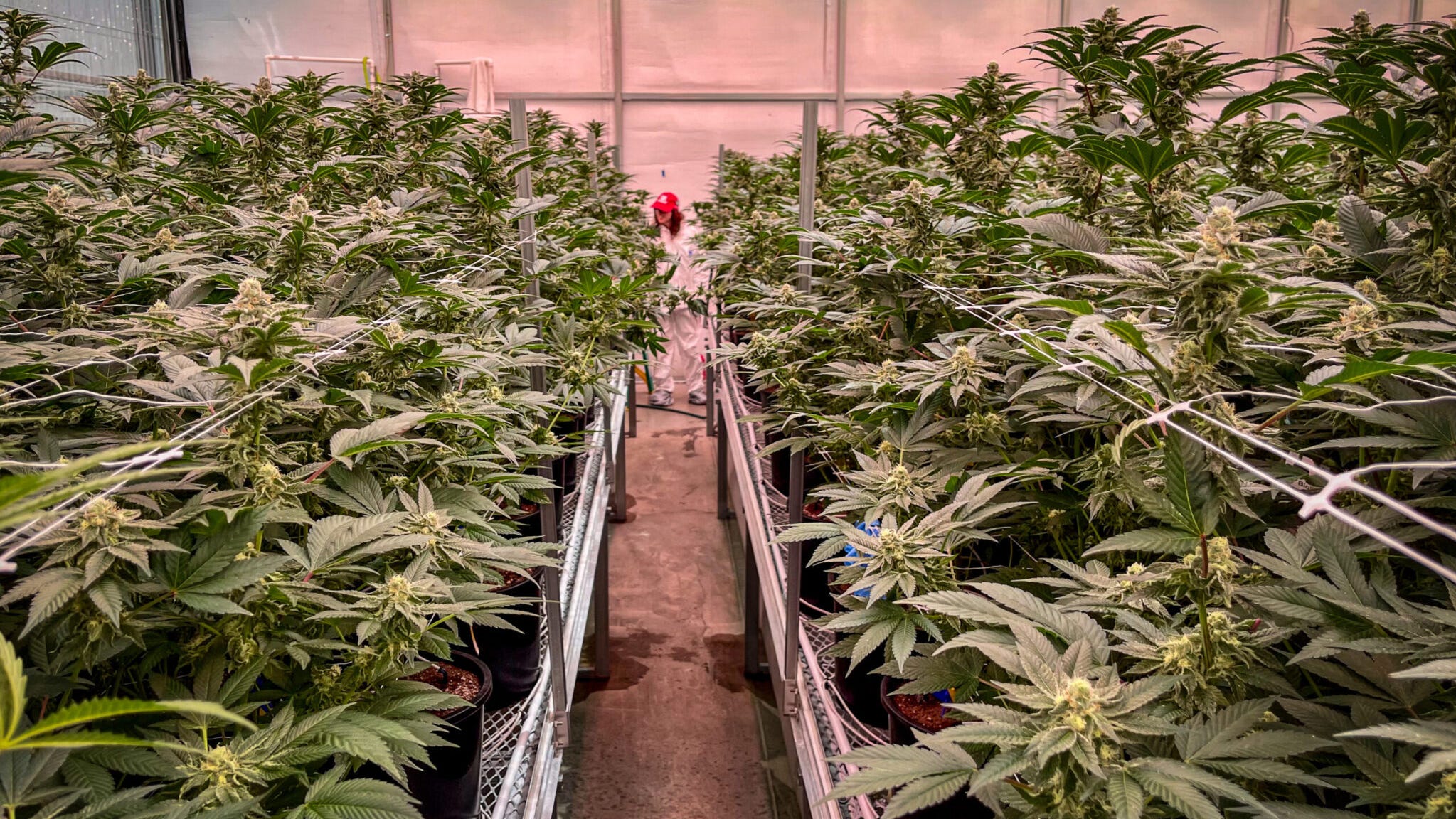
As more marijuana is grown, the market has become saturated. There were 113 million plants harvested in December 2025 compared to around 10 million in late 2020. As a result, this January, the average retail price for one ounce of flower was $114.82, down from more than $400 in 2020, according to Cannabis Control Commission data.
Ellen Rosenfeld, president of Medway-based marijuana cultivation and retail company CommCan, used to give retailers who bought CommCan’s marijuana wholesale up to 30 days to pay. Then she found herself repeatedly in small claims court trying to collect. After writing off approximately $40,000 in bad debt, she now gives new clients a discount to pay cash on delivery. Rosenfeld said the large operators whom she buys from and sells to routinely pay bills late, so she adopted a new practice: “I always owe them more than they owe me.”
When a marijuana company is distressed, it can’t go bankrupt because federal bankruptcy law doesn’t recognize marijuana companies as legal businesses. Instead, companies enter receivership, where a state judge approves a receiver to manage the business until it’s closed or sold, ideally while paying creditors. As of January, 24 marijuana businesses were in receivership. The Globe reported that 71 marijuana businesses surrendered licenses since the recreational industry started in 2018, almost half in the last fiscal year.
Receivership court filings illustrate the cycle of debt.
Revolutionary Clinics, which had dispensaries in Leominster, Somerville, and Cambridge, was sued for the $10 million it owed creditors. The company was itself owed more than $3 million in accounts receivable from unspecified debtors, according to a receiver’s report.
Dudley-based Greatest Hits and its affiliates, sued for the $15 million it owed lenders, faced a separate lawsuit from a wholesale distributor for failing to pay for $60,000 in cannabis products. The company owed $1.25 million to nearly 50 vendors for utilities, legal fees, consulting, and other services, according to court filings.
4Front, which operates dispensaries under the brand name Mission in Worcester and Georgetown, wrote in a court filing that it had $140 million in outstanding debt payments and potential litigation exposure to its lenders, landlord, and others. In a filing, the company blamed “a lack of federal reform, a competing illicit market, high taxes, stringent regulations, price deflation, and higher than anticipated operating costs.”
Cliff Sanders, operations director for collection agency CannaBIZ Collects, told the editorial board that in most industries companies expect 1 to 2 percent bad debt, but he’s had cannabis clients with 20 to 30 percent of debt uncollected. One reason is people entering the industry without business experience. “A lot of people get into this industry as a get-rich-quick scheme,” Sanders said.
Mike Blumenthal is executive director of the Cannabiz Credit Association, which companies can join, report their collections data, then access a database ranking companies’ creditworthiness. Blumenthal told the editorial board that nationwide, around 49 percent of invoices for wholesale cannabis are overdue.
A bill pending in a legislative conference committee would create a model similar to the Massachusetts alcohol industry — and the New York cannabis industry — where any cannabis company with 60-day overdue debts is put on a delinquency list and required to pay cash on delivery.
Some retailers support the policy, since companies that don’t pay their bills undercut competitors who do. But others told the editorial board that requiring everyone to pay immediately could force smaller companies out of business and disrupt informal agreements allowing late payments or product exchanges.
There are also concerns about whether the Cannabis Control Commission has the resources to maintain a list. And it’s not clear government should regulate something that can be addressed through business practices like conducting credit checks.
There are other ways regulators can stabilize the market. For example, every license to grow marijuana has a maximum cultivation space. If a grower can’t sell its supply, regulators have authority to reduce the size of its grow. In January, for the first time, the commission requested information to determine whether to lower growers’ canopy size.
Commission Chair Shannon O’Brien, in a statement to the editorial board, partly blamed regulators who held the office before her for businesses’ financial struggles, saying they spread resources too thinly among social equity businesses and their “lack of timely oversight” let municipalities charge unchecked fees. O’Brien said those issues, combined with high taxes, compliance costs, and a market glut, led to receiverships and hundreds of millions of dollars in unpaid accounts receivable.
O’Brien suggested the commission conduct financial reviews of businesses using a “proactive, risk‑based oversight model…. Going forward, the CCC is zeroing in on smarter financial surveillance, exploring measures like red‑tape reduction and even a cultivation pause to stabilize prices,” O’Brien said. “We welcome the Legislature’s attention to tools like delinquency lists or cash‑on‑delivery measures, but the real solution lies in stronger, earlier oversight and a marketplace that sets all licensees up for success.”
Inevitably, some companies will close as the market determines how many businesses it can support. But eventually, the industry needs to settle into a new normal where companies pay their bills on time, as in any other industry.
Editorials represent the views of the Boston Globe Editorial Board. Follow us @GlobeOpinion.
Search
RECENT PRESS RELEASES
Related Post