Podcast – Outlander VC: What Founder-First Investing Really Means
March 13, 2026
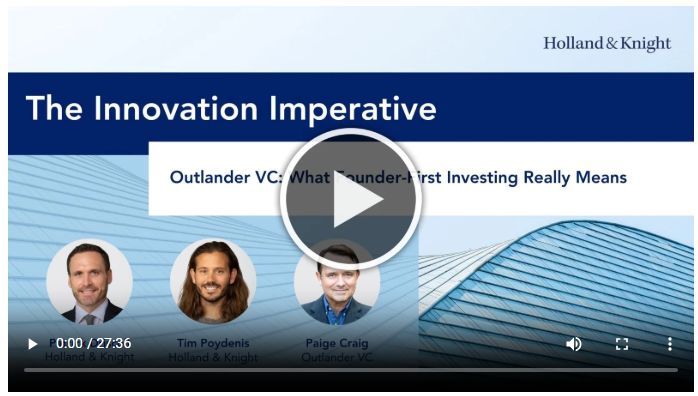
For Outlander VC, people are the most critical factor in a
startup’s success. That founder-first philosophy shapes every
investment decision the company makes.
In the debut episode of “The Innovation Imperative”
– a new podcast from Holland & Knight’s Emerging
Companies and Venture Capital teams – Patrick
Driscoll hosts Partner Tim Poydenis and
Paige Craig, founder and managing partner of
Outlander VC, for a conversation on the group’s investment
strategy, sector focus and approach to founder relationships.
Mr. Craig explains how his background in military intelligence
influences his work in venture capital, from evaluating founders to
anticipating where markets are headed. He also shares his
“walk and talk” practice: regular, informal check-ins
with founders and team members to keep communication open and
relationships strong. The result is an investment model built on
trust, collaboration and a clear-eyed view of what it takes to
build lasting companies.
Podcast Transcript
Patrick Driscoll: Welcome everyone, and thanks
for tuning in to “The Innovation Imperative.” My name is
Patrick Driscoll, and I’m the director of client development
for emerging companies and venture capital at Holland & Knight.
At Holland & Knight, we work closely with founders, venture
capital firms and investors navigating the full life cycle of
innovation, from company formation and early fundraising through
growth, scaling and ultimately that exit. A big part of our work
sits at the intersection of law, capital and strategy, helping
innovators and investors think clearly about how they build, fund
and protect durable businesses. “The Innovation
Imperative” is really about that journey. Each episode we sit
down with founders, investors and operators who are shaping the
innovation economy, often behind the scenes, to unpack the real
stories, lessons learned and inflection points that don’t
always show up in a pitch deck or press release. We focus on VC,
early-stage companies and the decisions that matter most when the
stakes are high.
I’m pretty excited about today’s conversation, as
I’ve followed this fund for a long time. It brings together two
great perspectives. I’m joined by my colleague, Tim Poydenis, a
partner at Holland & Knight and the head of our EC/VC practice
group who advises funds in emerging companies across formation,
financing and strategic transactions. And we’re thrilled to
welcome Paige Craig, general partner at Outlander VC, an
early-stage firm known for its founder-first approach and
systematic sourcing model. Paige has invested across categories
with a sharp lens on what makes a team and market truly fundable.
And with that, I’ll hand it off to Tim to take away the
conversation.
Tim Poydenis: Thanks, Patrick. Really excited
to be here and pumped to have Paige as guest number one in this
podcast series for us. So, Paige, welcome, we love working with you
and we’ve thought highly of you and your fund for a while. So I
think it’d be helpful for everyone out there listening to hear
your story and your path and how it shaped what you’re doing
over at Outlander.
Paige Craig: Yeah, thank you. I think it is
only relevant in the sense that my very unconventional, weird path
reflects the kind of people we like to invest in. So I grew up dirt
poor. In fact, we were homeless. We lived in cars, lived in a river
in Sacramento. I had a pretty good family life, but you know, we
were just very poor folks from Pennsylvania. And I had a very early
life of struggle. I eventually went into the Marine Corps, the
intelligence community, built a wildly successful private military,
across the battlefields of Iraq, Afghanistan, Syria, sold that
company in ’09 and built my venture fund back then. And that
weird journey really led me to realize two things. One, I tried to
raise money for my startup. I was a weirdo, I was very different. I
thought that because I was first in my class at Dam Neck, Virginia,
that [because] I was extremely good at my job, people would throw
money at me when I left to go start my defense startup back in
2002. Defense was not cool then like it is now.
Tim Poydenis:Yeah.
Paige Craig: And I also learned along the way
– I had no idea what VC was, I never thought I’d be a VC
– but when I did get into venture, I realized that most of VC
looks at tech or market or momentum and it doesn’t actually
look at people. And the unusual thing about my background is, in
the intel world, I spent a lot of time understanding, analyzing or
recruiting people overseas for a lot of the intel and other work
that we did. And so my lens was really framed by an unconventional
journey as an operator and founder and by this lens that people are
the most important thing. And so that’s what really framed me
when I came into the startup world back in ’09 and decided that
I was going to go be an investor with zero experience, zero
background, funding, investing, like I knew nothing about it.
Tim Poydenis: Wow, well, first off, thank you
for your service. That’s a phenomenal story and background that
you gave us. So when did you start Outlander? When did your fund
come to life?
Paige Craig: So Outlander is a rebrand of our
fund that I started in 2014, but I started investing in ’09 as
an angel. So I spent five years and did roughly 70 deals, just out
of my own capital. And then I’ve been a VC from the end of 2014
to the present day.
Tim Poydenis: Wow. And a lot of your thesis, if
you look at a lot of your guys’ social media and your website
and conversations, I know you and I have had, you talk a lot about
being founder first. Can you give a little bit of color on what
that actually means? Because I think a lot of folks out there say
that, but I don’t think everyone truly follows it. So it’d
be helpful to get some commentary.
Paige Craig: 100 percent. All humans are
somewhat social animals, some of us are more social than others.
Every VC probably tells you they invest in great people, and
that’s true, we all want to invest in great people. What we
mean when we say we are founder first, it means two things.
One, which is quite common, I think, in venture, is that we
really understand that we see startups from the end of a straw,
right? And so we don’t get to see the big picture that founders
see. And so we really respect being mostly former operators here at
Outlander, we really try to make decisions and work with founders
in a way that we would have wanted when we were operators.
Doesn’t mean that we don’t have hard discussions, but we
really try to remember that we are here to back up these crazy big
visionary founders who are struggling daily. So we try to avoid
second guessing them, but we try to make sure we have hard
conversations with them. So we try be a great friend to founders,
and that means also not pulling punches. There’s a lot of
people out there that I think are cheerleaders to founders versus
being good coaches and mentors. So first we want to be aligned with
our founders helping them build big companies.
Second, we look deeply into the nature of the founder or the
founding team. And what that means is beyond just thinking like a
vibe investment: Do we like this person? We dig into your life from
middle school, even elementary school onward. And we have a founder
framework. It used to be 38 points, I condensed it down to 20 in
the last year, but it started life as a 14-point framework a decade
ago. We have evolved it, but it’s a very formal framework for
all of our partners to dig in and analyze the founding journey. And
it focuses on vision, intelligence, character and execution. And
it’s a selection process where we have long conversations with
founders. We really don’t care that much about reference calls.
We really look at life and talk to you about your life. I teach my
partners a couple dozen elicitation tactics, essentially ways to
talk to people and try to get the truth. And not that these are
people trying to lie to us mostly, or they’re not foreign
adversaries trying to deceive us, but the reality is everyone lies
and deceives themselves to a bit. And so we really try to get to
the uncomfortable truth about who you really are, what drives you,
why do you do this? So that’s really important to us, spending
a lot of time digging into the founding journey. And like, we
don’t want to see decks. We tell people to send us a deck just
so we understand where you kind of plug in for future combos, but
we really dig deep into your story: your love, your hates, your
disappointments, the wrecks, the abysmal low points of your life.
We want to dig into everything that was crap and understand what
happened, how you dealt with it. So that’s us. So we really get
in the weeds of who a founder is and what drives them to be
great.
Tim Poydenis: Two questions there. The first
one: Do you dig into the attorneys that you decide to work with at
that level?
Paige Craig: No, and I’ve had VCs and LPs,
especially LPs, always want to know, oh, let me tell you my story.
And it’s like, you can build a framework – because we did
this in the military – we built these frameworks to
understand certain types of targets. And so in this case, this is
specifically built for founders, early-stage founders in
high-growth technology startups. This framework does not define a
good buddy, a coach, a father figure, it’s designed based on
now over 10 years of work and thousands of interviews to find
founders that have a better chance than the average population to
succeed.
Tim Poydenis: Sure, on that point, obviously
founders know that funds and potential investors are vetting them
individually in the business. Do your founders at the outset know
that you’re running that level of process on them behind closed
doors? Or do you just sort of tell them you’re going through
your typical checks and diligence? Or do they understand what the
process entails?
Paige Craig: I think anyone that reads anything
about us should know. We do tell them what we care about. We
don’t tell them each detail because we do not want people to
game us, but we do tell them that we really care about them. So
most founders, even the thousands we reject – we take about
5,000 partner meetings a year – we tell founders, we are
really digging into you. We’re trying to find not only great
founders, but founders that are going to work well with us. There
has to be a match between us and the founder as well. There’re
people out there who sometimes think there’s something special
about them, but it’s not a fit for us as a partnership.
Tim Poydenis: Yeah, let’s just look at the
start of 2026, like if you had a checklist of things that need to
be true for you guys to lean in on a deal and ultimately make an
investment, what are those high-level punch list items?
Paige Craig: It’s three things. So the
founder framework side, we need to be 90-plus percent certain that
you just knock it out of the park for our founder framework.
Second, you need to be in a sector that we think is going to have
extraordinary outcomes in the next decade where we have an unfair
advantage to help you win. And third, the deal needs to be right.
And this is often where our lawyers help us out. Everything from
the pricing, the terms, the board, board observer, all those little
details that we go through on those term sheets in the week.
Tim Poydenis:Sure.
Paige Craig: All three, and this is something I
learned as an angel and early VC: It can’t just be a great
founder, and it can’t just be a great founder in a sector that
I love, it’s got to be a great founder in a great sector with a
deal, with terms that let me make a massive return if you win and
let me invest along the way and all this, you know, all the other
stuff that you guys do as lawyers to help us get that edge on the
deal.
Tim Poydenis: No, for sure. And that’s an
interesting one. I mean, I’ve been fortunate enough and our
team’s been fortunate to work alongside you guys on a number of
deals. And I can tell folks listening that I’ve had a front row
seat to where you guys have put terms out there, we thought we had
a deal and then terms tried to get renegotiated at the finish line
and Paige swoops in for a phone call saying, hey, I’m going to
talk to Founder X and this is the deal, take it or leave it,
otherwise we’re walking. As much as I’m sure you guys
don’t like walking away from deals, there have been situations
where I’ve seen you walk. So I do think that it shows a lot of
focus to the guidelines that you guys have and commitment to your
deals. And I know that there’s investors out there that
sometimes, for lack of a better word, can cave. But that’s
interesting to hear on your guys’ approach. You talked a little
bit there about the industries over the next decade or so that you
think are going to be there for success. In terms of like the
industry focus and pockets within the industry that you think are
high right now, what would be a focus area for you guys in the
market?
Paige Craig: There’s a handful. I mean,
this is the fun part. Beyond picking the right people, we’ve
done, I think, exceptionally well predicting the future of the
world. And that’s something I had to do back to my North Korea,
Iraq – like, one of the fun things about intel is one of my
jobs was to digest the world, literally the world, and talk to
generals and admirals about where the world was going in the next
10, 20 years. And so that’s the other really fun part of our
job, kind of predicting where that puck is going. So where do we
think the world’s going right now? America and the world are at
an amazing inflection point. Obviously applied AI, we started off
doing infrastructure AI a decade ago, before it was cool. We’ve
been very focused on applied AI for the last five years. But
we’ve also set our sights on robotics, hardware and autonomy,
which is still not as popular, but we started doing that years ago.
And the recognition was that software is becoming a commodity. It
is clearly going to be a commodity when anyone can build software.
That’s where we’re going. And so you need another edge if
you’re going to create value. We think hardware and robotics
are two places where investors can find value, where founders can
create value. So AI and software embedded in a robot that does
agriculture, does construction, does healthcare, does anything
– we’re at this amazing point where software plus
hardware can build that future world. And also related to that is
the re-industrialization of America. We are investing in 3D
printing battery companies, companies that build software to design
propellers and homes. We have a 3D printing munitions business
that’s 3D printing weapons and warheads for the next generation
systems out there. So we really think that robotics, industry,
autonomy and deep tech are our big categories for the next 10
years. And we really invest in people, so we’re open to any
idea, but those are four lanes that get a lot of our attention
these days.
Tim Poydenis: Yeah. It’s truly remarkable
to hear and how you compare it to the time you spent in North Korea
and Iraq. It’s a perspective that I can imagine founders are in
a room with you, and there’s a reason why so many companies
want you on their board and want you guys on their cap table, given
that perspective and just viewpoint on the direction, not only just
where the venture landscape is going, but more just where the
world’s going. In terms of industry and your investments that
you’ve made, I obviously have an idea or two on what I think
some of your favorite investments have been over the course of your
investing, but I think one that’s obviously very interesting to
me and most people that are probably listening was the investment
you all made in Scale. Can you give a little bit of background on
how that investment came to be? And I know that you guys, I think,
I mean, you tell us, were the first check in, right?
Paige Craig: Yeah, we were the first and only
check in their very first round pre-Y Combinator. The founders had
come to us – and not that we were the first or only –
like every founder out there, they had pitched dozens and dozens of
people, and we were someone that they hit up. And so the story goes
that they were in an Uber, the Uber driver knew about us and said,
hey, you should go pitch Paige. They reached out on Twitter, I said
hey, follow me back. Within days, we were doing a hike in the San
Monica Mountains and a few weeks later, we were the first and only
money in that first round. They went to Y Combinator, did OK, it
wasn’t amazing business, but we introduced them to like
literally 90-plus different VCs. Accel, amazing fund, Dan Levine
led that round, he was instrumental in their business. But yeah,
that was the early days. And the funny thing is when we invested,
it had nothing to do with their product. At the time, the company
was called Avra. They had a couple different AI ideas: One was
dating, one was medical, but neither one was actually core to the
founders. And I really think I did probably only two things that
really mattered in the life of that business. One was investing in
them and saying, I don’t care about either one of these
products, I think you guys are amazing. And second, when they came
back a couple months later and said, hey, we think this data
labeling thing is big, we want to do this API, where any AI company
can call up our API and just get data labeled. And I read through
it and I called them back and I responded, saying, this is a big
idea, this is worth dropping everything else and just focusing on
that.
Tim Poydenis: Wow, that’s wild. From a
Twitter message to an Uber ride to hiking in the Santa Monica
Mountains, that’s a pretty wild backstory. And something you
said there was very interesting for me, because I know a lot of
founders that we work with ask this question. You mentioned after
that initial investment, you made introductions and reached out to
I think hundreds of other venture funds for them. Is that something
that you do with all of your portfolio companies, like when the
time is right, do you try and play matchmaker and facilitator for
them?
Paige Craig: We do. So I’ve been a big
believer back to my intel days that you want to build a massive
network and then you want to leverage it for your founders as they
prove themselves. So in early days of Scale, we saw that
they’re very impressive. So we started to do more and more
investor intros. Customers are another thing we focus on in early
days. But we help founders build out their early networks. It’s
one of the things that you could do as a VC, is to really open up
these networks to founders who might be on their first company. The
founders of Scale were 18 and 19 years old when we funded them and
didn’t have much of a network. We just funded a group, amazing
guys, actually a guy whose family escaped Iraq and he was a little
boy when I was running around Iraq.
Tim Poydenis: Oh my God.
Paige Craig: And this amazing dude Hadi from
Lebanon, and they came to Canada, they went to school up there.
Hassan, the CEO, went to University of Waterloo, and we just funded
his AI lab. They’re building this amazing technology to help AI
navigate the web and make it useful, which it can’t actually do
right now. And I just spent the last week making introductions to
founders, angels, investors and helping them just meet really
brilliant founders and other folks that are like a step ahead of
them. And we do that for almost everyone we invest in, whether
it’s investments across the Pentagon or investments in
industry, it is one of the biggest things that an investor can
do.
Tim Poydenis: That’s awesome. I think that
if you talk to any of my entrepreneur clients on the company side,
I think they’ll all recognize this phrase that I say to them
when they’re talking about term sheets and everyone’s
bogged down on what’s the valuation, how much cash are we
getting and all this. And the phrase that I always come back to is,
“not all money is created equal.” Like you truly need to
be evaluating the funds that’s investing into you because
it’s going to be a partnership for, potentially, the whole life
cycle of the company. So I think hearing your guys’ approach to
working with your portfolio companies and founders is something
that’s pretty remarkable. And we’ve seen it firsthand on
the success your companies have had with your guys’ touch
points all over them. I want to go back a little bit to something
that you mentioned a handful of minutes ago when you were talking
about your team at Outlander. You made a comment about how you guys
are all former operators. Is that a requirement for your team as
you’re growing, that you only want former founders, former
entrepreneurs as part of the investment team?
Paige Craig: I’d say mostly. We’ve made
some exceptions, but on the partner, senior partner, managing
partner level, yes, to come here at any of those levels. And we are
looking, so if you’re out there, we want operators, founders
who’ve had success, who are now ready to be coaches and mentors
to the next generation of founders. I think that experience and
that perspective is critical to the stage and strategy that we have
of being very hands-on and being very early. And the other part
that we didn’t really nail as part of our strategy is we are
not looking for hot deals. We want to reject those deals, not
because they’re not good, but the founder who can get
Andreessen’s attention on day one, YC’s attention on day
one – you could be a great person, but we are really looking
for those oddball, unknown, under networked, underrepresented,
we’re looking for those black swan opportunities. And so we
want the founder who really wants our assistance. We like working
with those founders that are not known quantities right now.
Tim Poydenis: And why is that? Is that because
you think you’ll get better deal terms, or is it because you
think that with your guys’ relationship and the infrastructure
you build up for your founders and your portfolio companies, that
you’ll help push them in the right direction?
Paige Craig:For me, it’s three things. One,
it really just speaks to where I came from, and I really like
working with people where success is not guaranteed, it has to be
earned.
Tim Poydenis:Sure.
Paige Craig: I really love working with
founders who come at it with determinism and a work ethic that is
undefeatable. Second, as an investor theme of strategy, I would
rather have this night vision to pick the right person and help
them win when that deal and that opportunity is unproven. We get a
better price. And third, we have a real impact on the world.
There’s a lot of great companies and founders I meet and
they’re raising, not just high terms, because usually an
inflated evaluation as we think about it, or just a high valuation,
is simply a reflection about how the market perceives the risk or
quality of this team. And so someone coming out of their third
great startup with two unicorns under their belt. The price is
high, but it’s high because most of the market is saying, hey,
we think this is a de-risk deal. I want to go find that first-time
founder or that founder that had three massive failures under their
belt but they’ve learned from it. I want that founder who is
ready to win and the market doesn’t see it. And when they win,
we know that we did something important in the world and we had an
amazing 10-, 15-year journey with them. That is what we want. We
want all three of those things to be true when we invest in that
unknown founder.
Tim Poydenis: I don’t know how a founder
doesn’t want to be on your guys’ portfolio. It’s pretty
awesome to hear and to hear it explained like that. It speaks
volumes, I think, about how you operate. You gave in your history
and sort of your character and reputation that I know you’ve
built in the industry. So it’s exciting for me just to hear you
lay that out. In terms of the success that you guys have had,
obviously, with a lot of your wins – not limited to the one
that we spoke about – I know there’s been a lot of other
successful investments. I think it’d be helpful for the funds
folks out there to understand how have you been able to scale your
fund and the size of your portfolio with building the right
infrastructure, both internally and externally, with support and
help. Because as much of a stud you are, I imagine that you only
have so many hours in the day, so you need to build stuff up around
you.
Paige Craig: We do. You know, venture is really
limited, not by the dollars, but by the people that work here and
the support that we have. So one thing is we haven’t scaled
that fast. We have focused on results and driving returns versus
getting too large. I think the last decade showed a lot of funds
that got too big, too fast.
Tim Poydenis: Sure.
Paige Craig: And we know what our mission is.
We know that our focus is to invest in the earliest stage unknown
founders and to be hands-on with them, which means we can’t
grow too fast. But the way I’ve scaled is every year we’re
open to hiring a partner and maybe an operational support person.
That’s kind of been our growth. On the fun side, we added an
opportunity fund last year, which let us double down on our biggest
wins, but we’ve been very careful to not expand our cash too
much and we interview a ton of people to find the operators that
join us. And then on top of that, we have, like most funds, we have
a back office that helps us on the finances, the auditing, all the
financial stuff that none of us as partners are great at, nor is it
the best use of our time. We employ lawyers, you guys handle a lot
of the diligence to not just do the deal, the term sheets in it,
but to look over and have a second set of eyes to make sure that
we’re checking and doing proper diligence for these deals. As
much as we love founders and deals, it’s important to have that
perspective, the second institution that’s not vested in the
deal, to make sure that we don’t make a mistake. And we all
know that we get deep on a deal and we want to make it happen, but
you guys can come in there and say, hey, did you see this issue and
this issue? And that’s also very helpful. So in areas like
finance and legal, we’ve outsourced some of that work to make
sure it’s done the right way.
Tim Poydenis: My last question is – I
know we’re coming up on needing to wrap this up –
what’s a day in the life of Paige look like on a regular
workday with all the things you have on your plate?
Paige Craig:I have, probably, a different
perspective than many. I try to keep about half my day completely
free and that way I generally am working from around 6:30 in the
morning – I have a 2-year-old and a 4-year old – so
generally around 6:30 ’til midnight, 1 a.m., I’m living and
working through all of those moments. And 24/7, weekends, holidays,
doesn’t matter to me. I invest in founders, and I tell them you
can hit me up any time you want. Like this weekend I talked to the
AI Labs company, I talked to Havoc, one of our maritime and
multimodal autonomy companies. I talked with a laser weapons
business. I talked to Calvis, an AI company for security. And like,
that was all over the weekend, that was on Sunday. I keep half my
schedule open every day. And I like to do this thing, I walk and
talk. I pick up the phone, and I dial friends, colleagues, new
contacts and I just see if I can get ahold of people. I have my
deliberate calendar of things that need to get done. If a founder
texts me, half the time I’m available to call or text back
quickly. I called a number of VCs today, and I just have
conversations. And those conversations can be about things I’m
looking to invest in, they can be about my startups that are
raising money, they can be for talent that we’re helping our
founders with. And so I keep half my calendar free to support my
founders and to let me go out there and engage versus having the
calendar tell me what to do.
Tim Poydenis: That’s awesome. I love that
approach.
Paige Craig: And everyone that works for me
knows that you might wake up to a 7 a.m. call or a 10 p.m. call. I
would like to call all the partners and junior folks every week and
just talk to them about what they’re working on, what they are
struggling with, what they are interested in. That’s just how I
work. It’s a little bit different, but that’s my
process.
Tim Poydenis: I think that’s awesome. And I
think it helps the team see it from the front lines, but then also
it helps some of your younger partners grow and have that direct
interaction with you that I’m sure that folks in other funds
and honestly other companies just don’t get. So I love that
approach that you have. Patrick, I’m going to turn it over to
you here.
Patrick Driscoll: Yeah, and I think if
you’re adding a ton of value, working at that rate makes so
much sense, right? And thanks so much to both of you. This was a
very interesting conversation. And I wanted to highlight my top
three points and my takeaways from it. One is founder-first
investing is a rigorous discipline, not really a slogan. So, I
think, Paige, your background in intelligence really allows you to
figure out the framework of how to get after those founders who are
going to change the world, so that was super interesting to hear.
The second one is great outcomes come from the right founder, in
the right sector, with the right deal. I love this point because
you always hear VCs talk about, we only look at the founder, we
only look at the founder, we only look at the founder. And
you’re being a little bit more truthful here. It has to be a
sector fit and it has to be a good deal, and VCs, I don’t know
if they talk about that as openly as they should. And the third is
the frontier of innovation is kind of shifting towards the deep
tech, autonomy, AI infrastructure, robotics and
re-industrialization sectors. You mentioned your ability to digest
the world, which, I love that term, allows you to kind of figure
out where the momentum really is in this VC investment sector.
And with that, I did want to say thanks again to Tim and to
Paige and to everyone who’s listening. If you want to learn
more about Outlander VC and their founder-first approach, check
them out. You could find them on their website, find Paige on
LinkedIn, and for the guidance on forming funds, structuring deals
and supporting early-stage companies, check out Holland &
Knight. Our EC/VC team is quite fantastic and robust. Tim is the
lead of the team, and you could find his information online. And
with that, we’ll see you next time on “The Innovation
Imperative.”
To view the full article please click here.
The content of this article is intended to provide a general
guide to the subject matter. Specialist advice should be sought
about your specific circumstances.
Search
RECENT PRESS RELEASES
Related Post