Possible China tie-ups for idle German auto plants highlight cooperation’s value amid Euro
June 7, 2026
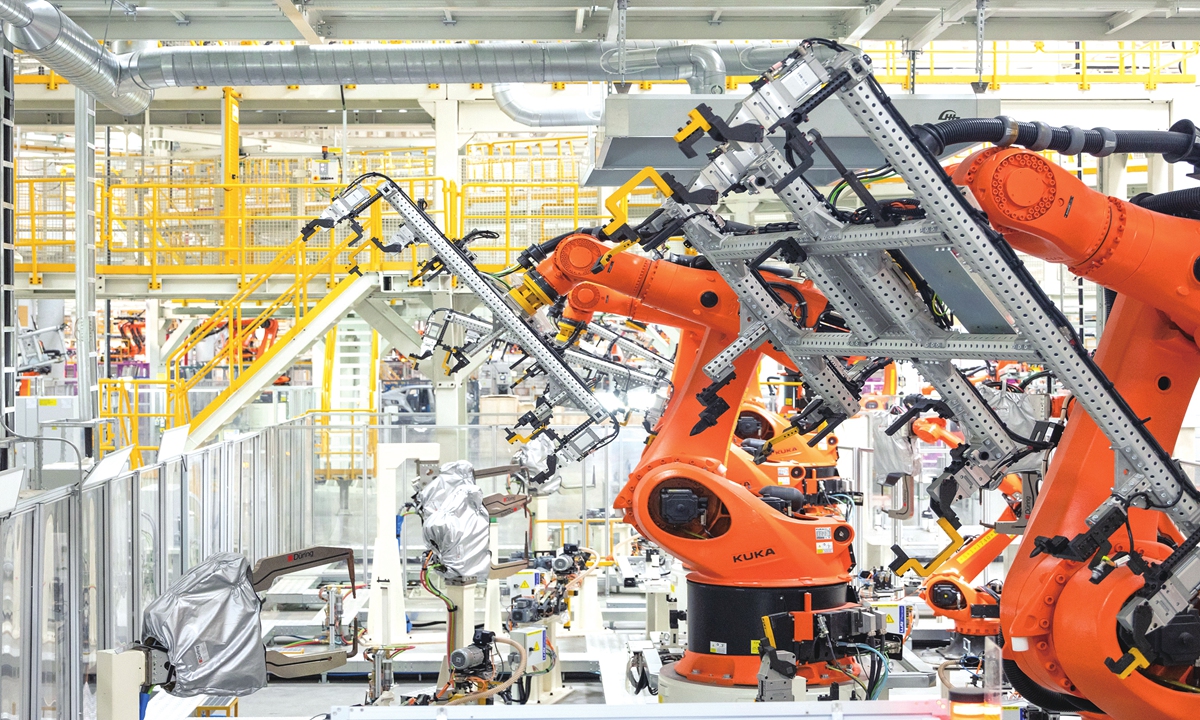
Reported proposals in Germany to explore cooperation with Chinese automakers in using underused auto plants have brought Europe’s industrial reality into sharper focus, showing that pragmatic engagement with China may offer a more viable path for the region’s auto transition than restrictive policies that add costs and uncertainty, Chinese analysts said.
Germany’s beleaguered carmakers are seeking solutions for underused factories, including possible tie-ups with Chinese manufacturers or weapons makers, as weak demand and a choppy transition to electric vehicles (EVs) have left many European auto plants operating well below capacity, AFP reported on Sunday.
Volkswagen, Europe’s largest automaker, could bring its cars developed in China to the European market or even share capacity in Europe with Chinese partners, Reuters reported in late April, citing CEO Oliver Blume’s remarks to analysts after the company’s quarterly results.
The company, which is in the process of slashing thousands of jobs as profits and sales suffer, is seeking to reduce global production capacity by around 1 million vehicles, according to AFP.
Dirk Panter, economy minister of Saxony, where Volkswagen’s Zwickau plant faces an uncertain future, noted that other Chinese manufacturers are starting to produce cars around Europe, including through such tie-ups, AFP reported.
“To secure the future of the automotive industry in Saxony and in Germany, it is essential not to ignore this reality,” he told AFP. In a statement published by Saxony’s economy ministry in May, Panter described China as “an opportunity for Zwickau.”
Panter said that he was not proposing the sale of any plant, but cooperation through existing or new joint ventures in which Volkswagen already has a stake, including SAIC Volkswagen – Volkswagen’s joint venture with SAIC Motor – as well as FAW-Volkswagen and its EV plant in Hefei, East China’s Anhui Province, according to Saxony’s economy ministry.
Jian Junbo, director of the Center for China-Europe Relations at Fudan University’s Institute of International Studies, said that the possibility of such cooperation reflects a more pragmatic view taking shape in parts of Europe’s industrial and local-government circles – that Chinese companies can be partners in industrial transition rather than merely competitors.
Such a model of cooperation could bring concrete benefits to Germany and Europe by helping preserve local jobs, putting existing capacity to better use and supporting technological transformation, Jian told the Global Times on Sunday.
AFP’s report on Sunday put growing Chinese competition first among the reasons why European carmakers are in trouble. It noted that VW’s capacity cuts would be mainly split half in China and half elsewhere, particularly in Europe.
Jian dismissed such attribution as simplistic and misleading, saying “the deeper causes lie within Europe itself – high energy and production costs amid geopolitical tensions, labor constraints, and a failure to keep pace with the rapid global shift toward electrification, especially in key technologies such as new-energy batteries.”
Reuters reported on Wednesday that European Commission projections pointed to the risk of up to 1.3 million job losses this year across the bloc’s vehicle, construction, metals, chemicals and transport sectors as a result of a surge in energy prices caused by the US-Iran conflict, with the automotive sector facing the largest potential losses.
These multiple pressures further show that the difficulties of Europe’s vehicle sector are closely tied to energy costs, production constraints and deeper structural challenges at home, rather than simply competition from Chinese carmakers, Jian said.
Deeper industrial cooperation with Chinese automakers could become part of the solution by helping Europe make better use of existing plants, preserve jobs and accelerate the shift toward new-energy vehicles, Jian added.
Beyond the Volkswagen debate, Chinese automakers have already begun to localize production in Europe. Stellantis said in May that it intended to deepen cooperation with China’s Leapmotor, with potential production of the Leapmotor B10 at its Zaragoza plant as early as 2026 and a possible new Leapmotor vehicle allocation to its Madrid plant from 2028.
Reuters reported on Tuesday that Chery, through a joint venture with Spain’s EBRO, plans to produce vehicles at a former Nissan plant in Barcelona, while SAIC is planning its first EU plant in Spain’s Galicia region.
However, Brussels has recently been intensifying its use of restrictive trade and regulatory tools across sectors from clean technologies to digital infrastructure and foreign subsidies, with many of these measures seen as directly affecting Chinese firms and adding strain to China-EU economic relations.
Chinese Foreign Ministry spokesperson Mao Ning on Thursday called on the European side to view China-EU trade ties in an objective and rational manner, and work with China to shorten the list of problems and make the pie of cooperation bigger for win-win results, in response to a question about bilateral economic and trade ties.
Search
RECENT PRESS RELEASES
Related Post