Prediction: Amazon Will Be the Worst “Magnificent Seven” Stock to Own for the Next 10 Years. Here’s Why.
April 26, 2026
From its origins as a scrappy online bookseller, Amazon (AMZN +3.47%) has evolved into an ecosystem that powers everything from doorstep deliveries to enterprise-scale computing to original entertainment.
Investors who recognized this potential decades ago have been rewarded beyond measure — cementing Amazon as one of the most transformative technology investments in recent history.
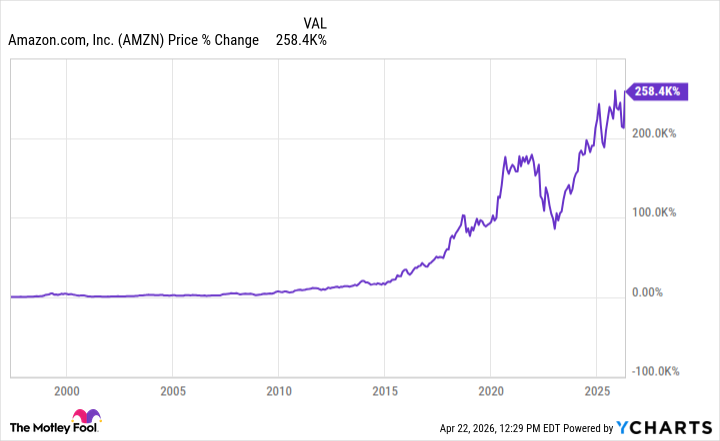
Yet looking ahead over the next decade, I’ve formed a contrarian view: Among the “Magnificent Seven” stocks, Amazon risks delivering the weakest relative returns. Investor enthusiasm for the company’s ambitions could be masking structural headwinds that ultimately limit upside compared to more focused peers.
While Amazon bulls cite untapped potential from an AI-fueled ecosystem, I think reality quietly points to a company stretched thin, where breadth actually becomes more of a burden rather than a boon.
Vertical integration has its limits
Supporters highlight Amazon’s push into custom silicon as a game changer, arguing that owning the full AI stack — from chip design to model training and deployment across Amazon Web Services (AWS), e-commerce, and emerging ventures — creates a misunderstood moat. In theory, the idea is compelling because tighter control over hardware and software could unlock operational efficiencies that competitors reliant on third-party suppliers can’t replicate at scale.
In practice, though, Amazon has implemented vertical integration into its playbook for decades. Amazon spent years building warehouses, logistics networks, and even its own delivery infrastructure to control costs and speed.
In fact, AWS was developed for internal IT needs before becoming a commercial profit engine. While Amazon’s cloud business remains a high-margin segment, the retail and fulfillment side of the business has long witnessed margins that fluctuate based on labor costs, fuel prices, and competitive pricing.
Advertising, another hypergrowth division, operates in a saturated digital arena where attention is fragmented and algorithms from rivals can replicate success quickly. While AI can sharpen targeting or automate ad creation, it does little to mitigate the commoditization trap or users tuning out or blocking ads.
Against this backdrop, Amazon’s story isn’t really a sudden revelation. Rather, it’s a continuation of the company’s DNA. Investors forecasting explosive multiple expansion thanks to vertical integration are at risk of projecting overly aggressive breakthroughs into a model that has already delivered obvious gains.

Image source: The Motley Fool.
Amazon’s moonshots are distant profit generators
Amazon’s history of pursuing ambitious side quests — advanced robotics in warehouses, low-Earth orbit satellites for connectivity, and even forays into healthcare and autonomous systems — fuels much of the growth narrative. Indeed, these bets embody Amazon’s relentless innovation, and history shows that some paid off handsomely.
My contrarian lens reveals a harsher timeline. Many of Amazon’s initiatives are years from delivering predictable and reliable unit economics. While robotics promises to cut fulfillment costs dramatically, scaling advanced hardware that can navigate chaotic real-world environments while also maintaining safety and uptime requires massive up-front capital and iterative testing.
Satellites sound visionary as they relate to narrowing digital divides and enabling new data services. But in reality, the regulatory, launch, and maintenance hurdles involved with these services suggest profitability could remain elusive well into the next decade.
This long runway creates a mismatch with today’s market expectations. Growth investors, especially those concentrated on AI, favor companies that demonstrate a clear path to outsize returns on invested capital within a handful of years. Amazon’s approach of subsidizing new experiments with cash flow from mature businesses works well when growth is abundant. But in an environment where delayed payoffs dilute near- and mid-term earnings power, skepticism becomes invited into the equation.
Big tech peers concentrating on one or two high-conviction areas inherently avoid this drag — allowing them to compound value faster. While Amazon’s moonshots may eventually succeed, the interim period of uncertainty risks turning these projects into capital-intensive distractions rather than definite accelerators.

Amazon
Today’s Change
(3.47%) $8.85
Current Price
$263.93
Valuation multiples have a ceiling in perpetual growth businesses
Amazon runs on a self-reinforcing cycle: Extract capital from today’s top-performing businesses, pour it into tomorrow’s frontiers, and repeat the idea that hypergrowth demands endless reinvestment. The subtle theme here is that investors have become accustomed to accepting lower multiples precisely because of this strategy. In other words, the market consistently prices Amazon as an “investing for growth” story rather than rewarding current earnings power.
With a growing number of concurrent projects spanning retail, cloud infrastructure, consumer devices, entertainment, advertising, and speculative new categories, Amazon must manage a complex landscape that few organizations can realistically sustain indefinitely. Each new venture comes with execution risk and the challenge of synchronizing profitability timelines. In my eyes, there is a natural limit to Amazon’s valuation expansion potential.
Compare this story to a more agile disruptor whose core technology sits at the center of the AI revolution. Such a player, like Nvidia, has been able to capture outsize value creation in a compressed time frame — scaling to enormous market capitalization far sooner.
In my eyes, Amazon’s path to similar scale feels more distant because steady execution across so many different pockets is required before the company’s ecosystem fully matures into a multitrillion-dollar profit compounder.
While Amazon stock could very well rise in absolute terms, I think its Magnificent Seven peers are positioned to deliver sharper returns as smart capital rotates toward businesses with clearer and nearer-term payoffs. Over the next decade, I think Amazon’s patience premium could translate into relative underperformance, and it will be the worst Magnificent Seven stock to own.
Search
RECENT PRESS RELEASES
Related Post