Renewable Energy Growth Signals Promising Outlook for Zambia
March 30, 2026
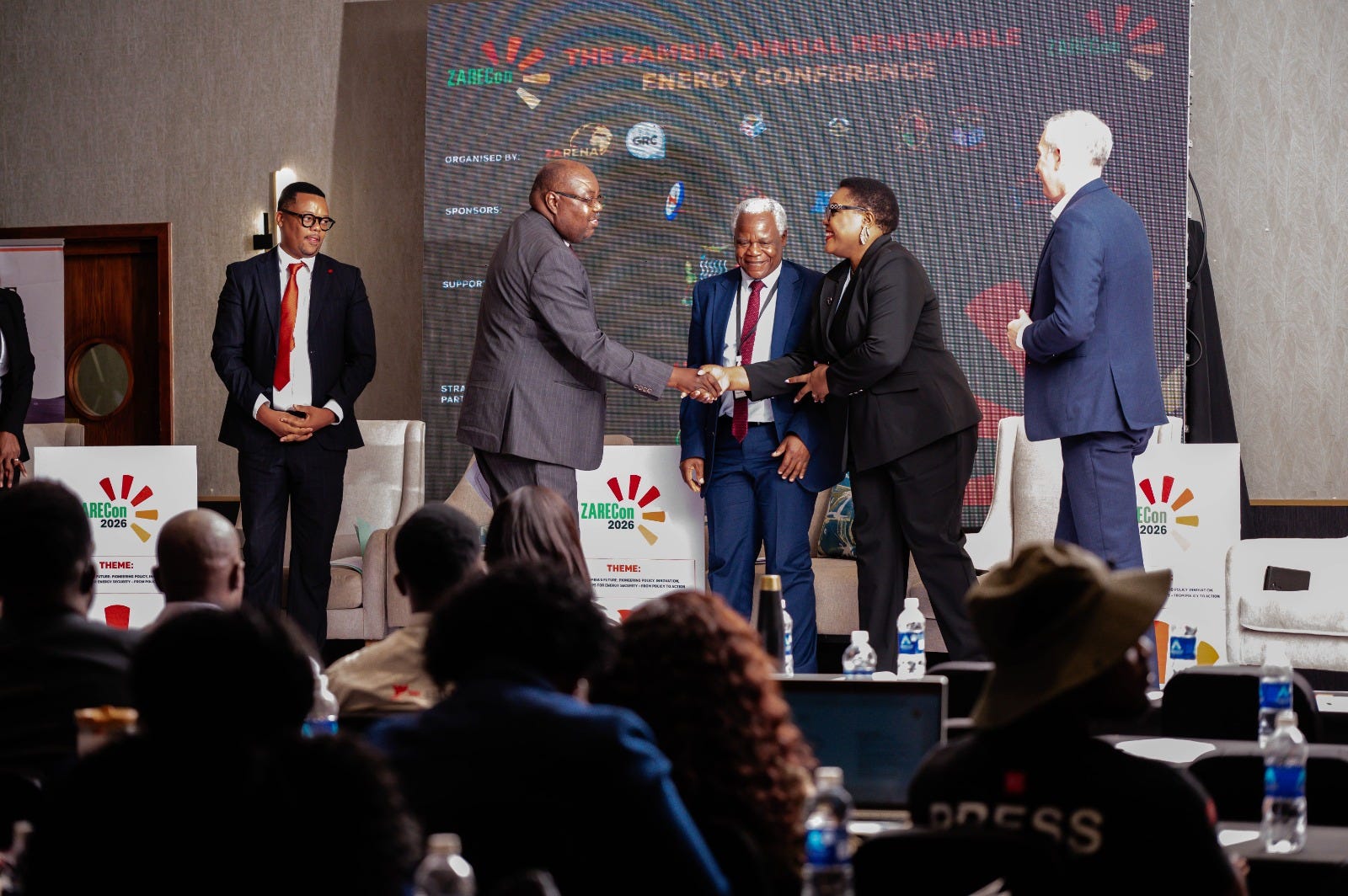
Closing the conference, Board Chairperson of ZARENA, Professor Joseph Mutale, urged stakeholders to sustain momentum beyond the event.
LUSAKA, ZAMBIA, March 30, 2026 — Zambia’s renewable energy sector is showing strong potential for growth, as stakeholders across the region call for increased investment, skills development and policy implementation to unlock its full capacity, writes Juliet Makwama.
According to market analysis by Mordor Intelligence, Southern Africa’s renewable energy capacity stood at 37.21 gigawatts in 2005 and is projected to reach 42.84 gigawatts by 2026, before more than doubling to 86.63 gigawatts by 2031.
The International Renewable Energy Agency also notes that renewable energy is accounting for a rapidly growing share of power generation in the region, presenting significant investment opportunities.
This momentum formed the backdrop of the inaugural Zambia Renewable Energy Conference (ZARECON) 2026, which brought together nearly 200 delegates from countries including Rwanda, Malawi, Zambia and Scotland.
Convened by the Zambia Renewable Energy Association under the theme “Powering Zambia’s Future: Pioneering Policy, Innovation, and Partnerships for Energy Security—From Policy to Action,” the conference featured panel discussions, research presentations and technical masterclasses.
Policy Push and Energy Transition
Opening the conference, Permanent Secretary in Zambia’s Ministry of Energy, Professor Ephraim Munshifwa, emphasised that energy remains central to national development.
He outlined key reforms including the open access framework, a one-stop licensing system, the Integrated Resource Plan (IRP), and expanded net metering as critical tools to increase generation capacity and attract investment.
Zambia’s electricity demand currently stands at around 2,400 megawatts, against domestic generation of about 1,635 megawatts, supplemented by 511 megawatts of imports — leaving a notable supply gap.
The country has traditionally relied on hydropower, but recurring droughts have exposed vulnerabilities, prompting a shift toward diversifying into solar and other renewable sources.
Skills Gap and Sector Challenges
Despite progress, stakeholders identified limited technical skills as a major barrier to growth in the renewable energy sector.
Discussions highlighted the need for stronger collaboration between academia and industry to ensure graduates are equipped with the practical skills required for renewable energy projects.
Dr Rekha Rajan stressed the importance of aligning education with industry needs.
“There is still a skills gap that needs to be improved so that the theoretical aspect of renewable energy is translated into practical knowledge,” she said, adding that Zambia has the potential to become a regional leader with the right investments in training.
Regional Collaboration Key
Stakeholders also emphasised the importance of regional cooperation in advancing renewable energy adoption.
From Rwanda, Serge Wilson Muhizi noted rapid growth in the country’s solar market, driven by a national goal of achieving 100 percent electricity access by 2029.
Fabrice Ntukirutimana highlighted emerging business opportunities in clean cooking and heating solutions, while Beston Gama underscored the importance of knowledge sharing among countries to accelerate the energy transition.
Economic Implications
Experts noted that unreliable electricity supply continues to affect businesses, particularly small and medium enterprises, while increasing production costs for key industries such as mining.
Energy development, they said, remains a critical driver of economic growth, with direct impacts on healthcare, education and overall service delivery.
Call for Continued Action
Closing the conference, Board Chairperson of ZARENA, Professor Joseph Mutale, urged stakeholders to sustain momentum beyond the event.
He encouraged participants to build on partnerships and synergies established during the conference to drive meaningful progress in the renewable energy sector.
As Zambia continues to navigate energy challenges and climate risks, stakeholders maintain that scaling up renewable energy will be key to ensuring long-term energy security and economic resilience.
Search
RECENT PRESS RELEASES
Related Post