Renewable energy is now more than ever a strategic business imperative
December 1, 2025

The global transition to renewable energy has fundamentally shifted from a moral obligation focused on mitigating climate change to a central pillar of economic strategy and national security. That is the key takeaway of a new report from Management Partners.
The thought leadership draws on in-depth discussions with energy expert Bart Boesmans, former chief technical officer at ACWA Power and a visiting professor at KU Leuven in Belgium. The piece argues that cost breakthroughs, rapid deployment, and enhanced resilience have become the primary drivers of renewable adoption among governments and corporations.
The narrative is no longer solely about fulfilling environmental goals, but rather about securing a competitive advantage and driving robust economic growth.
One profound shift in recent years has been the sustained decline in the cost of clean energy production. The global weighted average for Levelized Cost of Energy – a metric representing the total lifetime cost of building and operating a power plant – for utility-scale solar has plummeted to $43 per megawatt hour (MWh) in 2024, a dramatic fall from over $350 per MWh in 2009.
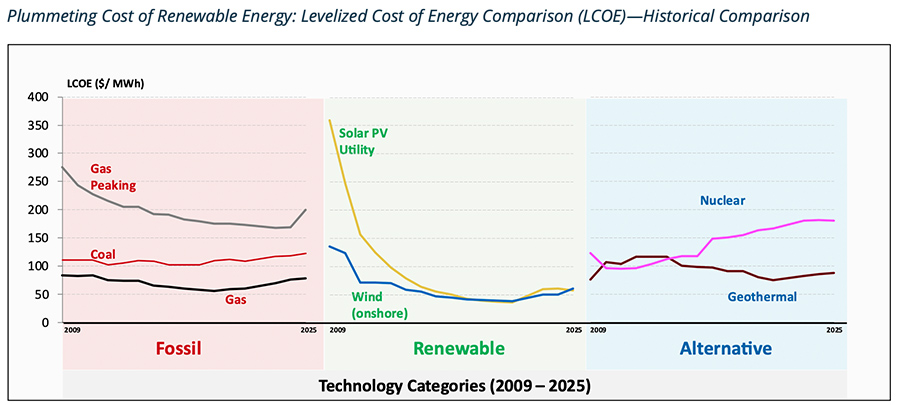
Onshore wind generation has also achieved competitive pricing, at approximately $44 per MWh. This remarkable reduction is attributed to new modular technologies in both solar and wind, which allow for industrial-scale manufacturing and cost reductions similar to those seen in the automotive and electronics sectors.
Regions such as the Middle East today enjoy world-leading affordability, with the Fasiliyah Photovoltaic project in Saudi Arabia achieving a tariff of $10.40 dollars per MWh. This trend is expected to continue as the GCC countries continue to shift away from oil and gas into sustainable energy.
The speed advantage
Beyond the purely financial argument, renewable energy offers critical strategic advantages. One key benefit is the speed of deployment, with solar and wind projects often constructed within one to two years, which is significantly faster than the five or more years required for gas plants or up to two decades for nuclear facilities.
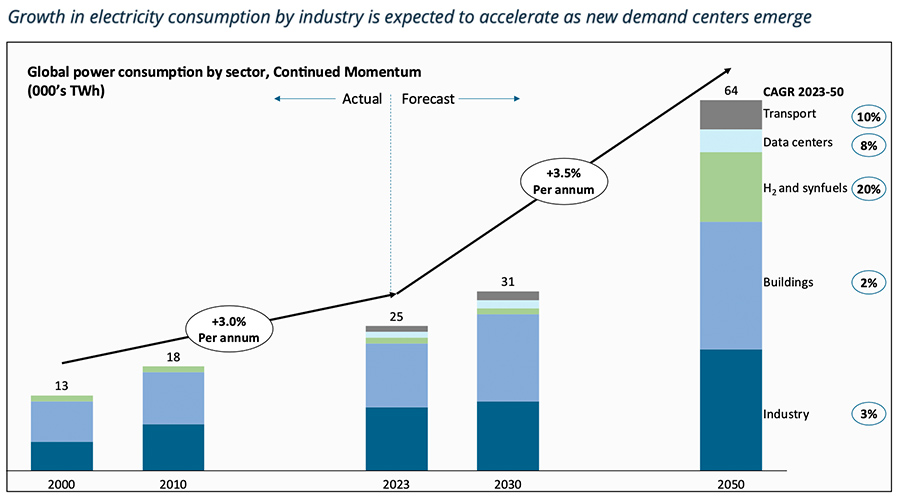
This ‘speed advantage’ is important for fast-growing economies and energy-intensive industries. The shift from energy scarcity to abundance is reshaping industrial geography, as regions with strong renewable resources are emerging as new industrial hubs, attracting data centers, steel mills, and chemical producers seeking reliable, low-cost power.
“Renewables can be deployed at scale within 1 to 2 years, significantly faster than conventional gas plants or nuclear plants, making them ideal for fast-growing economies,” notes Boesmans.
Energy sovereignty
Renewables are also becoming a crucial tool for national resilience and risk mitigation. Since a renewable asset requires no fuel after construction, it provides a stable, fuel-free source of power that operates independently of volatile global energy markets and geopolitical instability.
This strengthens energy sovereignty for nations and offers corporations a hedge against unpredictable price spikes. The final piece of the integration puzzle is energy storage, with battery costs following the same steep decline as solar energy.
“Energy storage, particularly battery technology, is critical for enabling higher penetration of renewables and is following a similar cost-reduction trajectory as solar PV,” says Boesmans. “The same is true for energy efficiency technologies. Renewables, storage and energy efficiency should be seen together.”
Time for action
To seize this opportunity, policymakers must move beyond financial subsidies and focus on establishing stable, long-term regulatory frameworks that streamline permitting and ensure sufficient grid access. Corporate leaders, for their part, are advised to secure long-term power purchase agreements (PPAs) – contracts with renewable suppliers – and prioritize strategic site selection to lock in cost stability for decades.
The ultimate goal for the industry is to reframe the conversation, establishing renewable energy not as a niche, subsidized sector, but as essential infrastructure that drives national competitiveness, industrial expansion, and job creation. The time for action is now, as stakeholders must align their strategies swiftly to capture the full potential of this generational economic opportunity.
“The renewable energy transition has already moved from being a climate-first solution to becoming an economic imperative,” says Boesmans.
“It is no longer about whether renewables should be adopted, but how quickly stakeholders can align their strategies to capture the full potential of this generational opportunity. As the world accelerates toward an energy future defined by renewables, the opportunities are vast, but the window to act is limited.”
Search
RECENT PRESS RELEASES
Related Post


