Rivian partners with Tesla co-founder’s Redwood on energy storage
April 14, 2026
Rivian is partnering with Redwood Materials, the battery company founded by Tesla co-founder JB Straubel, to build a second-life battery energy storage system at its EV manufacturing plant in Normal, Illinois.
The initial deployment will use more than 100 used Rivian battery packs stitched together into a 10 MWh system that can feed power back into the factory during peak demand.
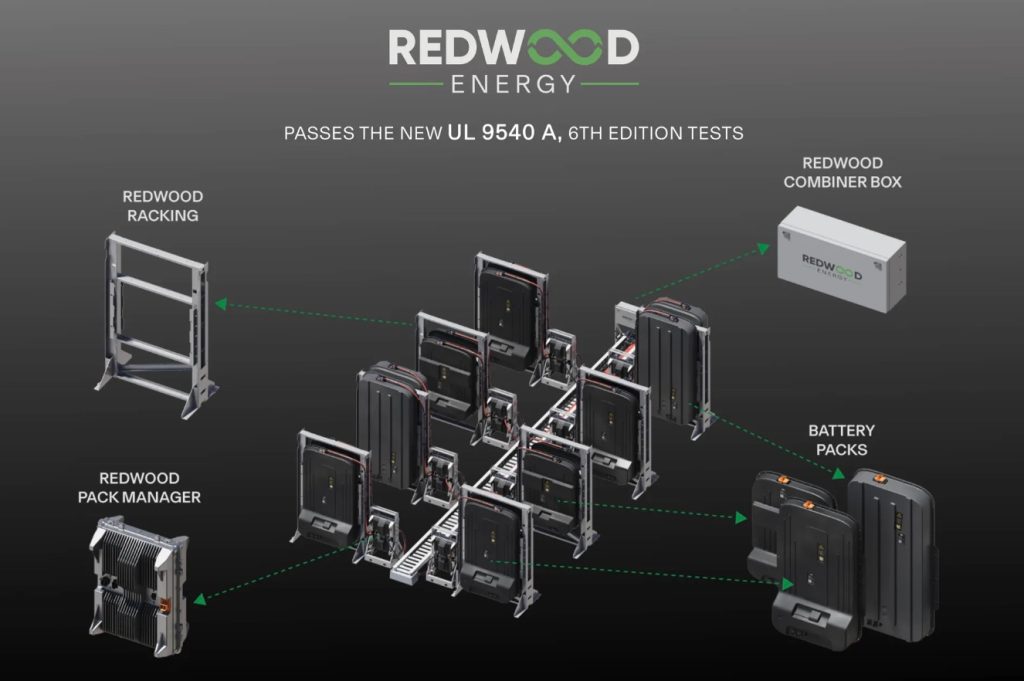
The two companies announced the tie-up on Monday, billing it as the first repurposed battery energy storage system deployed at a U.S. automaker’s manufacturing facility. Rivian is supplying the EV battery packs, and Redwood is integrating them into a Redwood Energy system running on its in-house Redwood Pack Manager software, which is designed to control packs of mixed chemistries and states of health as a single dispatchable asset.
The initial 10 MWh installation is modest compared to Redwood’s flagship project — a 12 MW / 63 MWh microgrid built from 792 second-life EV packs at its Sparks, Nevada campus to power a Crusoe AI data center — but it’s the first time Redwood has plugged its energy storage product directly into an auto plant.
Advertisement – scroll for more content
Rivian’s Normal plant is in the middle of a major ramp. The company is preparing to add R2 to volume production this year alongside the R1S and R1T, and its load profile is only going to get heavier. A battery buffer lets Rivian shave peak demand charges from the local utility and ride through grid stress events without pulling more power off the wires at the worst possible moment.
“EVs represent a massive, distributed and highly competitive energy resource,” Rivian founder and CEO RJ Scaringe said in the announcement. “Our partnership with Redwood enables us to utilize our vehicle’s batteries beyond the life of a vehicle and contribute to grid health and American competitiveness.”
For Rivian, the deal also solves a downstream problem that every automaker will eventually face: what to do with warranty returns, engineering mules, and early high-mileage packs that still have plenty of cycle life left in them. Instead of heading straight to recycling, those packs now have a paying second home at Redwood.
Straubel spent 15 years as Tesla’s CTO before leaving in 2019 to focus on Redwood, which he founded in 2017 as a battery recycling startup. Over the past year, the company has aggressively repositioned itself as an energy storage player, launching the Redwood Energy division in mid-2025 and raising another $350 million in October to scale the business.
“Electricity demand is accelerating faster than the grid can expand, posing a constraint on industrial growth,” Straubel said. “At the same time, the massive amount of domestic battery assets already in the U.S. market represents a strategic energy resource.”
The Rivian announcement lands on top of a growing stack of automaker partnerships. Last summer, Redwood signed an MOU with General Motors to repurpose GM’s EV batteries into grid-scale storage. Together with the Crusoe deployment in Nevada, it gives Redwood something unusual in the U.S. energy storage market: a feedstock of domestic batteries and a set of anchor customers willing to take delivery.
The companies also cite the scale of the opportunity. The U.S. will need more than 600 GWh of storage by 2030 to handle peak demand and the AI-driven load surge — a number Redwood compares to running the Hoover Dam flat-out for two months.
This is a smart deal for both sides, and it’s another datapoint in a trend that’s becoming hard to ignore: second-life EV batteries are turning into a real business, not just a sustainability talking point.
Rivian gets two things it actually needs. Cheaper, more predictable electricity at Normal as it scales R2 production at the plant, and a home for aging packs that doesn’t force it to eat a recycling bill. Redwood gets a reference customer in an auto plant, a much harder sell than powering a data center, and a new supply of packs from a carmaker whose fleet is now old enough to generate meaningful second-life volumes.
The more interesting question is what this says about the energy storage market. Straubel’s argument is that the grid can’t wait five years for new stationary cells, and there are already hundreds of gigawatt-hours of battery capacity sitting in or coming out of cars that can be stood up in months, not years. If he’s right, and the Crusoe project is a strong proof point, the companies with an automaker Rolodex and pack-management software are going to capture a disproportionate share of the near-term storage buildout. Tesla has been running Megapack as a first-life business. Redwood is quietly building a parallel market in second-life, and it’s pulling Rivian and GM along with it.
The 10 MWh Normal deployment is a pilot. The interesting number will be how fast it scales.


Search
RECENT PRESS RELEASES
Related Post