Solar Siting Reforms Advance in Virginia After Years of Failed Attempts
February 6, 2026
RICHMOND, Va.—The Virginia House passed legislation on Thursday by a 63-33 vote, nearly along party lines, that would facilitate the development of solar facilities by prohibiting bans by local communities but spelling out site requirements designed to satisfy the concerns of local governments.
Similar legislation has failed in recent years after opposition in rural areas from local governments and farmers.
“The General Assembly must act to reform our state’s renewable energy siting process,” said House Majority Leader Charniele Herring, D-Alexandria, sponsor of the legislation. Herring began carrying the bill after its previous sponsor, Del. Candi Mundon King, became secretary of the commonwealth in the new Democratic administration of Gov. Abigail Spanberger.
The Senate version of the solar siting legislation, sponsored by Sen. Schuyler VanValkenburg, D-Henrico, passed the upper chamber last week on a nearly partly line 21-17 vote.
Get Inside Clean Energy
Today’s Climate
Tuesdays
A once-a-week digest of the most pressing climate-related news, written by Kiley Price and released every Tuesday.
Get Today’s Climate
Breaking News
Don’t miss a beat. Get a daily email of our original, groundbreaking stories written by our national network of award-winning reporters.
Get Breaking News
ICN Sunday Morning
Go behind the scenes with executive editor Vernon Loeb and ICN reporters as they discuss one of the week’s top stories.
Get ICN Sunday Morning
Justice & Health
A digest of stories on the inequalities that worsen the impacts of climate change on vulnerable communities.
Get Justice & Health
VanValkenburg, in a brief interview last week, said he was hopeful that his bill “just creates a better conversation—a conversation that’s less about ideology and more about merits of individual projects.”
The bills now head to the opposite chamber for any final debates and passage by mid-March before going to Spanberger for a signature. Spanberger, a moderate Democrat, is a proponent of solar and preserving rural interests, but hasn’t publicly commented on this legislation.
The Challenge
The bills aim to reverse sharp increases by local governments in denying solar facilities over the past two years, even as the need for electricity has been skyrocketing to meet the vast power demands of data centers in a state that currently has more of the giant server farms than any other state in the country, or nation in the world.
Democrats won back control of the governor’s office in November’s election, giving the party “trifecta” control of the executive and both houses of the legislature. The last time Democrats had trifecta control, in 2020, they passed the Virginia Clean Economy Act, which seeks to decarbonize the state’s grid by mid-century. Within the VCEA is a target to build 16.1 gigawatts of solar by 2035.
Until the recent slowdown, solar developers had steadily moved Virginia toward that VCEA goal, which typically meant finding sites for projects in rural areas where land is available, flat and cheap. The electric grid also had space to safely connect the projects.
The highest rate of approvals by localities happened in 2022, when 74 percent were approved. Those 52 projects were designed to generate 2.7 GW of electricity, according to a database from the University of Virginia.
But by 2024, rural residents began urging their local government to oppose such projects, saying fields filled with solar arrays obstructed their rural viewsheds and degraded farmland at a time when agricultural profits are diminishing and there is a lack of interest from younger generations to continue farming.
At the same time, some solar projects that were built engaged in bad soil management practices. In Buckingham, Henry, Sussex and Wythe counties, the solar firm Energix was found to have had stormwater runoff issues that caused erosion and harmed waterways with sediment.
In 2024, solar facilities had their lowest post-2020 rate of approval by local governments, at 51 percent. There were only 39 projects approved to generate about 1.1 GW. Denials had gone from 22 percent in 2022 to about 40 percent in 2024.
Localities began adopting ordinances that banned projects outright or made them too difficult to construct. But Evan Vaughan, the executive director of the Mid-Atlantic Renewable Energy Coalition, a backer of the bills, said of the legislation: “This isn’t a silver bullet siting policy but it will establish baseline ordinance criteria for ground mount solar projects. Local governments will retain final decision making authority over individual projects, but we will see more project proposals that communities can consider on the merits, rather than excluding solar by ordinance.”
The approval trends also come as the service territory for Dominion Energy, the state’s largest utility, is expected to rise from a peak demand of about 25 GW from all customers at the end of last year to about 40 GW in 2035, a need that’s almost three times larger than the electric demand from all the households in Virginia.
Solar developers want to be able to build to help meet that demand. Solar is considered the cheapest form of electricity, and also does not pollute the air or emit climate-warming greenhouse gases. The siting challenges for solar also involve PJM Interconnection, the regional grid operator for Virginia, a dozen other states and the District of Columbia. PJM has a lengthy process to study what grid upgrades may be needed to safely connect solar projects, which can fluctuate their generation when a cloud moves overhead.
PJM in November approved its latest round of projects, which includes about 1.5 GW of solar that could connect to the grid in Virginia. The state currently has about 4.8 GW of solar from larger utility-scale and small-scale projects, and ranked 28th in the country in electricity consumed from renewables, according to the U.S. Energy Information Administration. But because of a potential for local denials, along with financing and final agreement details, not all of them may actually come online.
If passed, the bills now moving through the legislature wouldn’t take effect until July 1, meaning developers waiting for the new standards couldn’t take advantage of federal tax credits that will go away by then because of the Trump administration’s One Big Beautiful Bill Act. Those tax credits, which are repealed after July 1, were designed to help make the development process cheaper for solar projects, Vaughan said.
“There’s some hope that the [new state] standards will informally help inform decisions made between now and July,” Vaughan said. “The urgency around (those) tax credits primarily comes from the fact that project economics will tighten after the tax credits expire.”
What the Bills Would Do
The bills would prevent localities from passing ordinances that outright ban a solar project, or have requirements that effectively ban them, by limiting them to areas unsuitable for solar. Local governments would have to consider and follow a set of development standards prescribed in the bills. Those standards include having the solar panels setback between 150 and 200 feet from homes on other properties; between 50 and 100 feet from roadways; and either 50 feet or 100 feet from wetlands, depending on whether a project is less than 25 MW, or greater, respectively.
Those standards are less restrictive than ones Fluvanna County passed by ordinance, which had setback requirements of “between 375 and 500 feet from nearby dwellings, parcels, or property lines, 300 to 500 feet from roadways, 1,000 feet from the James, Rivanna, and Hardware rivers, and 500 feet from ponds or perennial streams,” according to the Fluvanna Review.
Under the bills, localities would still retain the right to deny a project if they wanted.
“If we want to talk about affordability and we want to talk about putting Virginia in a good place in the future for families and business, we have to have housing, we have to have energy and we have to have a process that ensures good projects can come online,” VanVaulkanburg said.
This story is funded by readers like you.
Our nonprofit newsroom provides award-winning climate coverage free of charge and advertising. We rely on donations from readers like you to keep going. Please donate now to support our work.
Despite allowing local governments to maintain a degree of control, the Virginia Association of Counties is opposed to the legislation because it has development standards written into the law. The association wants more flexible authority to account for geographic and design differences.
As local governments await passage of the new state legislation, Joe Lerch, director of local government policy for the association, said some localities have been approving projects, noting how project delays are often now the result of PJM demanding grid upgrades.
The American Planners Association, however, favors the legislation because localities would still be able to require a project to have a siting agreement to negotiate any additional requirements, including financial payments.
The Virginia Farm Bureau is still concerned with the bills because of how they would require a locality to consider the setback standards in the bill, and how any changes made by local governments would hold up to challenges. And the Piedmont Environmental Council, a group interested in preserving Virginia’s countryside, would rather see a state agency draft regulations for localities to follow, as opposed to those standards contained in the bills.
“Best management standards…should be developed by state agencies involving all stakeholders,” said Dan Holmes, a lobbyist on behalf of the Piedmont Environmental Council. “Our state agencies are the subject matter experts on these issues, not the industry.”
Jay Ford, Virginia policy manager with the Chesapeake Bay Foundation, said that the idea of having a working group made up of representatives from the Virginia Department of Environmental Quality, advocates and local governments craft regulations was “something we offered last year,” but failed to pass.
The Chesapeake Bay Foundation, concerned with fossil fuel pollution trickling down into waterways and the loss of forested areas to development, advocated for stronger environmental protections in the bills to avoid stormwater runoff that could hurt Chesapeake Bay cleanup goals. Those protections would exist outside the watershed in Southwest Virginia.
“We do need to accelerate solar deployment, but we also need to do it in a responsible way,” said Ford, who ultimately spoke in support of the bill.
The Path Ahead
The Senate would need to accept Herring’s additional protections for both bills to go to Spanberger’s desk. The additional protections in her bill include having solar panels setback between 100 and 125 feet from wetlands in Chesapeake Bay Preservation Areas, which aim to preserve trees to achieve the Chesapeake Bay water quality goals.
Sen. Lacherise Aird, a Democrat representing Petersburg and its rural surrounding areas, supported VanVaulkenburg’s bill to support renewable energy, after voting against solar siting legislation last session. Sen. Travis Hackworth, a Republican representing Tazewell in Southwest Virginia who has championed personal property rights, also voted for the bill.
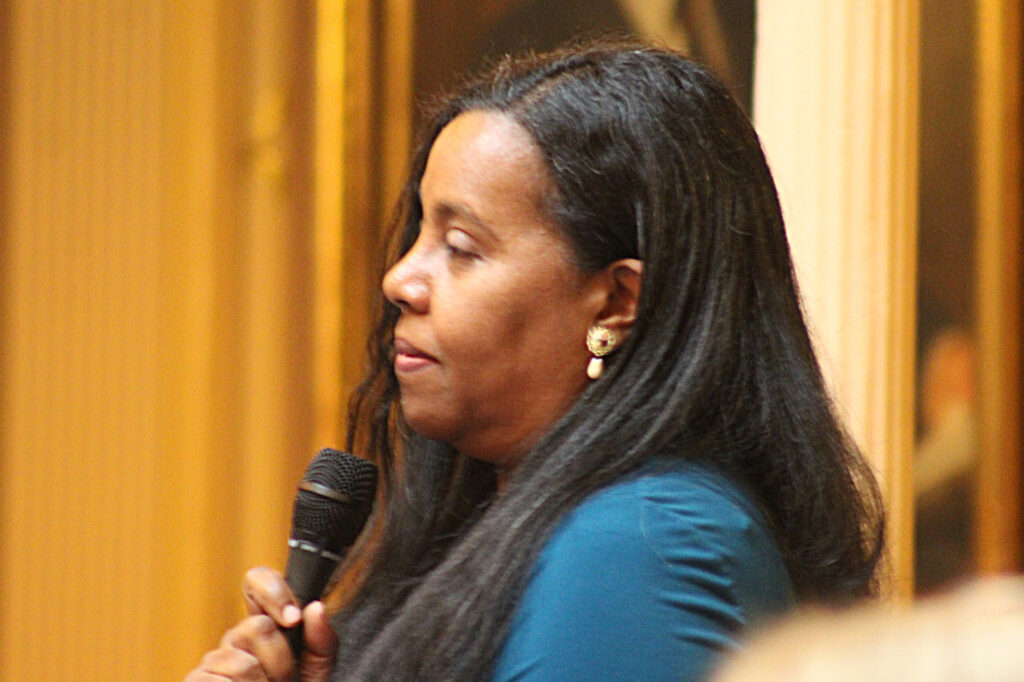
The lone Democrat voting against the bill was Sen. Russet Perry, representing Loudoun County, where data centers are sprawling into farmland, vineyards and horse country. She has also voted against previous attempts to facilitate development of solar energy. Now, she said she wants to advance cheap, clean energy, but doesn’t want to placate the solar industry.
“I think there’s a better balance that we can reach in trying to take care of both of those goals,” Perry said, while echoing desires of the Piedmont Environmental Council to have the Virginia Department of Environmental Quality draft regulation guidance with a condensed time frame.
“I think the people who care about rural localities want to make sure that those people are heard and that we’re not overriding them with trying to get more clean energy onto the grid,” she said.
Herring, who will have to shepherd her bill through the Senate, said Thursday in an interview, “I like the bill the way it is…We’ll see what happens as it moves through the process.”
About This Story
Perhaps you noticed: This story, like all the news we publish, is free to read. That’s because Inside Climate News is a 501c3 nonprofit organization. We do not charge a subscription fee, lock our news behind a paywall, or clutter our website with ads. We make our news on climate and the environment freely available to you and anyone who wants it.
That’s not all. We also share our news for free with scores of other media organizations around the country. Many of them can’t afford to do environmental journalism of their own. We’ve built bureaus from coast to coast to report local stories, collaborate with local newsrooms and co-publish articles so that this vital work is shared as widely as possible.
Two of us launched ICN in 2007. Six years later we earned a Pulitzer Prize for National Reporting, and now we run the oldest and largest dedicated climate newsroom in the nation. We tell the story in all its complexity. We hold polluters accountable. We expose environmental injustice. We debunk misinformation. We scrutinize solutions and inspire action.
Donations from readers like you fund every aspect of what we do. If you don’t already, will you support our ongoing work, our reporting on the biggest crisis facing our planet, and help us reach even more readers in more places?
Please take a moment to make a tax-deductible donation. Every one of them makes a difference.
Thank you,

Charles Paullin
Virginia Correspondent
Charles Paullin is a Richmond, Virginia-based reporter focusing on energy and environment issues. He’s won several awards for his previous work covering state policy with the Virginia Mercury and local news with the Northern Virginia Daily in the Northern Shenandoah Valley. His first reporting gig was with the New Britain Herald in Connecticut, a couple years after attending the University of Hartford, where he first studied sports journalism.
Search
RECENT PRESS RELEASES
Related Post
