Some of the Wisconsinites working for environmental change in 2025 and beyond
December 30, 2025
Many of us find ourselves reflecting on the last 12 months as the year winds to its end. 2025 has been turbulent politically, socially and environmentally.
Still, change-makers live among us. We’re revisiting a few of the people we met in 2025 who are trying to make a difference.
You know the type: people who despite extreme weather, cuts in funding and threatened environmental policy, step up for what they consider the good of their community.
An aspiring leader focused on climate change
Growing up in Milwaukee, Jariel Ramos knew climate change was real. “I’m seeing how people are really being impacted,” Ramos says.

Susan Bence
/
WUWM
Instead of throwing up his hands, Ramos rolled up his sleeves. In high school he joined Action for the Climate Emergency.
Now a college sophomore, Ramos is working to create a student environmental organization on campus at Dominican University in Illinois. He’s also thinking ahead.

“I really want to run for public office — be elected by people who believe in me and the work we can accomplish together. We can’t control the weather, but we can control how much we’re warming our planet and we can control our pollution and our consuming,” Ramos says.
Using Indigenous knowledge to guide environmental work

Nancy Aten
For Bazile Minogiizhigaabo Panek, climate action is steeped in his roots as a member of the Red Cliff Band of Lake Superior Ojibwe. We first met near his homeland in Bayfield, Wisconsin.
“I need to be of good heart and good mind in all the work I do,” he says.
Now a graduate student in Minnesota, Panek says his focus on natural resources management is grounded in traditional knowledge.

Standing In The Good Sky: His Ojibwe name inspires young Indigenous leader
Bazile Panek is a proud member of the Red Cliff Band of Lake Superior Chippewa. When he was just a few days old, he was given the traditional name Minogiizhigaabo, or Standing in the Good Sky. The 25-year-old says it helps ground his determination to be of good heart and good mind in all the work he does.
“There has been a lot of efforts to oppress Indigenous peoples across centuries and across the world. But the resiliency carried by our ancestors shows our generations that we can also be resilient in the face of climate change, oppression and racism,” Panek says.
Preserving buildings displaced by data centers

Susan Bence
/
WUWM
David DeVooght wouldn’t call himself a change-maker, just a guy with a simple mission.
“The father owned this property. He was bought out and they decided to give it to the son. You know, they’re repurposing it,” DeVooght explains, talking about a barn on property at the edge of Port Washington bought up in order to build a massive data center.
DeVooght set out to move the barn six miles to its new home.

“It’s just another opportunity to save another building,” he says.
DeVooght and his crew — including his son — have now moved two barns from the Port Washington site, and DeVooght hopes to find new homes for several houses and sheds.
“To me it would be nice to see more saved because we throw so much away,” he says.
Finding safe drinking water for her community

Susan Bence
/
WUWM
There’s no question residents of the Town of Campbell, a neighbor of La Crosse, consider Lee Donahue to be a change-maker.
Five years ago, she had just joined her town board when news erupted that some Campbell residents’ private wells might be contaminated with PFAS — called the forever chemical.
The state tested almost 600 wells on this small island community that hugs the Mississippi, “And what we discovered then is that 97.3 percent of all wells tested had some level,” Donahue says.
The source was the nearby regional airport that used firefighting foam containing PFAS for decades. Campbell residents started drinking bottled water.

Donahue didn’t waste time pointing fingers. She helped lead an effort to create a new, safe drinking water source — a municipal well. The $50 million project will tap into a deep uncontaminated aquifer.
“It’s a hassle, but in comparison to not being able to drink out of your tap, it is a healthy tradeoff,” Donahue says.
Taking public access to shoreline to court

Susan Bence
/
WUWM
Paul Florsheim could have just paid a $313 fine and walked away.
Instead, the Shorewood resident decided to push for public access to the Lake Michigan shoreline.
“My understanding has always been that along the shoreline you can walk,” Florsheim says.
The Village of Shorewood cited Florsheim for walking along what it considers private property beyond Atwater Beach. Florsheim took it to court.
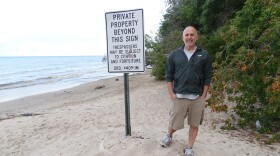
“I believe that the village is acting unconstitutionally about trying to deny me and others access to walk on a waterway that belongs to all of us,” Florsheim says.
The Shorewood municipal judge is expected to decide on the case in early 2026.
Some environmental lifts feel heavy — fighting for clean air, land and waters, and for people’s access to those resources.
But change-makers continue to show up and do the work.
Search
RECENT PRESS RELEASES
Related Post