New York State on Tuesday approved a roadmap to meet state energy needs for the next 15 years — but the plan may make it harder for New York City to achieve its own green goals, according to city officials.
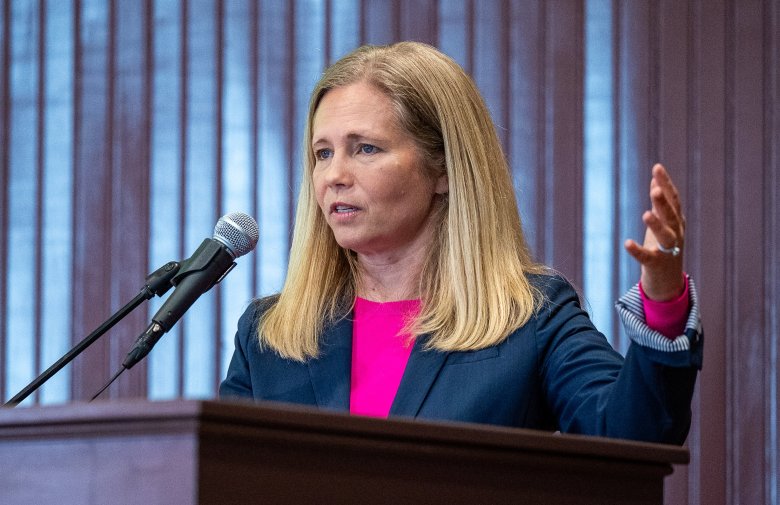
“The state energy plan is a realistic assessment of where we are, and a roadmap for where we need to go,” New York State Energy Research and Development Authority (NYSERDA) President Doreen Harris said Tuesday, reading from a letter Hochul wrote. “It’s frank about the challenges ahead and confident in what New York can accomplish.”
The plan codifies Hochul’s approach, and local officials and energy experts warn that it presents New York City with particular challenges: The plan envisions that gas-fired plants in the city could operate longer than anticipated, and some could be turned back on. The plan will also make it harder for large buildings in the five boroughs to reduce carbon emissions, as they must under a city law. And the emissions of the city itself will remain higher than its own goals specify.
Elijah Hutchinson, executive director of the Mayor’s Office of Climate and Environmental Justice, said the energy plan puts New York City “on the path of delayed action.”
“To ensure New York City has affordable and reliable energy into the 2030s, we must invest in our aging infrastructure now,” he said in a statement on Tuesday. “We can either start planning projects that will bring renewable energy to New York City in the 2030s, or we can delay action, which will leave no choice but to rely on existing and new polluting fossil fuel infrastructure that will make New York City less affordable, less healthy and less resilient for generations to come.”
And when and how New York City takes action to meet those long-term goals could impact New Yorkers soon — very soon. New York City’s grid faces reliability problems — possible brown-outs and blackouts — starting next summer, according to NYISO , the state grid operator. NYISO has pegged the problem on retiring fossil fuel plants faster than new sources come on the grid, along with rising energy demand.
If key in-progress projects — Empire Wind offshore wind project and the Champlain Hudson Power Express, a transmission line to carry hydropower from Canada — are finished on time, then NYISO forecasts the lack of dependable power would begin later, in 2029. Con Ed, New York City’s electric utility, has also forecast reliability issues for New York City starting in 2030.
In comments submitted to NYSERDA in October, New York City accused the state of not finding a solution to ensure the city has enough power generation to avoid energy droughts and meet climate goals.
The state board’s move reinvigorates a debate about particularly polluting facilities designed, in a pinch, to offer the city more power: peaker plants.
As a state lawmaker, Assemblymember Zohran Mamdani cheered the state’s 2021 decision to deny permits for a company to replace an old, gas-fired power “peaker” plant with a new one in Astoria, Queens. Peakers run when electricity demand is high, such as during heat waves or cold weather — but they are dirtier, emitting more nitrogen oxide and carbon dioxide than typical power facilities. Such pollution contributes to climate change and harms the health of nearby communities.
At the time, Hochul praised the denial, saying, “Climate change is the greatest challenge of our time, and we owe it to future generations to meet our nation-leading climate and emissions reduction goals.”
Democratic mayoral nominee Zohran Mamdani speaks alongside Gov. Kathy Hochul about a $5 million grant for the Queens Boys & Girls Club, Oct. 14, 2025. Credit: Alex Krales/THE CITY But now, as Mamdani is on the cusp of becoming mayor, the picture has changed on the federal and state levels, and projects that would’ve made shutting down more New York City peaker plants have stalled.
“Every New Yorker deserves affordable, clean energy, and ensuring that access will be critical to Mayor-elect Mamdani’s administration,” said Dora Pekec, Mamdani’s spokesperson. “The Mayor-elect knows that the fight against the climate crisis is inseparable from the fight for affordability — and that meeting this moment requires confronting the intertwined challenges of climate change and its growing effect on working New Yorkers.”
As mayor, Mamdani has limited ability to decide on opening and closing peakers, but he can use the bully pulpit to advocate for investments in clean energy for the city.
“The mayor should be calling out for the help that the city needs, whether it’s from the federal government, from the state government, from the private sector,” said Daniel Zarrilli, the former chief climate policy advisor in the de Blasio administration. “The mayor’s voice really matters.”
President Donald Trump has been hostile to renewable energy development, across the country and especially here in New York. His administration has rolled back clean energy tax credits and advanced policies that hamstrung projects requiring federal permits, such as offshore wind. Tariffs, inflation and supply chain tangles further complicated the feasibility of developing new clean energy projects.
New York City’s grid is almost entirely powered by fossil fuels. Indian Point, the nuclear plant providing zero-emissions power then-Gov. Andrew Cuomo ordered closed, was largely replaced by gas-fired generators, which increased the greenhouse gas emissions and raised costs associated with electricity usage.
On the state level, several projects to bring more clean energy into New York City and allow for the replacement of fossil fuels have been cancelled or are delayed, including Clean Path New York, a transmission line that would run from upstate New York to Astoria.
Only two offshore wind projects to power New York City are moving forward, short of the state’s ambitions years ago. Amid the uncertainty related to wind, the state also halted work to develop transmission lines to connect future wind farms to the city.
The lack of new clean energy sources — and the means to bring the energy to the city — creates a void, said Rob Freudenberg, vice president of energy and environment at the Regional Plan Association.
“The peakers are very unfortunately a necessary evil right now because they are there and we haven’t replaced them,” he said.
The state’s progress in decarbonizing the grid directly ties to the ability of city building owners to comply with Local Law 97, which imposes limits on how much carbon large buildings can spew. Buildings are the biggest source of planet–warming emissions in New York City. The longer it takes the state to switch to cleaner sources of energy, the more costly and complicated complying with the emissions caps will be, a 2021 report found .
Local Law 97 also mandates city government operations reduce emissions further and faster than private properties: 50% by January 2030. The reductions are compared to 2006 baseline levels. But the state energy plan means that target is further away, with higher city emissions projected in the coming years.
Under the plan approved Tuesday, the state itself won’t achieve the climate law’s benchmarks on time, either. The state climate law mandates 70% of electricity must be sourced from renewables by 2030 — now on track for 2033 — and slashing emissions 40% by 2030, a target now on track for 2037 at the soonest.
Repowering or prolonging the life of the gas-fired peakers runs counter to regulations and local efforts that seek to close them over time. Many peaker plants in the city are rather old and set to retire under a state rule that limits nitrogen oxide emissions. The New York Power Authority must retire its peaker plants — which are cleaner than most other privately owned ones — by 2030, as legislatively mandated. Peakers have the opportunity to extend operations with approval if they’re needed for reliability.
“The solution is not to think about repowering at this point,” said Daniel Chu, senior energy planner at New York City Environmental Justice Alliance and a member of a coalition seeking to close the peakers. “But actually look at the kinds of energy demand that we have in New York City and properly manage the demand.”
Related