Stock Market Investors Got a Warning From Fed Chair Jerome Powell in 2025. History Says Th
December 27, 2025
The S&P 500 is trading at one of its most expensive valuations ever by a a key metric.
The benchmark S&P 500 (^GSPC 0.03%) index has returned an impressive 18% so far in 2025 despite the economic uncertainty created by President Donald Trump’s trade policies. After decades when the nation’s average tariff rate on its trade partners was below 3%, he has hiked the average tax on U.S. imports to 17%, according to the Budget Lab at Yale.
After Trump announced his most severe tariffs in April, the S&P 500 dropped by 19%, and many economists forecast that the U.S. would enter a recession. But the economy has continued to grow at a robust pace, likely because high spending on artificial intelligence (AI) infrastructure has so far offset the negative impacts of tariffs.
“In the first half of 2025, AI-related capital expenditures contributed 1.1% to GDP growth, outpacing the U.S. consumer as an engine of expansion,” wrote JPMorgan Chase strategist Stephanie Aliaga. In turn, the S&P 500 has posted gains in every month since its plunge in April, as the market has become increasingly confident in the economy’s resilience.
However, Federal Reserve Chairman Jerome Powell and other policymakers are warning that stocks have become unusually expensive. In fact, the S&P 500 currently trades at one of its most expensive valuations in history, and the patterns of past cycles suggest a decline is ahead in 2026.
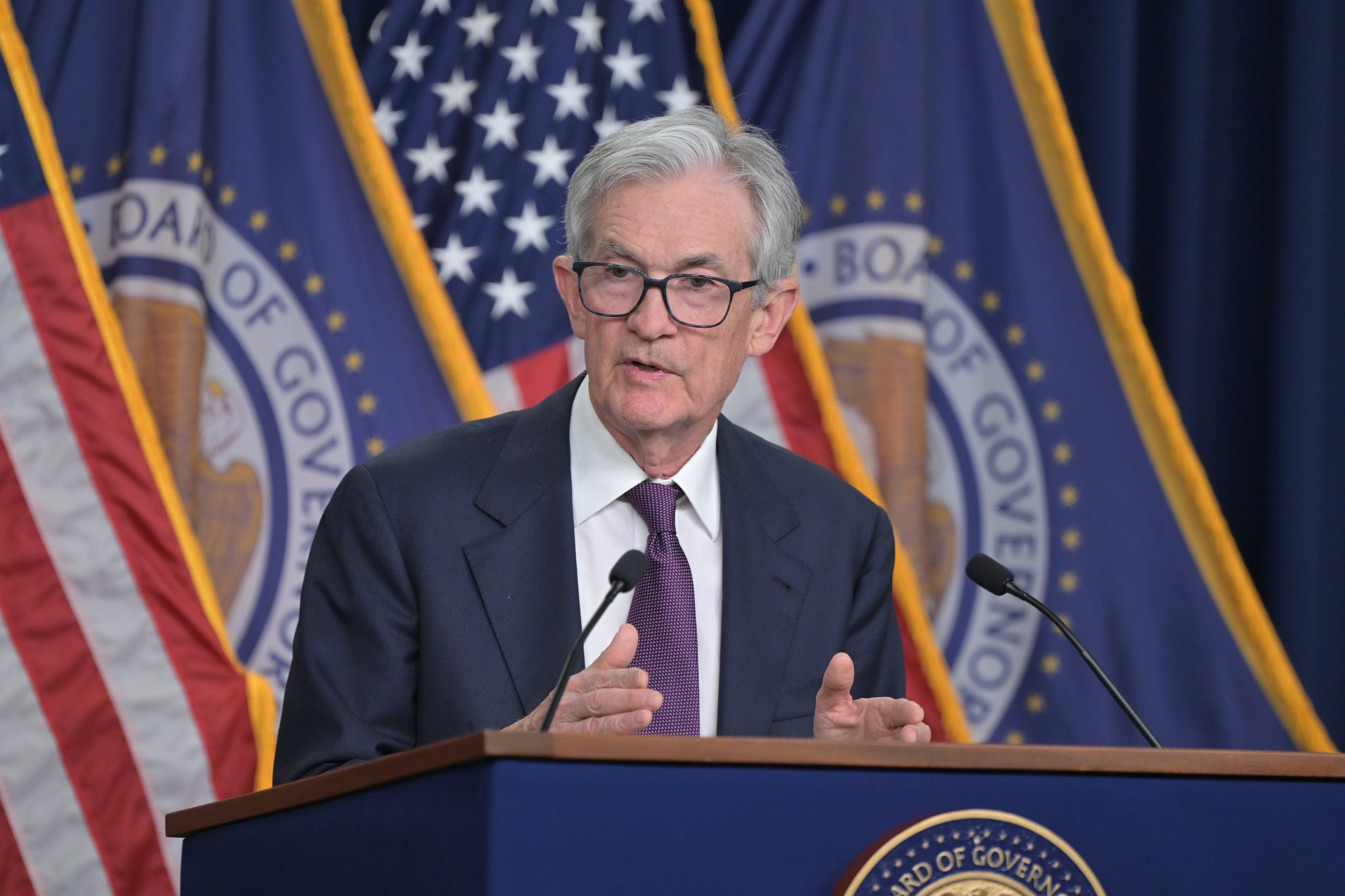
Image source: Federal Reserve.
Stretched asset valuations
The Federal Reserve does not attempt to influence stock prices with its monetary policy, nor does it take an official stance on what the correct prices would be for any particular financial assets. Nevertheless, Powell in September warned investors, “By many measures… equity prices are fairly highly valued.”
Advertisement
Other policymakers have expressed similar concerns. Fed Governor Lisa Cook said she would not be surprised by “outsized asset price declines.” And the minutes from the Federal Open Market Committee’s October meeting state: “Some participants commented on stretched asset valuations in financial markets, with several of these participants highlighting the possibility of a disorderly fall in equity prices.”
History says the S&P 500 could decline (perhaps sharply) in 2026
Some investors worry that the artificial intelligence sector is in a bubble that will burst, triggering a stock market crash similar to the one that occurred when the dot-com bubble popped in the early 2000s. On one hand, those concerns seem excessive because AI stock gains have been driven in many cases by strong earnings, whereas many dot-com-era internet stocks’ prices were largely speculative.
JPMorgan strategist Jacob Manoukian writes, “Over the past three years, the forward price-to-earnings multiple of publicly traded AI stocks has declined, while earnings per share estimates have more than doubled.” He specifically referenced Nvidia as an example. In the last five years, its stock price has increased by 14 times, while earnings have increased 20 times.
On the other hand, the stock market can be overvalued even in the absence of an AI bubble. The S&P 500 has recorded an average cyclically adjusted price-to-earnings (CAPE) ratio of 39.4 in December, a valuation last seen during the dot-com bubble. In fact, the index’s average CAPE ratio has only exceeded 39 in 25 months since it was created in 1957.
What usually happens next? While past performance is no guarantee of future results, history says the stock market is likely to perform poorly in 2026 and 2027. The chart below shows the S&P 500’s average, best, and worst returns over different time periods following a monthly CAPE multiple above 39.
|
Time Period |
S&P 500’s Average Return |
S&P 500’s Best Return |
S&P 500’s Worst Return |
|---|---|---|---|
|
1 year |
(4%) |
16% |
(28%) |
|
2 years |
(20%) |
8% |
(43%) |
Data source: Robert Shiller. The chart shows the S&P 500’s average, best, and worst returns during the one-year and two-year periods following past incidents where its monthly CAPE ratio exceeded 39.
As shown above, the S&P 500 has usually declined after achieving a monthly CAPE ratio above 39. If its performance from here matches the historical average, the S&P 500 will decline 4% by December 2026 and 20% by December 2027.
Of course, investors may tolerate higher valuations today because they think AI is likely to increase corporate profit margins in the future. Such speculative outcomes are something that a valuation metric like the CAPE ratio doesn’t account for. If earnings grow more quickly in the coming years, the CAPE ratio could fall even if the stock market continues to move higher.
Indeed, Wall Street’s median target price for the S&P 500 in December 2026 is 8,011. If it hit that, it would amount to a 15.5% gain from the current level of 6,932. Investors should hope for that outcome, but they should also mentally prepare for a more challenging 2026. Now would be a good time to make sure your portfolio includes only high-conviction stocks that you would feel comfortable holding onto through a downturn.
Search
RECENT PRESS RELEASES
Related Post