Sutton council meeting, June 3, 2026: roads, development, environment and community issues
June 6, 2026
Politics
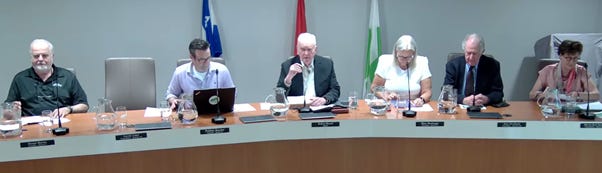
Mayor Robert Benoît presides over Sutton’s June 3 council meeting, where councillors discussed road reconstruction projects, planning reforms, environmental concerns, transportation funding and community initiatives. Photo courtesy of the Town of Sutton and YouTube.
Get local news like this every morning. Subscribe free below.
Pulse Newsroom
Residents of Sutton received a broad update on municipal priorities during the June 3 council meeting, with discussions ranging from road repairs and urban planning reforms to environmental protection, housing, recreation and transportation. The meeting also featured debate over development projects, concerns about Hydro-Québec’s transmission line plans and several community initiatives. A recording of the meeting, which lasted just under 2 hours 45 minutes, is posted on the Ville de Sutton YouTube page.
Major Roadwork Underway
One of the most significant announcements was the start of major roadwork projects by Quebec’s Ministry of Transport (MTQ). After several years of requests from the municipality, reconstruction work has begun on sections of Main Street, Maple Street and Academy Street between Main and Pleasant streets.
Municipal officials acknowledged that construction is causing delays but said the work is necessary to address deteriorating road conditions.
Sweeping Changes to Planning Rules
Council devoted considerable attention to major changes to Sutton’s urban planning and zoning regulations. Officials explained that approximately 500 pages of amendments have been prepared as part of the implementation of the municipality’s recently adopted urban plan.
The revisions affect zoning, subdivision rules, construction standards and agricultural uses. Public consultations will continue throughout June before the regulations are formally adopted. Council members said many of the proposed changes reflect concerns raised by residents, farmers and tourism stakeholders over the past four years.
Agriculture, Recreation and Tourism
Agriculture and recreation emerged as important themes within the planning discussions. Council highlighted efforts to make regulations more supportive of local agricultural operations and rural businesses while also encouraging recreation and tourism development.
Council approved recreation-oriented projects, including mountain biking and cycling initiatives, which officials said would help expand outdoor recreation opportunities and strengthen Sutton’s position as a destination for active tourism.
Community Partnerships and Food Security
Community development was another major focus. Council celebrated the 80th anniversary of the Sutton branch of the Royal Canadian Legion and the opening of its newly renovated commercial-grade kitchen. The project, supported by federal funding, is expected to contribute to local food security efforts.
Municipal leaders said the facility will support local food security initiatives.
Parc Gagné and Community Events
Residents also heard about improvements to local parks. The municipality announced the official opening of the redesigned Parc Gagné, describing it as a major transformation created through public consultation.
The project includes upgraded recreational facilities for children as well as riverside rest areas for adults.
Several community events were also highlighted.
This kind of local reporting doesn’t show up in your feed by accident.
Get it delivered daily by subscribing below.
Hydro-Québec Route Faces Opposition
Environmental issues featured prominently during discussions about Hydro-Québec’s proposed transmission line and the Jordan Road development proposal. One of the strongest reactions came in response to Hydro-Québec’s decision not to favour a transmission line route along Highway 104 between Cowansville and West Brome. Local officials argued that routing the line along an existing transportation corridor could reduce impacts on agricultural land and rural landscapes.
Local mayors and regional officials expressed disappointment with what they described as a lack of transparency surrounding the decision-making process. Sutton representatives said they remain concerned about how the selected route could affect agricultural land and rural landscapes.
Municipal leaders said they will continue seeking additional information and justification from Hydro-Québec as the project moves forward.
Jordan Road Development Draws Concerns
Residents raised several environmental concerns during a discussion of proposed residential development on Jordan Road. Several residents expressed concerns about biodiversity, wildlife habitat, groundwater supplies and the cumulative impact of development outside Sutton’s village core.
Residents cited concerns about ecological corridors, species-at-risk habitat, groundwater supplies and the impact of further rural development.
Council responded that environmental reviews are required before permits can be issued and that development proposals must comply with regulations governing wetlands, watercourses and protected areas. Officials also noted that the proposal includes a substantial conservation component intended to preserve significant portions of the property.
Transit Funding Remains Unresolved
Transportation remains another unresolved issue. Residents asked for an update on efforts to improve public transit services across the Brome-Missisquoi region. Council acknowledged that discussions are continuing following the rejection of a vehicle-registration tax that had been proposed to help fund expanded transit services.
Municipal leaders emphasized that Sutton residents should receive meaningful transportation services if they are expected to contribute financially to the system. The MRC is studying alternative funding models for future transit improvements.
Council also approved changes affecting the local housing office.
Council Debates Planning Exceptions
Several planning applications generated discussion about how strictly municipal regulations should be applied and when exceptions may be appropriate.
One of the most debated items involved a request to permit slightly taller garage doors on a rural property. Although the municipality’s advisory planning committee recommended against the request, council ultimately approved it. Supporters argued the change would have minimal impact and that regulations should allow some flexibility.
Others disagreed. Councillor Alan Pavilanis argued that municipal regulations should be applied consistently and that repeated exemptions risk undermining public confidence in the planning process. He maintained that if regulations need updating, they should be changed through the normal legislative process rather than through a series of exceptions.
Similar questions arose during discussions about access roads and development modifications elsewhere in the municipality. Residents questioned why council occasionally departs from recommendations made by the advisory planning committee, while municipal officials emphasized that the committee’s role is advisory and that elected councillors retain final decision-making authority.
Don’t miss the next story that affects your community.
Join thousands of readers getting The Pulse every morning—plus breaking news alerts when it matters most.
If you value this kind of local journalism, consider supporting it.
Subscribe, share and like!
Search
RECENT PRESS RELEASES
Related Post