Tesla rolls out FSD v14.3.2 (2026.2.9.8): first impressions, release notes, rollout status
April 27, 2026
Tesla (TSLA) has rolled out another FSD v14.3 point release version 14.3.2 (firmware version 2026.2.9.8). Tesla is constantly improving the latest Full Self-Driving AI software with quick turnaround times.
Tesla FSD users are not lagging as well. As soon as the new version becomes available, testing, reviews, and videos start to surface on social media. Tesla FSD receives instant feedback—both positive and negative.
FSD v14.3.2 is garnering good reviews for its overall smooth drive. However, there are minor issues handling pedestrians, which is highlighted by one experienced FSD tester (video below).
Tesla also hasn’t made any additions to the release notes for FSD v14.3.2 (see below). The notes are the same as in FSD v14.3 and FSD v14.3.1.
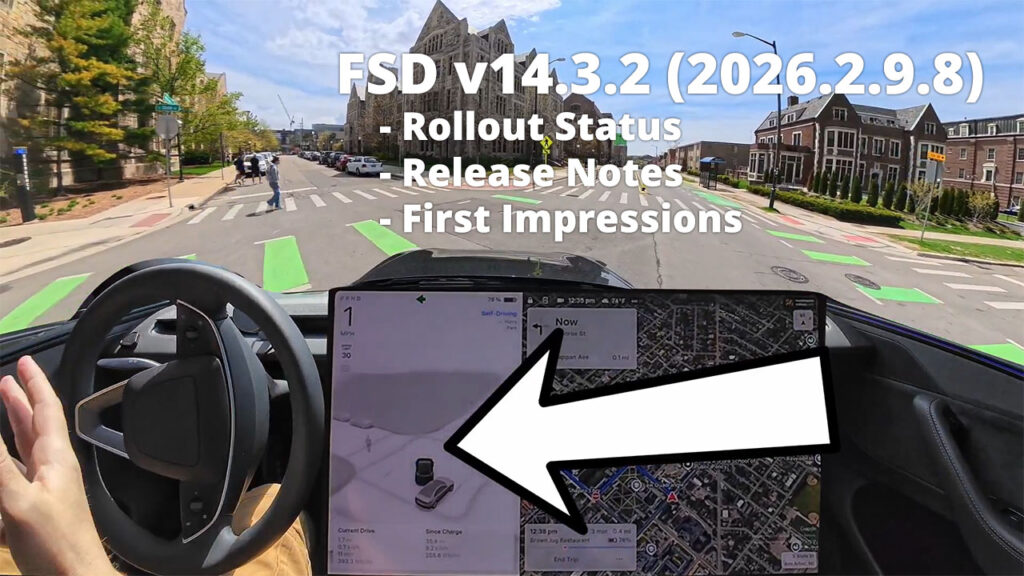
Even with the release of FSD v14.3.2, Tesla still hasn’t started a wide release. Europe has its own version (FSD v14.2.2.5) with a different firmware number.
According to Tesla vehicle software updates tracking data by TeslaFi.com and Tessie.com, the expansion of FSD v14.3.2 (2026.2.9.8) is still less than 1% of the fleet.
Tesla has halted the wide release to iron out the bugs and regressions. Handing out FSD (Supervised) to inexperienced Tesla owners without taking care of the edge cases is always a risk.
FSD v14.3.2 is only available to Hardware 4 (HW4/AI4) Tesla vehicles.
FSD v14.3.2 has comparatively better low-visibility handling, sharper 3D traffic awareness, and quicker emergency responses. Early access users experienced flawless lane changes in rain, better pedestrian braking at night, and confident yellow-light decisions.
Tesla FSD v14.3.2 users also reported a comparatively smoother driver compared to previous versions. Taking human-like safety maneuvers is also observed in this update. A user wrote on X:
Human driver tries to merge into FSD
V14.3.2 handles this perfectly – the car to our right starts to merge into the lane that we just moved into and FSD quickly gets out of the lane and continues on with the drive.
This again is a situation that had a human been driving it likely wouldn’t have been handled as smoothly, and may have even resulted in road rage.
I can’t wait until more and more people wake up to the fact that FSD is undoubtedly safer than your average human driver at this point.
@DevinOlsenn / X (video below).
According to Chris (@DirtyTesla), FSD v14.3.2 becomes a bit confused around pedestrians. Most probably, this is the reason that FSD v14.3 and its subversion point releases haven’t gone wide release yet.
“It could be the jerkiness in 14.3.x around pedestrians/small moving objects. To be clear, I am NOT complaining, it’s just my best guess,” Chris wrote on X.
Full Self-Driving (Supervised) v14.3.2 includes:
- Upgraded the Reinforcement Learning (RL) stage of training the FSD neural network, resulting in improvements in a wide variety of driving scenarios.
- Upgraded the neural network vision encoder, improving understanding in rare and low-visibility scenarios, strengthening 3D geometry understanding, and expanding traffic sign understanding.
- Rewrote the AI compiler and runtime from the ground up with MLIR2, resulting in 20% faster reaction time and improving model iteration speed.
- Mitigated unnecessary lane biasing and minor tailgating behaviors.
- Increased decisiveness of parking spot selection and maneuvering.
- Improved parking location pin prediction, now shown on a map with a (P) icon.
- Enhanced response to emergency vehicles, school buses, right-of-way violators, and other rare vehicles.
- Improved handling of small animals by focusing RL1 training on harder examples and adding rewards for better proactive safety.
- Improved traffic light handling at complex intersections with compound lights, curved roads, and yellow light stopping – driven by training on hard RL examples sourced from the Tesla fleet.
- Improved handling for rare and unusual objects extending, hanging, or leaning into the vehicle path by sourcing infrequent events from the fleet.
- Improved handling of temporary system degradations by maintaining control and automatically recovering without driver intervention, reducing unnecessary disengagements.
- Expand reasoning to all behaviors beyond destination handling.
- Add pothole avoidance.
- Improve driver monitoring system sensitivity with better eye gaze tracking, eye wear handling, and higher accuracy in variable lighting conditions.
- RL = Reinforcement Learning
- MLIR = Multi-Level Intermediate Representation (MLIR)
- FSD = Full Self-Driving
- AI = Artificial Intelligence
Stay tuned for constant Tesla updates, follow us on:
Google News | Flipboard | X (Twitter) | WhatsApp Channel | RSS (Feedly).
-
Tesla rolls out FSD v14.3.2 (2026.2.9.8): first impressions, release notes, rollout status
-
-
FSD v14.3.1 (2026.2.9.7): Tesla owners report some regressions, rollout status, and Release Notes
-
Tesla expands Unsupervised Robotaxi service to two new cities in Texas, and it’s cheaper than Waymo
-
-
Tesla obtains the first approval for FSD in Europe, opens the outright purchase option
Search
RECENT PRESS RELEASES
Related Post