Tesla Semi tackles the Grapevine with a loaded trailer, leaves fleet operator ‘amazed’
June 2, 2026
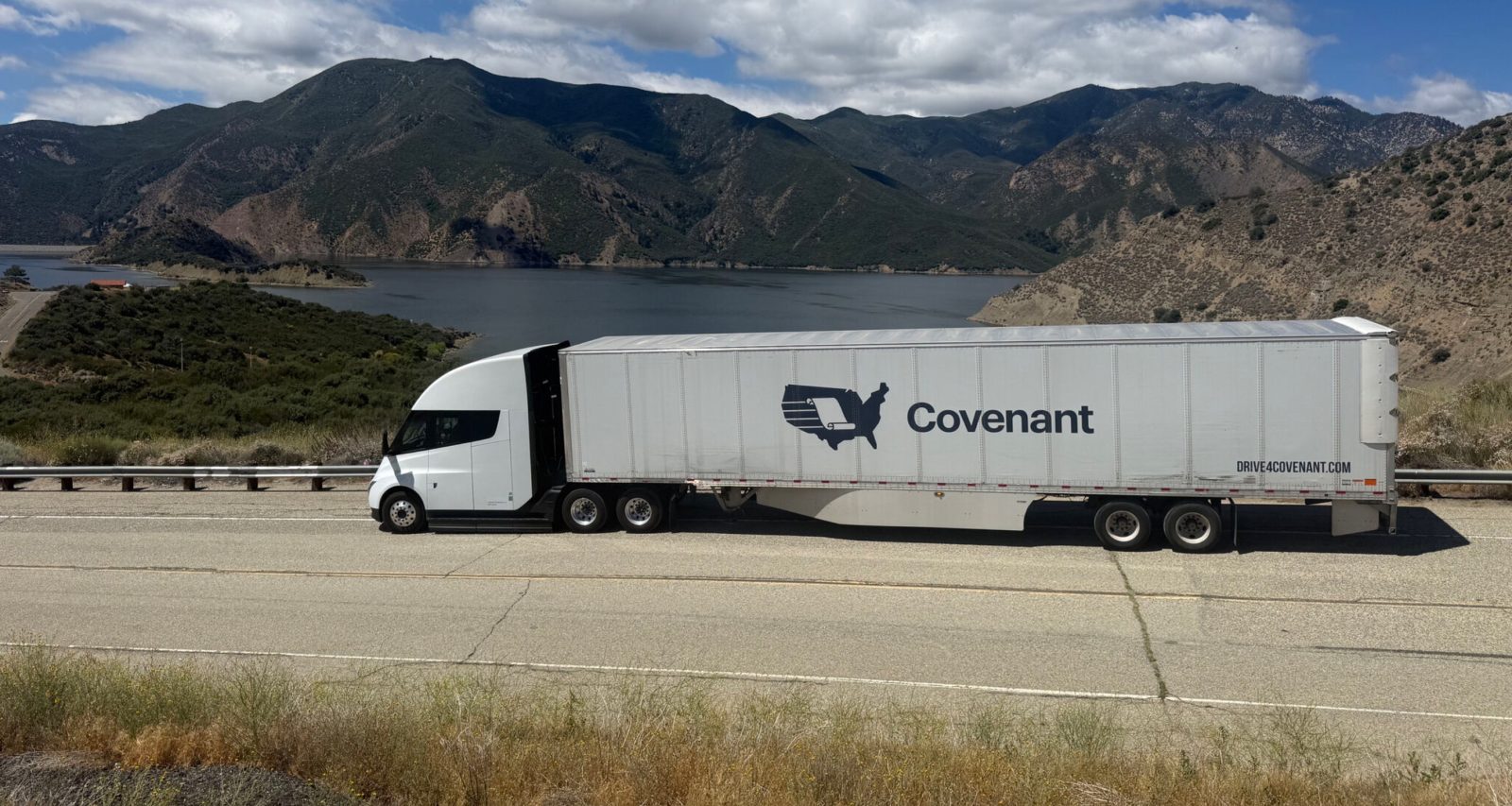
Covenant Logistics, one of the largest trucking companies in the US with a fleet of over 2,600 tractors, completed a two-week evaluation of the Tesla Semi in California — including a loaded run over the notorious Grapevine pass on I-5.
The company’s VP of Sustainability and Innovation, Matt McLelland, said the driver “was amazed at the performance of the Tesla Semi and felt a level of confidence that was hard to match in a diesel truck.”
McLelland shared the results in a LinkedIn post on Sunday, revealing that Covenant had been testing the 500-mile long-range Tesla Semi with one of its larger customers in California for the past two weeks.
The evaluation culminated in one of the most demanding real-world tests you could design for any truck: a loaded run over the Tejon Pass on I-5 between Santa Clarita and the San Joaquin Valley — commonly known as “the Grapevine.”
Advertisement – scroll for more content
The Grapevine sits at an elevation of 4,160 feet and represents the highest point on I-5 in California. It’s a critical freight corridor for trucks hauling cargo from the ports in Oakland, Los Angeles, and Long Beach. The northbound descent from Tejon Summit drops 2,613 feet over 11.6 miles, with the steepest section — the Grapevine Hill — running about 6% grade for 5 miles.
If you ever go through it, you will see plenty of semi trucks in the right lane slowly climbing the hill while getting passed by lighter vehicles.
McLelland described the challenge in both directions. Running northbound with a loaded trailer, losing momentum on a steep grade means speed drops fast and recovering is difficult. Running southbound requires constant attention to braking and heat management — though as McLelland pointed out, “that isn’t a problem for an EV when you’ve got regenerative braking doing most of the work.”
That last point is significant. Regenerative braking on steep descents is one of the Tesla Semi’s structural advantages over diesel, the truck recovers energy instead of burning through brake pads, and there’s no risk of brake fade on long downhill stretches. For a fleet operator running the Grapevine regularly, that’s a real operational benefit.
McLelland teased that a full summary of the evaluation is “coming soon.”
Covenant is the latest in a growing list of major fleet operators to put the Tesla Semi through structured evaluations since Tesla started volume production at its Nevada Gigafactory on April 29 — and the feedback has been consistently positive.
ArcBest logged 4,494 miles over three weeks and averaged 1.55 kWh per mile on typical dispatch lanes. DHL Supply Chain completed a 3,000-mile trial out of Livermore, California, averaging 1.72 kWh per mile at full load, and has since taken delivery of its first Semi. CEVA Logistics ran a West Coast trial and reported avoiding 4.38 metric tons of CO₂ emissions. MDB Transportation and AiLO Logistics both launched three-week pilots in late April focused on port drayage operations.
The consistency across different operators, routes, and cargo types is what makes this accumulating evidence compelling. These aren’t marketing partnerships — they’re procurement evaluations.
Covenant Logistics Group (CVLG) reported $1.16 billion in revenue for 2025 and operates one of the larger truckload fleets in the country. A positive evaluation from a fleet of this scale carries weight in the industry.
I’m looking forward to the full report here, but routes with elevation are certainly a great use case for electric trucks.
Fleet adoption of new truck technology often stalls not on economics but on driver resistance. If drivers actively prefer operating the Tesla Semi over a diesel equivalent, particularly on demanding routes like the Grapevine, that removes one of the biggest friction points in transitioning a commercial fleet.
We’ve now seen structured evaluations from ArcBest, DHL, CEVA, MDB, AiLO, and now Covenant — all with positive results. That’s a broad cross-section of the industry: long-haul, regional, and port drayage operations. The Tesla Semi’s total cost of ownership advantage over diesel is becoming harder to dismiss as more real-world data rolls in.
The remaining question is production. Tesla’s Nevada factory is ramping, and the company has already landed a 60-truck order from port drayage fleets. McLelland’s promise of a detailed summary “coming soon” should add even more data to the picture. At some point, the bottleneck shifts from “does the truck work” to “can Tesla build them fast enough”, and based on what fleet operators are saying, we might already be there.
If you’re a fleet operator evaluating electric trucks, locking in low energy costs is critical to maximizing your savings. With electricity rates climbing nearly 10% last year, home solar protects you against future rate increases. And with lease and PPA options, you can go solar with zero upfront cost and start saving immediately. If you want to find the best deal, check out EnergySage. It’s a free service with hundreds of pre-vetted installers competing for your business, so you save 20 to 30% compared to going it alone. No sales calls until you pick an installer. Get your free quotes here.


Search
RECENT PRESS RELEASES
Related Post