‘The biggest transformation in a century’: how California remade itself as a clean energy
December 20, 2025
As officials from around the world met in Brazil for the Cop30 climate summit last month, the US president was nowhere to be found, nor were any members of his cabinet. Instead, the most prominent American voice in Belém was that of the California governor, Gavin Newsom.
During the five days he spent in Brazil, Newsom described Donald Trump as an “invasive species” and condemned his rollback of policies aimed at reducing emissions and expanding renewable energy. Newsom, long considered a presidential hopeful, argued that, as the US retreated, California would step up in its place as a “stable, reliable” climate leader and partner.
Among the talking points he used to demonstrate California’s leadership was its progress on renewable energy – and the battery capacity needed to store that power.
“We’re running the fourth-largest economy in the world [on] 67%, two thirds, clean energy on nine out of 10 days in 2025,” Newsom said. “Outside of China, there’s only one other jurisdiction in the world – California – that has as much battery storage implemented.”
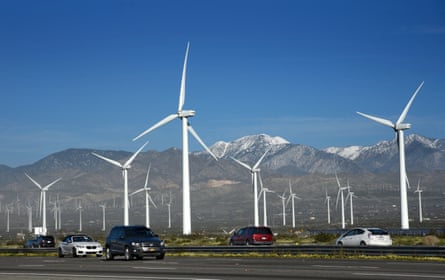
The Golden state has transformed how it powers its main electrical grid in recent years, setting ambitious targets to create an emission-free grid by 2045 and investing heavily in solar, wind and battery storage. And as the federal government abandons climate initiatives, California seems poised to take on an increasingly important global role.
The state appears to have much to celebrate. Since 2019, the state has added 30,800 megawatts of clean energy and battery storage. And while natural gas still remains the top energy source in the state, that’s on the decline: California saw its largest-ever year-to-year drop in natural gas production this year.
Meanwhile, solar and batteries, which allow energy to be stored for later use, providing an alternative to gas, are stepping up to replace it, said Mark Jacobson, a Stanford professor and renewable energy expert: “This is a remarkable shift.”
‘A leader in the clean-energy space’
When touting his achievements as governor, Newsom has frequently pointed to California’s grid. State lawmakers in 2018 passed a bill requiring California to generate 60% of its electricity from renewable and zero-carbon sources by 2030 and 100% by 2045.
So far, California appears to be on track, Jacobson said. Clean energy accounted for 67% of retail electricity sales in 2023, according to the most recently available data. For the first time, clean energy – which the state recognizes renewables such as as solar, wind, small hydro, geothermal, and biomass, as well as large hydroelectric and nuclear – provided 100% of power to the state’s main grid almost every day for at least some of the day in 2025.
Renewables are booming worldwide and are expected to grow more quickly than any major energy source over the next 10 years with more projects in the next five years than in the last 40, according to the International Energy Agency (IEA).
California is no exception and is in the midst of what the state’s energy commission (CEC) has described as the “biggest transformation of its power grid in a century”. The state is seeing new solar and battery storage projects in “record numbers” and is expected to soon completely eliminate coal from its power supply, according to the CEC.
Key to this growth has been the expansion of battery storage, a crucial tool to retain the energy produced from renewable sources. In 2019, California had 771 megawatts – by October of this year, it had almost 17,000. The state has 2.5 times more battery storage available than it did in 2022.
The batteries have helped the state avoid rolling blackouts and allowed the California Independent System Operator (Caiso), the non-profit that manages the flow of electricity on the state’s main grid, to store solar energy when there is an excess during the day.
“Then we can use that stored energy and release it in the evening hours when the sun is going down,” said Mark Rothleder, Caiso’s senior vice-president and chief operating officer. “Having a mix of resources that are capable of producing when needed is an important addition as we try to make this transition to renewable resources.”
But, he said, solar and wind are intermittent sources, meaning they can only be generated when there is sun or wind and the state’s main grid continues to rely on gas resources that can be utilized as needed.
Natural gas was the single largest resource for electricity production in 2024, but natural gas generation fell by 8% that year, in part because of the growing role of solar and wind power and enhanced battery storage, according to the CEC.
Nuclear power too plays a role – in 2024, it accounted for nearly 10% of the state’s total electricity generation – although not without controversy. California has been a center of anti-nuclear activism for decades, but supporters argue it could be a crucial tool to provide reliable power as the state transitions from fossil fuels.
While natural gas may be on the decline, it’s far from obsolete – and is relied on as a critical backup during times of peak energy usage. California has nearly 200 natural gas plants that provide roughly a third of the state’s electricity generation, said Julia Dowell, a senior campaign organizer with the Sierra Club.
“California is seen as a leader in the clean-energy space,” Dowell said. “But we’re really struggling to figure out how we meet demand in those evening hours when we’re seeing the most electricity demand, and that’s historically when we’ve relied on gas plants.”
A 2025 report from Regenerate California, which Dowell helped author, found that batteries are a less expensive and more reliable alternative to gas plants, and reduce toxic air pollution.
“They can directly compete with gas plants, and they can provide even more benefits because of their ability to ramp up so quickly,” said Heena Singh, with the California Environmental Justice Alliance and a report author. “That’s something that is important in California, where we have all these heatwaves and natural disasters.”
Fending off the Trump administration
California has long been a frequent target of Trump’s White House – and strife has only intensified during his second term.
With Trump back in power, the federal government has been focused on expanding fossil fuels and putting a damper on seemingly any effort to reduce emissions. The White House has proposed offshore lease sales along California’s coast. The president blocked California’s first-in-the-nation rule banning the sale of new gas-powered cars by 2030, and his EPA terminated a $7bn program to bring solar energy to low-income communities.
The administration cancelled $679m in funding for offshore wind developments across the US – California was expected to see about $427m for a project to build the first offshore wind terminal on the west coast. Months earlier, California and nearly 20 other states successfully sued after the federal government moved to pause offshore wind development.
More lawsuits are expected. The state attorney general’s office has established an office dedicated to pushing back against the president’s agenda.

Republicans and the Trump administration have also sought to blame the transition to renewable energy for high utility bills – California has some of the most expensive in the nation. But experts attribute those costs to power companies passing the costs of wildfires to customers.
Despite these pressures, California’s energy transition is well under way – and unlikely to reverse course.
“You’re going to see California fiercely litigating every single effort of the federal government to undo the fight against climate change and the fight against clean energy,” said Noah Perch-Ahern, an environmental attorney. “I think that’s going to continue for years.”
Meanwhile, advocates and experts hope to see California continue to expand clean energy with more rooftop solar projects that can reduce demand on the grid, and ultimately phase out gas plants.
“We’re just really hoping that people start to recognize that we don’t need these gas plants,” said Maia Leroy, an author of the Regenerate report, adding that there are significant costs to keeping them running even when the state isn’t using them for power. “It’s time to shut them down. It’s an expensive insurance policy.”
She’s hopeful California will continue to move ahead despite the federal obstacles.
“We made it through the first Trump administration. California survived, and we never once went back on any of our clean-energy goals. And so I don’t foresee that being an issue again this term,” she said.
Search
RECENT PRESS RELEASES
Related Post