The Different Kinds of Investors – A Wealth of Common Sense
May 31, 2026
Someone alerted me Risk & Reward was the best seller1 in stock market investing this week:
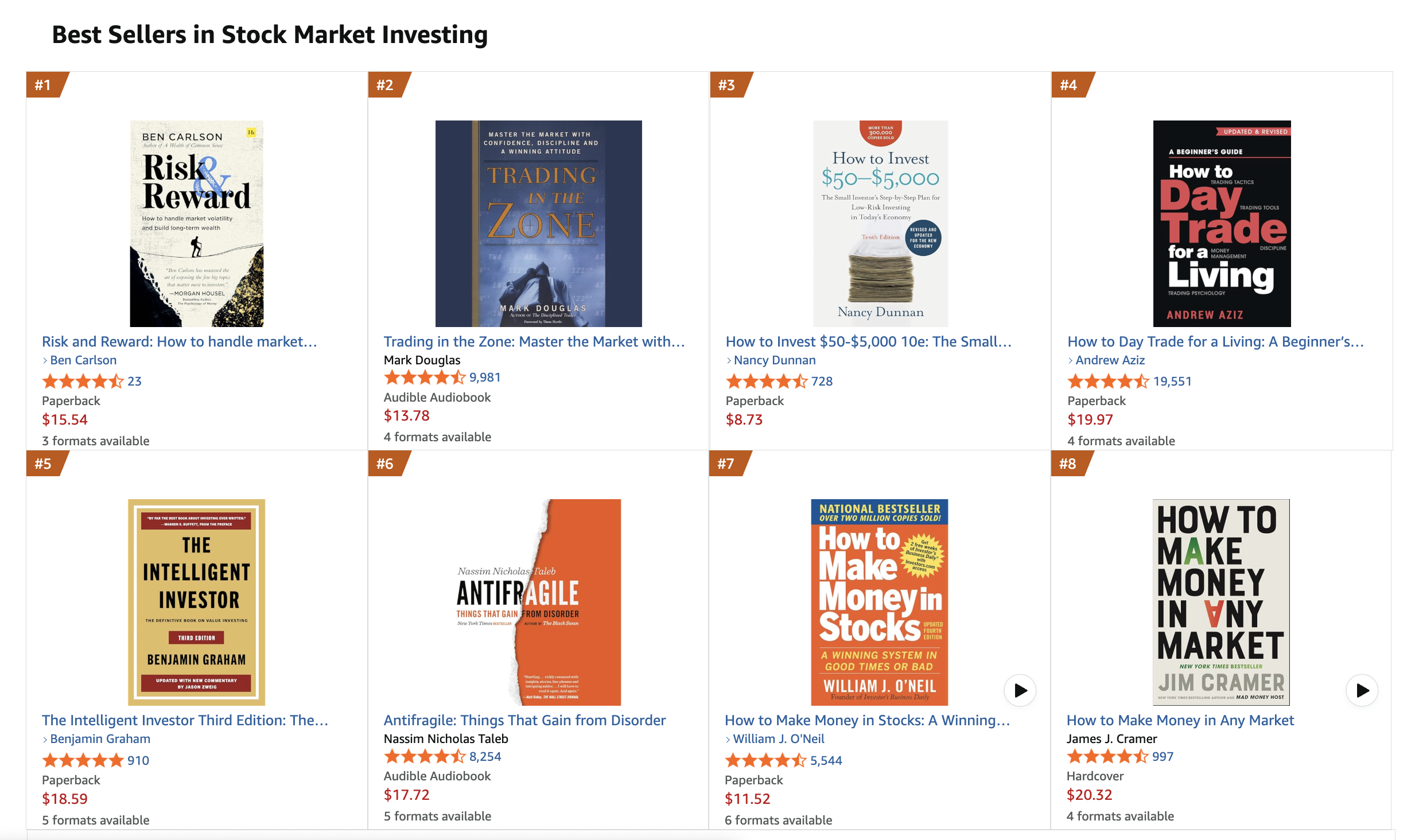
It’s a pretty eclectic mix of investment styles here.
You have value investing (Benjamin Graham), growth investing (William O’Neill), risk management (Nassim Taleb), stock-picking (Jim Cramer) and some day trading books.
This is what makes a market. Something for everyone.
It’s also why it’s so difficult wrap your arms around the “retail” investor psyche.
There are so many different kinds of investors.
There’s something like $5-6 trillion dollars in targetdate funds.
Vanguard manages $12 trillion. Blackrock is in the neighborhood of $15 trillion.
So there are plenty of set-it-and-forget-it Boglehead types out there.
But we’ve also been breaking records for option and futures trading by retail investors this decade. You have meme stocks popping up like weeds. Leverage ETFs. Prediction markets. Sports gambling. Speculation out the derriere.
Some people go to each extreme. There are index fund investors who religiously follow a low-cost plan. There are degenerate gamblers who risk it all.
But there are also plenty of investors out there who dabble.
They hold mostly targetdate funds or index funds in their retirement accounts. Then in the brokerage account they do some stock-picking, maybe a little speculation on the side.
I used to be a staunch believer that there was a single right way to invest.
This is something I’ve changed my mind about in my many years of writing this blog and working with wealth management clients.
There are plenty of ways to be a successful investor.
I’ve met boatloads of wealthy DIY indexers.
As difficult as it is to consistently pick stocks, I’m constantly amazed at the number of people I’ve interacted with in the past 5-7 years who have created massive amounts of wealth in concentrated stock positions.
There are also plenty of successful real estate investors, private market investors, business owners/entrepreneurs and of course those who have simply diligently saved and invested slowly but surely over many decades.
There are many roads to wealth, which is good because different personalities mesh better with different investment philosophies.
I even look at it as a sign of emotional intelligence if you’re able to hold different investment strategies within the same financial plan. Cognitive dissonance is an uphill battle.
There is, however, one strategy that I believe is harder than all of the others — day trading.
I wrote a whole chapter in my book on the topic. Here are some studies I referenced:
A study of Brazilian futures traders revealed that 97% of those who traded for over 300 days ended up losing money. Just over 1% managed to earn more than the Brazilian minimum wage ($16 per day), while only half a percent made more than a bank teller’s salary ($54 per day) – all while taking on significantly greater risk. The longer these futures traders remained in the day trading casino, the more likely they were to experience losses – the opposite of long-term buy and hold investing.
A study of individual day traders in Taiwan over a 15-year span found that even the most experienced traders tended to lose money. That’s not surprising – but what is surprising is that even the traders who consistently lost money continued trading through the losses. The vast majority were unprofitable, with only 5% of traders turning a profit. Those who lost money were more likely to over-trade, with unprofitable traders making up 70% to 80% of the total trading volume. If at first you don’t succeed, trade, trade again.
There are more like this but you get the idea.
Day trading is easily the most low probability form of investing because the probability of gains is much lower over shorter time frames:
Can some people do it?
I personally know exactly one person day trades and is successful at it. There are hedge fund managers and rocket scientist-types who can do it with computers and such. But it’s a grind and your odds of success are very low given who you’re up against.
And yet…day trading books still do numbers.
Hope springs eternal.
Further Reading:
The 4 Abilities Every Investor Needs to be Successful
1Thanks to all for supporting the book.
Search
RECENT PRESS RELEASES
Related Post