The Ethereum Foundation has issued a ‘life-and-death statement.’ Will the community buy into it?
March 15, 2026
Original Title: “The Ethereum Foundation Issued a ‘Life-and-Death Statement’ – Will the Community Buy It?”
Author: KarenZ, Foresight News
On the evening of March 13, the Ethereum Foundation (EF) board released a mission statement titled ‘EF Mandate’.
When you open this mission statement, you might wonder if you’ve stumbled into the wrong scene—filled with stars, elves, wizards, and layouts resembling anime posters. Beneath this flashy exterior lies the current ‘ideological framework’ of the Ethereum ecosystem.
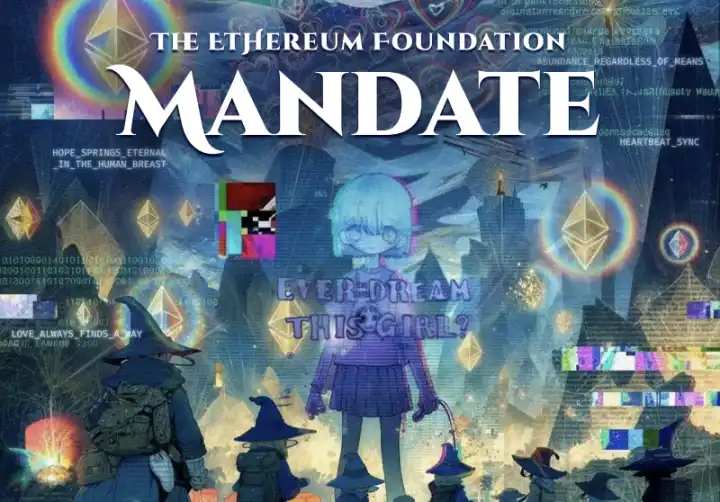
· EF Core Positioning: Guardian, not ruler. The ultimate goal of the EF is to pass the ‘Walkaway Test’—even if the Ethereum Foundation were to dissolve tomorrow, the Ethereum network would continue to operate seamlessly.
 · CROPS Principles are non-negotiable: Any technical development must meet the criteria of Censorship Resistance, Open Source, Privacy, and Security. None of these four attributes can be compromised, and no developmental priority should override them.
· EF Operational Philosophy: By doing less, Ethereum becomes more resilient. As the ecosystem matures, the Ethereum Foundation will gradually decentralize its authority.
· What Not to Do: Avoid being a ‘kingmaker,’ refrain from acting as a rating agency, avoid becoming a marketing entity promoting projects, and discourage treating Ethereum as a ‘big casino.’
· Ultimate Vision: Look ahead 1,000 years to provide a ‘digital sanctuary’ free from exploitation by power, capital, AI, or even family structures.
EF believes that in the digital age, two things are essential infrastructure-level needs: individuals controlling their own data, identity, and assets (self-sovereignty), and collaborating with others without being ‘held back’ by anyone (sovereignty-preserving coordination).
Achieving only the first point can be done by running an application locally; achieving only the second point can be accomplished through traditional internet. The unique value of Ethereum lies in simultaneously fulfilling both.
There is a passage in the declaration that reads: The existence of Ethereum is to ensure that no one, be it a government, corporation, institution, or AI, can “rug” you.
In line with this goal, the EF has proposed an acronym: CROPS. This term appears 32 times in the declaration.
· Censorship Resistance: No one can stop you from doing legal activities; regardless of external pressures, cryptography ensures neutrality.
· Open Source & Free: All code and rules are transparent, with no hidden black boxes.
· Privacy: Your data belongs to you, not the platform. You decide what information to share and with whom.
· Security: Both the system and users must be protected from technical failures and coercion.
These four attributes are defined in the document as an “indivisible whole,” representing the highest priority and non-negotiable baseline.
EF’s stance is clear: it would rather proceed more slowly than compromise on doing things correctly from day one. Once a principle is abandoned, reclaiming it becomes nearly impossible.
The EF is pursuing the ultimate measure of success: making itself unnecessary.
The document contains a term called “walkaway test,” which asks: If the EF disappeared tomorrow, could Ethereum continue to operate and evolve on its own? The EF’s goal is to make the answer to that question “yes.”
Therefore, the EF is practicing a philosophy of “subtractive development”: focusing on addressing critical tasks that no one else in the ecosystem can or will undertake—core protocol upgrades, long-term technical research, and public security safeguards. Once the community can take over a certain area, the EF hands it off, further reducing its relative influence.
At the same time, the EF has drawn up a lengthy “not-to-do” list, which reads like a formal disclaimer: not a company, not a kingmaker, not a certification body, not a product studio, not a marketing firm, not a boss, not a government agency, not a casino, not an opportunist.
Much has been said about overarching principles: CROPS, self-sovereignty, and the philosophy of subtraction. But what happens when specific issues arise? This chapter provides the answer.
It functions somewhat like the foundation’s “decision-making algorithm”: When faced with two paths, how does one choose without betraying the original mission?
When selecting a technical solution, choose the one that “won’t lead to future constraints,” even if it seems slower now. For instance, in transaction propagation: one solution offers better performance but relies on a private relay network (whitelist-based), while another is decentralized but advances more slowly. EF’s likely preference is the latter, as once the former is implemented, achieving decentralization later becomes virtually unattainable.
When designing or evaluating proposals, don’t just focus on the immediate layer; consider its impact on other layers. Some solutions may appear flawless in isolation and even align with CROPS principles, but within the broader ecosystem, they might create new problems elsewhere. Avoid solving one issue only to generate ten more.
User security is critical, but decisions should not be made on behalf of users. Provide tools for autonomous defense without imposing paternalistic restrictions, ensuring no one can deprive users of their right to make independent choices under the guise of “protecting users.” For example, certain wallets enable a default “safe mode” that covertly blocks specific contracts, redirects users to designated platforms, or uses opaque AI to determine “risky operations,” while secretly collecting user behavior data—all practices opposed by the foundation. True protection involves giving users verifiable filtering tools, transparent blacklists and whitelists, and ensuring all tools, including AI components, prioritize privacy protection by default.
If intermediaries are unavoidable for now, lower entry barriers and ensure exit options: Where intermediaries currently cannot be bypassed, minimize thresholds to encourage market competition while guaranteeing users access to viable non-intermediary alternatives that are practical and implementable.
When deciding which teams to support, evaluate based on actual technical choices rather than social influence. Many projects claim adherence to CROPS verbally but embed closed-source core components, impose whitelist restrictions, or guide users along fixed pathways—red flags to watch for.
This declaration is written with great conviction, but the questioning of reality never ceases.
Does this document represent a collective consensus or the ideals of a few authors? If EF were to replace its members, would it still hold true? Who oversees its implementation?
A more pressing question is:
A significant portion of EF’s operational funding depends on its holdings of ETH assets. A low ETH price compresses the budget. “Price indifference” reflects a mindset of discipline, not financial reality.
CROPS rules represent an ideal framework, but the world does not operate according to CROPS principles.
What most users truly care about is whether something is fast, affordable, and easy to use.
EF’s commitment to being fully CROPS-compliant from day one raises the question: Will this approach cause Ethereum to lag behind more “pragmatic” competitors in terms of user experience and commercialization?
How should EF’s ‘dos’ and ‘don’ts’ be evaluated? How should accountability be enforced? How can we determine whether ‘coordination’ is effective?
Less than 24 hours after the release of the manifesto, community feedback has already become polarized:
Critics:
Eigen Labs researcher Kydo bluntly stated that EF has made a 180-degree turn in direction, overturning its previous ‘pragmatic approach’ that supported stablecoins, institutional entry, and RWAs, thereby marginalizing the most market-relevant applications at present.
The chairman of Forward Ind. complained: ‘They build whatever they want, not what you need’—accusing EF of building purely on idealism while ignoring community and market demands.
Hazeflow founder Pavel Paramonov described it as ‘yet another pile of ideological nonsense,’ failing to clarify Ethereum’s specific direction moving forward.
Supporters:
Namefi founder Zainan Victor Zhou believes this is a restriction targeting EF as an organization rather than a limitation on the entire ecosystem.
Columbia Business School professor Omid Malekan pointed out that CROPS is precisely the foundation of Ethereum’s leadership in the financial sector—it provides genuine ‘accessibility + verifiability + property rights protection.’
In response to the controversy, Vitalik personally clarified: this manifesto was “unsurprising to many” and aligns with the direction EF has been contemplating over the past few months. EF will only act as the guardian of Ethereum, leaving everything else to the broader ecosystem — marking the beginning of a new chapter.
The declaration concludes with an Italian phrase: ‘E quindi uscimmo a riveder le stelle’—from Dante’s *Divine Comedy: Inferno*, literally meaning ‘And so we emerged to see the stars again.’
EF also created a meme titled “SOURCE SEPPUKU LICENSE,” which states: “If the Foundation fails to honor its solemn commitment to Ethereum, let it face the consequences and self-destruct.”
EF compared itself to a traveler passing through hell, determined to advance toward the “stars of digital freedom” despite enduring the trials and skepticism of reality. Of course, time will tell.
Search
RECENT PRESS RELEASES
Related Post