The hidden dead zones spreading across the Baltic Sea floor
May 26, 2026
The hidden dead zones spreading across the Baltic Sea floor
 Getty Images
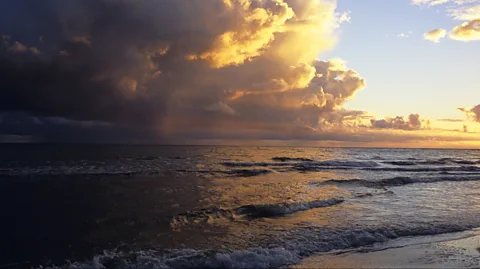
Bornholm is a strategically located, remote island in the heavily polluted Baltic Sea. Now the windswept Danish island finds itself at the centre of an environmental and geopolitical crisis.
The tourist season on Bornholm is short. When I step off the bus the large harbour is empty except for a handful of yachts and a detachment of Danish soldiers. The fish-processing factory on the quay is silent and apparently abandoned, and over its shoulder peeks a new estate of holiday homes.
The harbourmaster’s office is nonetheless still busy, one of its walls lined by old sepia photographs of the harbour in busier days. “I have worked here for nearly 27 years,” Tom Nielsen, the harbourmaster, says. “We used to have 55 boats at one time, and now we have one left… You could walk across the harbour from one fishing boat to another. It was absolutely full. So many ships, so many people in the industry, in the factory, as mechanics, electricians. There were three people on land for every one person at sea.
“It was a shock when the fishing disappeared… and there are still no fish.”
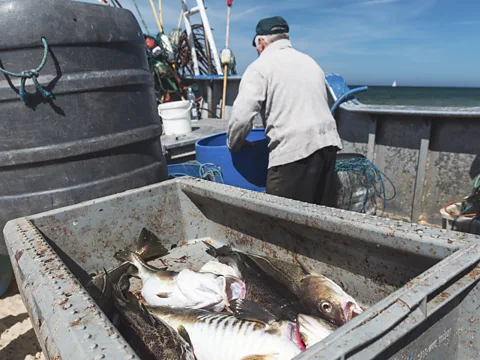
Commercial cod fishing around Bornholm has been banned since 2019 owing to the collapse of local cod stocks. In 2024, the 141-year-old fishermen’s association in Bornholm closed down.
It may take more than 400 years for the maritime environment to recover from factors such as overfishing, oxygen depletion and rising sea temperatures. Some believe it may not happen at all. For under the Baltic Sea’s waters, an invisible enemy is on the march.
Areas of the sea floor with little or no oxygen, known as “dead zones”, appear to be creeping closer to Bornholm’s beaches. This is due to human pollution from fertilisers and sewage creating huge algal blooms, which, when they die, sink to the sea floor and cover it. Their decomposition uses up the available oxygen, kills the living organisms that depend on it, and – as a result – creates dead zones.
 Ivandet
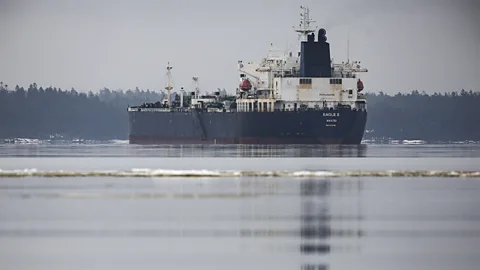
As if this wasn’t enough, the Baltic Sea is facing a new threat to its survival. Russia’s 2022 full-scale invasion of Ukraine created a “ghost fleet” of ships to bypass Western sanctions and the price cap on its oil exports.
Today there are growing fears of an accidental massive oil spill from one of the allegedly poorly maintained merchant ships of Russia’s ghost fleet that would further devastate the fragile Baltic Sea environments, a claim which Russian authorities deny.
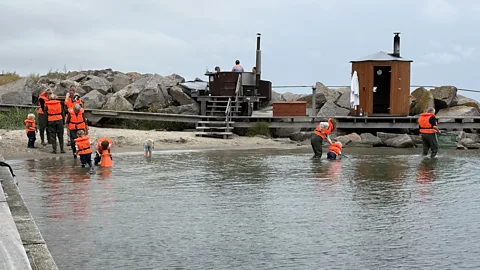
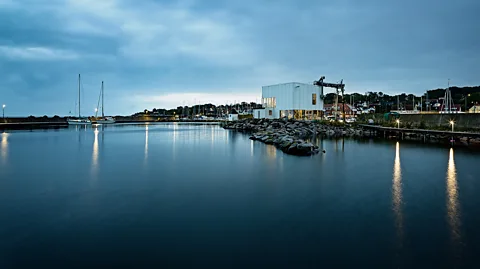
Towering over the harbour at the far end of the quay in Tejn is the tall corrugated-iron factory that used to make ice for the island’s fishing fleet. Now it is home to a local environmental education charity named Ivandet (Danish for “in the water”).
“After the industry collapsed no one wanted to talk about what happened,” says Marie Helene Miller Birk, a marine biologist and co-founder of Ivandet. “We found that the most important thing right now was to get people in the water and get them talking.”
Ivandet replaced the machinery with a café, a mezzanine office space and a balcony with 180-degree views out over the Baltic Sea. The walls and pipes of the factory remain as a memorial to the fishing industry. The organisation created an artificial lagoon out into the sea.
“In the summertime, families come down and spend time with us,” says Birk. “We have a marine biologist, usually me, with waders, fishing nets and water binoculars. The kids start getting curious, pull their parents in, and then the conversations begin.
“It’s like the parents have needed someone to ask about all these things that they’ve heard in the media about the pollution,” she adds.
Co-founder Magnus Heide Andreasen, a PhD student in marine ecology at the National Institute of Aquatic Resources in Copenhagen, and now co-founder of habitat restoration startup Redox, which is working on a new commercial technology which aims to reverse the oxygen depletion of the sea floor and restore its polluted sediments.
He’s can’t tell me much more, though. “It’s still secret.”
Looking out across the Baltic Sea from the balcony, it’s hard for me to believe that the sea is so polluted.
“That’s the biggest problem the sea faces,” says Birk. “It looks so beautiful.”
Under the sea’s surface, it can be a very different story.
Killing blooms
“The Baltic Sea is a small, semi-enclosed sea with a unique set of characteristics,” says Rüdiger Strempel, Executive Secretary, Baltic Marine Environment Protection Commission (HELCOM) over a video call. “It’s the biggest brackish water area in the world and has very limited water exchange with the neighbouring North Sea.”
 Ivandet
Helcom is an intergovernmental organisation founded to protect the environment of the Baltic Sea. It has 10 members, including Russia, and was set up in the 1970s.
“Water can remain resident for 30 years in the Baltic. It’s also very shallow.” The Baltic Sea’s average depth is around 180ft (54m); the Mediterranean’s average, in comparison, is 4,920ft (1,500m). “It has many species adapted specifically to these conditions,” Strempel says.
At least seven major rivers drain into the Baltic Sea. Its catchment area is four times the surface area of the sea itself and home to almost 90 million people.
“It is one of the busiest sea areas in the world,” Strempel says. “We have an average of 1,500 large vessels out there at any given moment, and around 55,000 vessels entering or leaving the Baltic Sea through the Danish Straits every year.”
“You can imagine that the Baltic Sea is subjected to a lot of pressures that it’s not very well equipped to deal with.”
I am looking at one of them. On my screen is a picture of beautiful swirls of dancing and shimmering colour that look like the Northern Lights – but they aren’t. They are blue-green algae blooms, and they are helping to kill large parts of the Baltic Sea.
“The Baltic is one of the most polluted sea areas in the world,” says Annamari Arrakoski-Engardt, CEO of Finland’s John Nurminen Foundation. “The main problem in the Baltic Sea is eutrophication.”
Eutrophication is natural process. It also occurs when too many nutrients such as phosphorus and nitrogen from farming end up in the sea. These nutrients stimulate the growth of algae and lead to the creation of dense blooms which can block out sunlight. But this is only the start.
When the algae dies, it sinks to the sea floor and start to decompose. This uses up the dissolved oxygen in the water and leaves little or no oxygen for fish and other life forms, resulting in dead zones.
 Sensemaker
Eutrophication is occurring in the Baltic on a massive scale. “We have a situation in which 97% of the Baltic Sea is in some way affected by eutrophication,” says Strempel. “The ‘dead zones’ vary seasonally from roughly the size of Denmark to larger than Ireland.”
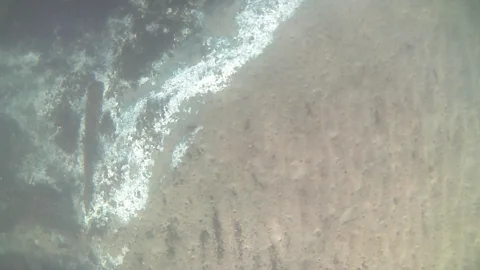
The cliffs and rocks of Bornholm’s coast provide the perfect protection for life. “But the sea bottom can end up covered in a white layer which we call in Danish a ‘corpse sheet’,” Birk says. “It’s covering a larger area each year and, in some parts, lasting all year.
“Normally it’s out in the deep sea,” she adds. “Now it’s getting more and more coastal. This is a new thing.”
The Baltic Sea faces many other serious problems as well. “We have a serious issue of hazardous substances in the Baltic Sea,” says Strempel, “which we now realise, thanks to new data, is at least as pressing as the issue of eutrophication.”
The pollutants in the Baltic Sea include chemicals, plastics, pharmaceuticals, shipping, World War Two munitions and chemical weapons. “In German waters alone, there are some 300,000 tons of conventional munitions. There are also some 40,000 tons of chemical munitions resting on the sea floor,” says Strempel.
Then there is climate change, which is having a significant impact on the Baltic Sea, in terms of – for example – sea temperature rise, growing dead-zones and reduction in bio-diversity.
Saving a sea
Many grassroots organisations like Ivandet have sprung up across the region. In 2024, the Save the Baltic Sea hiking expedition went on a nine-month, 6,000km (3,700-mile) hike around the Baltic Sea to raise awareness of the sea’s pollution and campaign for action by businesses and governments.
The John Nurminen Foundation is working with the agriculture community to reduce the amount of eutrophication causing nitrogen and phosphorus in the Baltic Sea.
“We are working with the farmers in Finland to use a gypsum treatment on the fields,” says Arrakoski-Engardt. “This keeps the phosphorus in the soil for five years to help the plants to grow and cuts the phosphorus load by 50%. This is something we are now testing all over the Baltic Sea.”
 Getty Images
Before the Russian invasion of Ukraine, the foundation also placed enhanced phosphorus removal equipment in five cities in Belarus. “This also motivated Lithuania and Poland to do more because they no longer had the dirty water coming from Belarus,” she says.
Helcom has also played an important part in fostering essential cooperation among Baltic Sea states with its action plan. The level of nutrient pollution in the sea has “significantly declined”. Thanks to a programme of aerial surveillance, the number of detected oil spills fell from 763 in 1989 to only 32 in 2023.
“We established in the late ’90s a system of pollution hotspots, and we are little by little able to delete more and more of those,” says Strempel. “We just heard that Poland, for example, was able to eliminate the last of its hotspots.
“Sulphur and NOx emissions are also limited for ships crossing the Baltic Sea. So that is something we have also achieved.”
While there is some good news, the Baltic Sea’s physical size and the scale of the pollution, as well as the increasing effects of climate change, mean that a full restoration is likely to be impossible.
“I couldn’t live without the hope that we can restore the Baltic Sea,” says Magnus Heide Andreasen. “But it will not be the Baltic Sea we had 150 years ago.”
The geopolitical crisis in the Baltic has made any potential recovery process more complicated. The widespread fears over the threat to the environment posed by the merchant ships of Russia’s “shadow fleet” are, perhaps, the most public expressions of the crisis.
“It would be a disaster if any of the Russian shadow fleet of tankers hit rocks and caused a massive oil spill in the Baltic Sea,” says Arrakoski-Engardt. “That’s the biggest threat, and therefore our biggest problem.”
Russia has in the past been accused by environmentalists of covering-up its “environmental assault on the Baltic”, a claim which Russia denies, including the biggest ever phosphorus leak from the land into the Baltic Sea.
Strained relations
While Russia has remained a member of Helcom after the invasion of Ukraine, the other nine members (H9) decided “business as usual with Russia” was impossible. Instead, they agreed to a “strategic pause” that ended formal meetings with Russia.
 Getty Images
Now, the H9 meet informally when decisions are needed. These are transmitted in writing to Russia through Helcom’s secretariat, and Russia can then reply in writing.
“Contacts have become more difficult and are greatly diminished,” says Strempel. “We are not getting any information from them, and there is no way we can monitor what they are doing.”
More like this:
On his most recent trip to the Baltic, Oliver Moody was surprised by the fear of Russia he found. Moody is Berlin correspondent at The Times and author of Baltic: The Future of Europe.
“The governments of the Baltic have really been rattled by the geopolitics in ways that they don’t let on in public,” he says. “There is a lot of genuine fear about the prospect for a massive oil leak from the shadow fleet tankers.” But he says he does not think the environmental issues “have yet fallen down the priority lists”.
The prospect of military action in the sea could, however, pose significant challenges. “Even a limited kind of military conflict in the Baltic is likely to paralyse a lot of the ongoing conservation efforts and set things back noticeably.” (The day after I arrive back in the UK, some airports in the region are closed due to drones that may have been launched from Russian ships.)
In response, the Russian embassy in London said: “Russia remains committed to its obligations under the Helsinki Convention and continues to participate in Helcom as a full member. The decision by the other nine members to suspend formal cooperation was a political choice, not a consequence of any alleged environmental violations by the Russian side.
“We believe that environmental issues in the Baltic Sea should not be politicised. Western allegations regarding the so-called ‘shadow fleet’ are largely based on hypothetical scenarios, while real and documented environmental damage caused by other incidents has received far less attention.”
The problems the Baltic faces seem so great that it has been hard for Birk to keep her natural sense of optimism. “But I keep coming back to the most important thing,” she says. “Keep going into the water and keep showing the life that is still out there to people.
“The Baltic Sea isn’t dead. It has changed. It’s not like it was before. We need to help Bornholm see the opportunities that the sea still can provide.”
—
If you liked this story, sign up for The Essential List newsletter – a handpicked selection of features, videos and can’t-miss news, delivered to your inbox twice a week.
Search
RECENT PRESS RELEASES
Related Post