The Internet can’t stop watching Figure AI’s humanoid robots handling packages
May 20, 2026
Figure AI’s 24/7 livestream showcases human soft spot for humanoid robots.
Credit:
Figure AI
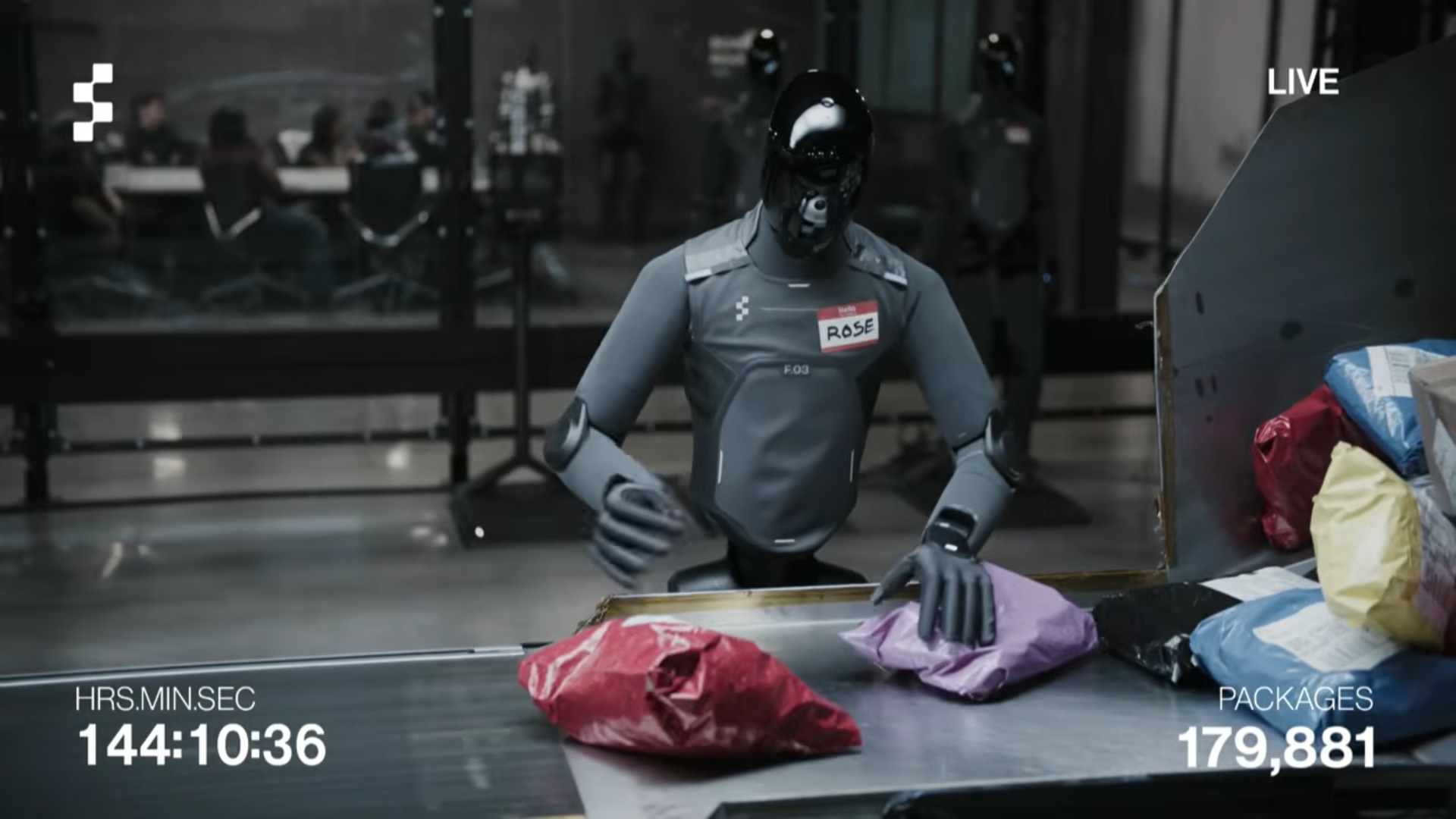
The robotics startup Figure AI has been livestreaming humanoid robots placing thousands of packages onto a conveyor belt for nearly a week—a spectacle that included a robot competing against a human intern at one point.
The promotional robot demo has become a viral sensation among tech enthusiasts, spurring YouTube commenters to name the robots and the company to rapidly roll out related robot merchandise in response. Users on X have described the livestream in glowing terms, such as “the greatest product demo since Steve Jobs’ ‘one more thing.’” But despite such sentiments, it’s worth bearing in mind that even the most impressive robot demos represent narrow windows for understanding real-world robot capabilities.
Figure’s event began on May 13 as a planned eight-hour robot demonstration featuring the company’s latest Figure 03 robots. The chosen robotic task involved inspecting the bar codes on various small packages—including cardboard boxes and soft padded envelopes or bags—and then placing the packages on a conveyor belt with the bar codes facing downward. The demo would feature the robots performing the task autonomously without any human intervention, according to Figure CEO Brett Adcock.
But Adcock initially played down expectations by noting that the Figure team was aiming for the robots to work for eight hours straight, whereas a previous Figure demo had lasted just one hour. “High odds something breaks,” Adcock posted on X.
The robots rely on the company’s Helix 02 neural network system that supposedly enables full-body control and “long horizon autonomy” to direct the robot’s actions for various tasks. Figure’s website describes the robots’ whole-body controller system as having been trained on more than 1,000 hours of human motion data, along with spending time training in simulation across more than 200,000 parallel environments.
That Helix 02 system runs “entirely onboard” each robot’s hardware, with AI inference being done on the device, Adcock explained in his X post. However, the robots are networked together for communication purposes, so they can autonomously request another robot to step in if they need to recharge their batteries—each robot is expected to work about three to four hours before its batteries run low. The robots may also swap out if they encounter hardware or software issues.
It keeps going and going
By the time Figure had livestreamed eight hours of the robots performing “autonomous, unsupervised work,” Adcock was declaring that the team had decided to keep going with the livestream 24/7. He also highlighted YouTube comments that named several of the robots Bob, Frank, and Gary.
On May 14, the robots had surpassed 30 hours of collective work, with individual robots taking turns swapping in and out. Adcock was capitalizing on the attention by wearing a T-shirt with the image of the robot dubbed “Frank,” all while touting the company’s merch store to viewers. He also welcomed another robot to the team by attaching a nametag with the name Rose.
Adding to the spectacle, people began placing bets through the prediction market Polymarket on how long the robots could run without failure and how many packages they could handle.
By May 15, the robots had seemingly achieved “48 hours of nonstop autonomous operation without a failure,” Adcock posted on X. “We are now running this until a failure to perform the use case,” he added.
David McCall, Figure’s head of design, also appeared briefly on the livestream to give another robot a “Jim” nametag. That particular robot would feature prominently in the Figure team’s next attention-grabbing scheme in response to one viewer’s comment—pitting robot against human on the same task.
Human versus machine
On May 17, Adcock laid out the “Man vs. Machine” scenario for the head-to-head competition that would last 10 hours. The human competitor would get meal breaks and paid rest breaks during the shift in accordance with California labor laws. Aimé Gérard, an intern working at Figure AI, was chosen to represent the human side.
A comparison video revealed some of the current differences between the humanoid robots’ performance and human capabilities. Whereas Gérard could speedily and precisely pick up packages for inspection before moving them along, the robots moved at a slower but methodical pace. The robots also sometimes spent extra time trying and failing to pick up packages or grabbed repeatedly at empty air when trying to sweep packages along.
That difference allowed Gérard to stay ahead on the package task until he took a mandated break, according to Business Insider. But he quickly recovered the human lead from the robotic competition once he returned—eventually claiming victory by sorting 12,924 packages versus the robots’ 12,732 packages.
The human intern worked at a rate of 2.79 seconds per package, whereas the robots averaged 2.83 seconds per package, according to Adcock. “This is the last time a human will ever win,” the Figure CEO predicted in his post on the competition.
What lies ahead
Not all the attention for the livestreamed robot demonstration has been uniformly positive. Some commenters pointed out moments when the robots seemed to mishandle packages and berated robots for occasionally dropping packages.
Others have questioned whether the robots are truly operating autonomously, despite Figure’s CEO insisting they operate independently, without any human teleoperators controlling their movements. The lack of independent verification on the ground for such robotic demonstrations often makes it difficult to confirm. There is also a history of some companies—notably Tesla—having relied on human teleoperators for many of their humanoid robot demonstrations.
The Figure event may appear especially compelling because it’s relatively rare for companies to present livestreamed endurance runs featuring humanoid robots. Such livestreams can convey seemingly greater transparency than short videos by allowing viewers to see robotic flaws and fumbles in real time. That may encourage viewers’ belief in the robots’ demonstrated capabilities, which in this case is limited to the Figure 03 robot’s ability to handle packages in one specific warehouse-style setup.
Even taking this particular demonstration at face value, what does this mean for Figure AI’s broader vision? The company is one among many betting on AI-powered humanoid robots becoming general-purpose workers capable of performing various tasks normally done by humans. To gain widespread adoption, humanoid robots will need to prove as capable and cost-effective as either human workers or industrial robots, with more specialized forms suited for specific tasks.
This demonstration, focused on a repetitive task, does not show off such general-purpose capability involving a more diverse array of tasks or environments—something that Figure has only hinted at in short video demonstrations so far. Still, the company has already raised nearly $2 billion from Silicon Valley investors and companies, including Microsoft, Nvidia, Intel, Amazon, and OpenAI.
Figure’s biggest real-world test to date involved deploying its Figure 02 robots to the BMW Group Plant Spartanburg in South Carolina in 2025. Over an 11-month period, the previous version of Figure’s humanoid robots focused on picking up sheet-metal parts from racks or bins and placing them on a welding fixture.
The robots supposedly contributed to the production of 30,000 BMW X3 vehicles while working 10-hour shifts throughout a typical Monday to Friday workweek. “Figure 02 handled the precise removal and positioning of sheet metal parts for the welding process—a task that is particularly demanding in terms of speed and accuracy while also being physically exhausting,” according to a BMW Group press release.
It remains to be seen whether BMW will also put the Figure 03 humanoid robot to work in more pilot deployments. In the February 2026 press release, the automaker said it was still evaluating future use cases for Figure’s latest robot.
Search
RECENT PRESS RELEASES
Related Post